

Close Menu
  • News
      • Appointments
      • EV Powertrain
      • Emissions
      • Engine Components
      • Electronics
      • Expo
      • Facility Developments
      • Forced Induction
      • Fuel Cell Technologies
      • Fuels & Lubricants
      • Heavy-duty & Diesel Engine Technologies
      • Hybrid Powertrain Technologies
      • Industry Forecasting
      • Legislation
      • Materials & Surface Treatment
      • Metallurgy
      • Mild-hybrid & 48V Technologies
      • New powertrain
      • Partnerships, Investments & Acquisitions
      • Quality Control
      • Prototyping
      • Sustainable fuels
      • Testing
      • Traction Control Systems
      • Transmissions Technologies
      • Webinars
  • Features
  • Online Magazines
    • April 2026
    • January 2026
    • September 2025
    • June 2025
    • March 2025
    • January 2025
    • September 2024
    • Subscribe to Automotive Powertrain Technology
    • Transmission Technology International
    • Subscribe to Transmission Technology
  • Opinion
  • Supplier Spotlight
  • Webinars
Facebook X (Twitter) Instagram
  • Automotive Interiors
  • Automotive Testing
  • Autonomous Vehicle
  • Professional Motorsport
  • Tire Technology
  • Media Pack
LinkedIn
Subscribe
Automotive Powertrain Technology International
  • News
      • Appointments
      • EV Powertrain
      • Emissions
      • Engine Components
      • Electronics
      • Expo
      • Facility Developments
      • Forced Induction
      • Fuel Cell Technologies
      • Fuels & Lubricants
      • Heavy-duty & Diesel Engine Technologies
      • Hybrid Powertrain Technologies
      • Industry Forecasting
      • Legislation
      • Materials & Surface Treatment
      • Metallurgy
      • Mild-hybrid & 48V Technologies
      • New powertrain
      • Partnerships, Investments & Acquisitions
      • Quality Control
      • Prototyping
      • Sustainable fuels
      • Testing
      • Traction Control Systems
      • Transmissions Technologies
      • Webinars
  • Features
  • Online Magazines
    1. April 2026
    2. January 2026
    3. September 2025
    4. June 2025
    5. March 2025
    6. January 2025
    7. September 2024
    8. Subscribe to Automotive Powertrain Technology
    9. Transmission Technology International
    10. Subscribe to Transmission Technology
    Featured

    In this Issue – April 2026

    By Web TeamMay 1, 2026
    Recent

    In this Issue – April 2026

    May 1, 2026

    In this Issue – January 2026

    December 3, 2025

    In this Issue – September 2025

    September 25, 2025
  • Opinion
  • Supplier Spotlight
  • Webinars
LinkedIn Facebook
Subscribe
Automotive Powertrain Technology International
Battery materials

UK government funds YASA rare-earth-free electric motors

Zahra AwanBy Zahra AwanAugust 19, 20263 Mins Read
LinkedIn Twitter Facebook Email
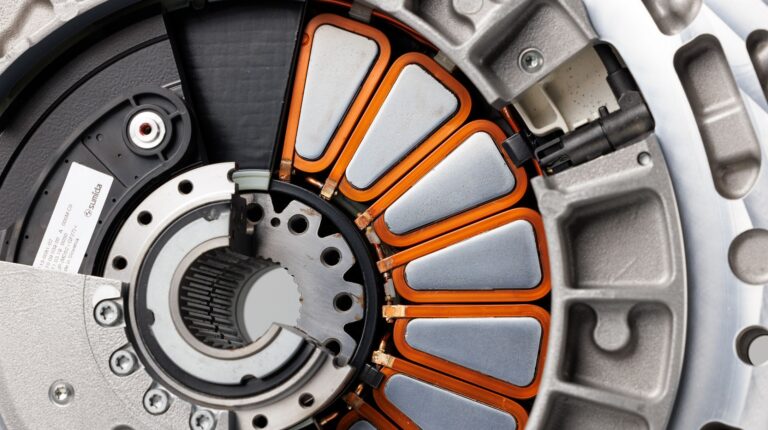
UK government funds YASA rare-earth-free electric motors.
Share
LinkedIn Twitter Facebook Email

YASA has secured UK government grant funding to design and develop a new generation of fully rare-earth-free and heavy-rare-earth-free axial flux electric motors.

As part of the program, YASA will lead Project Resilience in investigating two complementary technology pathways designed to reduce reliance on rare earth magnet materials while preserving the power density, efficiency and compact packaging required by future electrified vehicles.

Rare earth permanent magnets are widely used in high-performance electric motors, but their supply chains are highly concentrated geographically. This growing dependence can expose automotive manufacturers and suppliers to geopolitical uncertainty, export restrictions, price volatility and potential disruption as global demand for electric motors continues to increase.

Heavy rare earths are commonly used to help permanent magnets withstand the high temperatures and demanding operating conditions experienced within powerful electric motors. However, these materials can be particularly difficult and carbon intensive to extract and process.

At its core, Project Resilience will develop two complementary technology pathways designed to give vehicle manufacturers greater flexibility in selecting the most appropriate electric motor architecture for different applications.

For high-performance battery-electric and hybrid vehicles, YASA will investigate heavy-rare-earth-free permanent-magnet motor designs intended to maintain high levels of power density without increasing motor mass or package size.

In parallel, the company will also develop fully rare-earth-free axial flux technology for vehicle applications with different performance, cost and manufacturing requirements.

The two development routes will be built around common YASA stator technology, creating the potential for a modular electric motor architecture in which different rotor technologies can be selected according to the specific requirements of each vehicle program.

Tom Hillman, head of motor simulation at YASA, said, “Rare earth materials have played an important role in the development of powerful and compact electric motors, but the automotive industry must now prepare for a future in which availability, environmental impact and security of supply are increasingly important considerations.

“Project Resilience is about creating credible alternatives without losing sight of what vehicle manufacturers need from an electric motor. Different applications require different balances of performance, efficiency, packaging, cost and production volume, which is why we are developing two complementary technology routes rather than pursuing a single universal solution.

“Our axial flux architecture provides an exciting platform from which to explore these next-generation technologies. The aim is to help build a more sustainable and secure future for electric propulsion, while continuing to deliver the exceptional power density that defines YASA technology.”

Ian Constance, chief executive at the Advanced Propulsion Centre UK, added, “The projects announced today demonstrate the depth of innovation and engineering excellence that exists across the UK automotive sector. Through DRIVE35, we are supporting businesses to move promising technologies to commercial deployment and manufacturing at scale.

“This investment is about far more than individual projects. It is about strengthening the UK’s capability to design, develop and build the technologies that will define the vehicles of the future. By bringing together industry, government and academia, DRIVE35 is helping create the conditions for long-term growth, increasing investor confidence and reinforcing the UK’s position as one of the world’s leading destinations for automotive innovation.”

In related news, high-speed x-ray technology exposes hidden battery cell behavior

Share. LinkedIn Twitter Facebook Email

Related Posts

Integrals Power joins UK battery project to advance LMFP technology

August 6, 2026

BMW details Gen6 battery production process at Plant Woodruff

July 30, 2026

Integrals Power selected for €9m European LMFP battery project

July 1, 2026
LATEST NEWS

UK government funds YASA rare-earth-free electric motors

August 19, 2026

High-speed x-ray technology exposes hidden battery cell behavior

August 19, 2026

Phinia gains certification for hydrogen ICE retrofit technology

August 18, 2026

Receive breaking stories and features in your inbox each week, for free


Enter your email address:


Supplier Spotlights
  • Idemitsu Lubricants America (ILA)
Featured Listings
  • There are currently no listings to show.
Getting in Touch
  • Contact Us
  • Media Pack
  • Meet the Editors
  • Free Weekly E-Newsletter
Our Social Channels
  • LinkedIn
Related UKi Topics
  • Automotive Interiors
  • Automotive Testing
  • Autonomous Vehicle
  • Professional Motorsport
  • Tire Technology
  • Media Pack
© 2026 UKi Media & Events a division of UKIP Media & Events Ltd
  • Terms and Conditions
  • Privacy Policy
  • Cookie Policy
  • Notice and Takedown Policy

Type above and press Enter to search. Press Esc to cancel.