

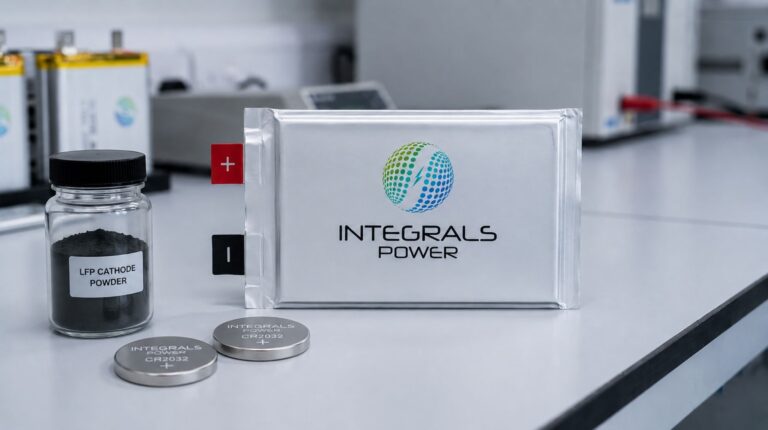
UK battery technology company Integrals Power has been selected to supply its manganese-rich lithium manganese iron phosphate (LMFP) cathode active material to Olimpus, a €9m (US$10.3m) Horizon Europe project to develop and industrialize LMFP battery cells using a European supply chain. Mass production of LMFP cells in Europe is targeted by 2032, with electric vehicles and maritime applications as the primary end uses.
Coordinated by Norwegian research organisation SINTEF, Olimpus brings together 16 partners from across the battery value chain, including Volvo Trucks, Magna Steyr, cell manufacturer Verkor, synthetic graphite anode supplier Vianode and Corvus Energy. As well as supplying more than 150kg of LMFP cathode active material, Integrals Power will also be responsible for scaling up and industrializing the manufacturing process and supporting cell prototyping and performance validation.
Running until 2030, the project will produce over 130 automotive-grade cells on SINTEF’s pilot lines and at Verkor’s gigafactory facilities, in both pouch and prismatic form factors and capacities ranging from 10h to 80Ah, with a target energy density of up to 220Wh/kg.
Sustainability is a key focus. Water will replace the toxic and highly flammable solvent NMP, a semi-dry electrode coating process will reduce energy use in the drying stage compared to conventional wet slurries, and synthetic graphite for the anode will be used to lower the overall carbon footprint. Compared to nickel cobalt manganese chemistry, NMC81, Olimpus projects a reduction in lifecycle CO2-equivalent emissions of approximately 1.8 million metric tons by 2050.
Integrals Power founder and CEO Behnam Hormozi said, “Our participation in Olimpus is the clearest demonstration yet that Integrals Power’s patented LMFP technology is a key enabler for establishing sovereign battery capability in the UK and Europe. Third-party testing has already proven its high energy density, cycle life and cold weather performance, and this project represents the next milestone in its development as we optimize the materials and processes for scale-up.
“A successful transition from fossil fuels to clean energy sources can only be achieved with a robust, transparent, sustainable and cost-effective battery supply chain, and that requires alternatives to cell chemistries and manufacturing reliant on critical minerals and Chinese technology. The Olimpus project is laying the foundations for this, and we are extremely proud to be a part of it.”
Integrals Power’s LMFP material has a high manganese content of 80%, which enables up to 20% greater energy density than conventional LFP while retaining its key advantages of cost, safety and long cycle life. This combination of attributes, together with freedom from expensive nickel and cobalt, makes it a compelling alternative to NMC, which is still the dominant cell chemistry for electric vehicles made by European and North American vehicle manufacturers.
Related news, How modular testing is supporting the shift to hydrogen, methanol and ammonia