

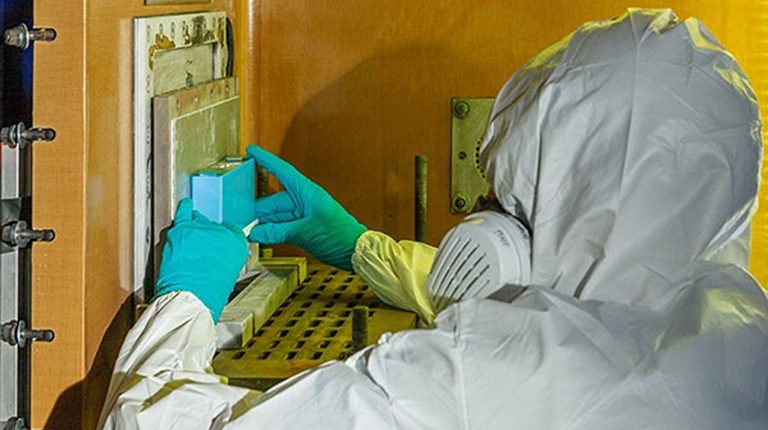
Cell manufacturers and vehicle integrators have always had to rely on simulations, destructive testing methods and indirect measurements. The Fraunhofer Institute for High-Speed Dynamics, Ernst-Mach-Institut (Fraunhofer EMI), has developed what it says is a unique high-speed x-ray system that makes dynamic processes inside large-format prismatic cells visible in real time for the first time. Together with the German cell manufacturer PowerCo, a Volkswagen Group company, Fraunhofer EMI is now bringing this technology into industrial use.
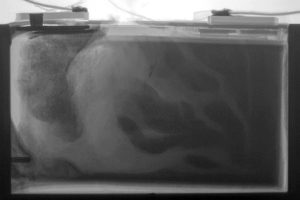
The system combines high-performance x-ray technology with a specially designed battery test chamber and advanced sensor systems that simultaneously capture temperature, pressure, voltage and gas flow. Recording up to 1,000 images per second, it reveals processes such as gas formation, material displacement and crack propagation inside the cell at extremely high resolution, events that until now have remained hidden from view.
“Our in-situ method allows us to see what happens inside a cell in fractions of a second – in real time and at the highest resolution,” said Dr Sebastian Schopferer, head of battery safety at Fraunhofer EMI. “This fundamentally changes how we understand battery design and safety.”
A key engineering milestone was the development of a protective chamber that reliably shields sensitive x-ray components from the extreme conditions generated during lithium-ion cell thermal runaway.
Proven in practice and already in use
Fraunhofer EMI has already used the system for several German car manufacturers, including VW and Audi, to characterize material ejection during thermal runaway and propagation behavior in multicell configurations. The resulting data enables engineers to assess cell designs based on directly observed processes and refine simulation models with greater precision, delivering direct added value for product development and certification processes.
Transfer to industry by 2028
In the next phase, Fraunhofer EMI and PowerCo will transfer the technology into industrial use.
Initial results from the collaboration are already feeding into the development of optimized production cells at PowerCo, accelerating the path from research to industrial implementation. The system is scheduled for installation at PowerCo’s Salzgitter site in Germany in 2028.
Designed as a modular platform, the system can be scaled to different cell formats and new cell chemistries.
“With in-situ high-speed x-ray imaging, we are taking battery research to a new level,” said H W Vassen, CTO of PowerCo. “For the first time, we can make the dynamic processes inside cells visible in real time and in slow motion. This unprecedented depth of insight allows us to optimize battery cell safety and design in a highly targeted way and bring innovations into industrial use much faster. Together with Fraunhofer EMI, we are advancing high technology made in Europe and are strengthening Europe’s role in the battery industry.”
In related news, V Engineering develops new hybrid battery for McLaren P1