

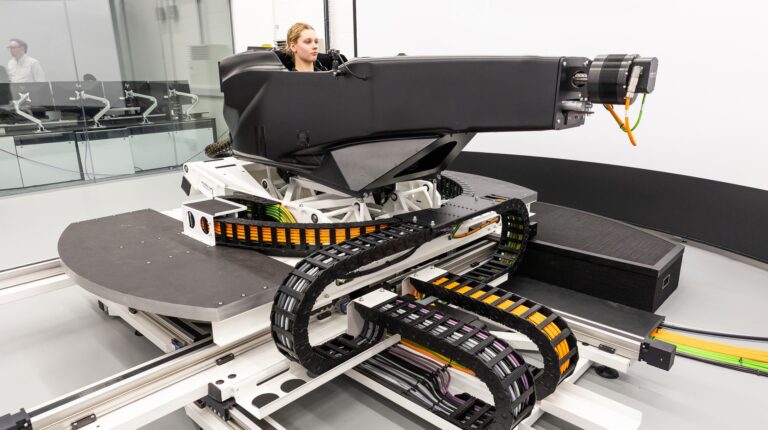
An advanced driver-in-the-loop (DiL) simulator will combine virtual vehicle dynamics with physical propulsion hardware at Bristol and Bath Science Park in the southwest of the UK to support faster development across motorsport, automotive and wider transportation applications.
IAAPS will integrate an Ansible Motion Delta S2 simulator with its 1,800kW four-wheel-drive powertrain test facility, bringing simulated vehicle behavior, human driver inputs and physical powertrain hardware together within a single real-time development environment. This will enable complex development and validation work to begin earlier, helping to reduce technical risk, physical prototype testing requirements and overall development time.
The simulator has already supported race preparation involving F1 Academy driver Rachel Robertson. IAAPS is now engaging with organizations across motorsport, automotive and the wider transportation sector to realize the capability’s broader potential.
For motorsport customers, the simulator supports vehicle setup optimization, calibration, strategy development and scenario testing. Drivers can also use the platform for track familiarization, race procedure practice, coaching and consistency training.
By evaluating more options before arriving at the circuit, teams and drivers can make better engineering decisions while reducing their use of valuable track time, tires and vehicle mileage. The controlled environment can also help develop driver confidence and improve communication between drivers and engineers.
For motorsport teams and technology partners
The new IAAPS DiL simulator gives motorsport organisztions and individual competitors access to professional simulation tools and engineering support without the cost and complexity of operating their own simulator facility.
IAAPS also provides integrated engineering services covering real-time simulation, x-in-the-loop methodologies, physical testing, control systems, data analysis and vehicle development.
“This capability gives customers a flexible platform for a diverse range of applications, from race preparation and driver optimization to automotive and wider transportation development,” said Professor Rob Oliver, managing director of IAAPS.
“By combining simulation with our advanced facilities and engineering expertise, we can help customers develop and validate complex systems earlier, more efficiently and with reduced technical risk.”
For OEMs and technology suppliers
For automotive manufacturers and technology suppliers, the DiL simulator accelerates vehicle development by moving testing and validation into a controlled, rig-based environment earlier in a program.
Driver behavior, propulsion system response and wider vehicle functions can be evaluated before a complete physical prototype is available. This supports more efficient development and validation of internal combustion, hybrid and battery electric vehicles while reducing dependence on physical prototypes and on-road testing.
The Delta S2 simulator features a six-degrees-of-freedom motion base, an immersive projection-based visual system and an interchangeable cockpit. It forms part of IAAPS’s broader portfolio of research, engineering and testing services for the development of future propulsion systems, technologies and advanced validation methods.
Recent news, Porsche produces battery cathode material using 100% recycled raw materials