

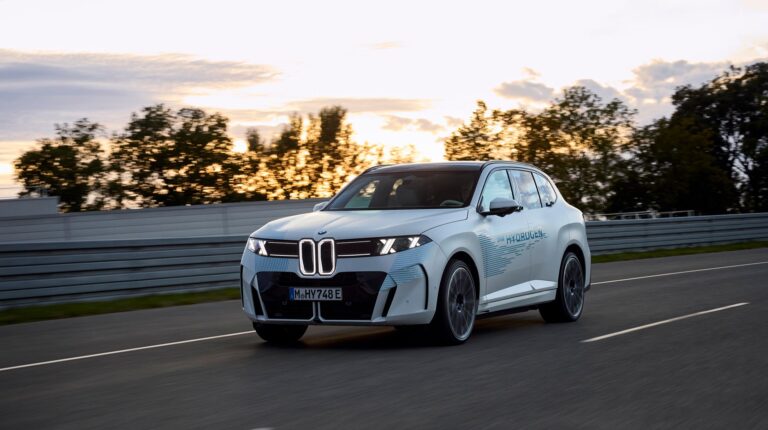
The BMW iX5 Hydrogen has entered its next development phase ahead of series production. Current prototypes are undergoing comprehensive road testing, while the third-generation fuel cell system is entering a new assembly phase at BMW’s Hydrogen Competence Centre in Munich. Preparations for industrialization and future series production of the fuel cell system are also underway at BMW’s engine facility in Steyr, Austria.
“Our ambition for the BMW iX5 Hydrogen is clear: a true BMW – with Sheer Driving Pleasure. A perfectly coordinated overall system is crucial for this,” commented Josef Hochreiter, head of hydrogen vehicles at BMW Group. “Current testing demonstrates how the fuel cell system, high-voltage battery and electric drivetrain are already successfully integrated and how systematically we are developing the technology toward series production. The primary focus is on further validation of the overall system, preparations for industrialization and the integration of fuel cell technology.”
Testing is currently focused on the interaction of all drive system components. This includes the fuel cell system, high-voltage battery, electric motor, hydrogen tanks and the overall system control unit. Efficiency, driving performance and driving dynamics will also be examined under different operating conditions.
Systems integration, efficiency and driving dynamics
Focusing on validation of the overall system under demanding environmental and operating conditions, the development teams validate the functionality of all components within the integrated vehicle system and optimize the complex system control, even under high loads. The aim is to ensure the full performance capabilities of the drivetrain at all times while optimizing BMW’s hallmark driving dynamics in the fuel cell electric vehicle.
Current testing is confirming the coordinated operation of the fuel cell system, electric motor, high-voltage battery, BMW Hydrogen Flat Storage and Energy Master. The high-voltage battery and Energy Master, which serves as the central control unit for the high-voltage system, enable greater recuperation performance and can improve overall system efficiency. Development is also targeting driving performance comparable with the BMW iX5, including acceleration from 0 to 100km/h in less than five seconds.
Fuel cell system enters next phase of construction
Inside the fuel cell, hydrogen from the tanks reacts with oxygen from the ambient air in an electrochemical reaction. This generates the electric current that drives the electric motor and powers the vehicle. The BMW iX5 Hydrogen uses the third-generation fuel cell system co-developed by the BMW Group and Toyota Motor Corporation.
Alongside vehicle testing, the next prototype assembly phase for the third-generation fuel cell system is getting underway at the Hydrogen Competence Centre in Munich. The focus is on finalizing and validating the testing methodology and preparing for industrialization.
The previous prototype phase centered on component buildability and basic qualification of suppliers. Series production of fuel cell systems will take place at BMW Group Plant Steyr.
“Prototype assembly is about much more than manufacturing individual components. Each phase helps us optimize processes, gain experience and systematically share this knowledge with the teams in Steyr. In this way, we are laying the foundation for the next steps on the road to industrialization,” explained Claudia Stephan, head of technology development and fuel cell prototype assembly at BMW Group.
Industrialization
With the start of this new assembly phase, the project has reached another important development step on the road to industrialization. The first test benches and manufacturing equipment have already been set up at BMW Group Plant Steyr, with employees being trained in stages. The insights gained will form the basis for further industrialization steps and subsequent production ramp-up.
In related news, the hydrogen powertrain technology behind the JCB Hydromax world land speed record