

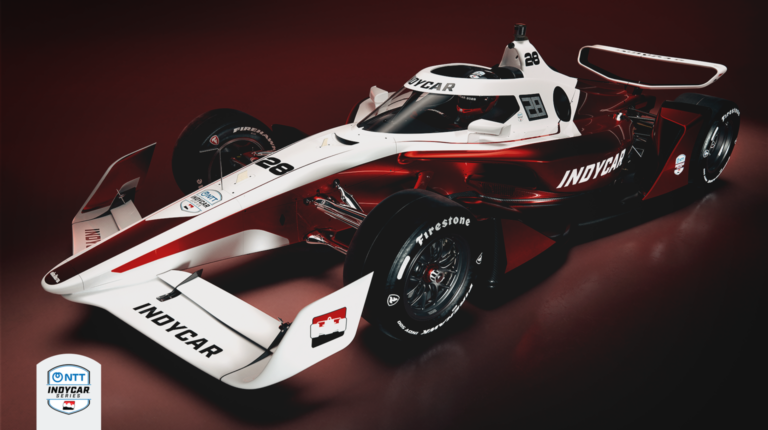
The NTT IndyCar Series chassis and powertrain package for 2028 has been unveiled. Introducing a modernized look designed to provide for faster lap times and “improved raceability”, the IR-28 race car has been designed to encourage more “wheel-to-wheel action” while also creating the “safest car yet,” according to the racing series.
The IR-28 chassis was developed in partnership with Dallara, with the new car making its competition debut at the start of the 2028 NTT IndyCar Series championship.
IndyCar president J Douglas Boles commented, “With initial testing to begin this week, there is still plenty of work to do before 2028, but we are well on our way to showcasing a new era of IndyCar, which will include enhanced wheel-to-wheel competition, track records, standards in raceability and new benchmarks in safety.”
As part of the improved raceability, the IR-28 will weigh approximately 100 lb less than the current car.
New car design
The entire vehicle has been designed and built from the ground up. New front and rear wings, optimized for style and efficiency, give the road and street course car an aggressive stance, while the superspeedway wing configuration provides maximum downforce with limited drag in a sleek, high-speed-looking package.
The car’s aerodynamic architecture has been purpose-built to optimize the wake from the front to the back in order to enhance overtaking opportunities. The 2028 design also delivers reduced outwash and, for Indianapolis Motor Speedway, a more aerodynamically stable speedway front wing.
The new car will feature electronically controlled driver-adjustable anti-roll bars, which will enable enhanced tuning and raceability while cleaning up the cockpit by eliminating standard knobs and handles, thus also improving driver safety.
The IR-28 also introduces the Custom AXIS Inertance Control Suspension System, offering expanded spring, damper and inerter tuning within a lightweight shared damping architecture. According to the company, the system improves mechanical grip through suspension optimization while providing greater setup flexibility.
The 2028 powerplant
The power for the new 2028 NTT IndyCar Series machinery will be provided by 2.4-liter twin-turbocharged V6 internal combustion engines capable of producing up to 760hp. Chevrolet and Honda have committed to participate under the new engine formula, which will deliver increased torque, power and overall performance compared to the current generation of IndyCar Series engines.
GM vice president of Global Motorsports Competition Eric Warren said, “This new car builds on more than a decade of collaboration with IndyCar.”
The low-voltage hybrid technology of the IR-28 will deliver greater power storage, more deployment options for teams and the decrease in package weight of approximately 20 lb. The significant performance advancement and deployment variability will be provided through a new partnership with UK-based Helix.
The new hybrid platform will feature the first battery-based energy storage system (ESS) in NTT IndyCar Series history, supplied by BOLD Technology and selected by IndyCar for the program. BOLD’s ESS for the IR-28 delivers approximately 14 times the energy storage capacity of the current supercapacitor-based system.
Xtrac, an exclusive supplier for IndyCar since 2000 and a Helix associate, is providing transmissions for the new chassis. Development includes a gearbox that sheds 25 lb from the current unit.
Safety evolution
The IR-28 has also been designed to keep drivers safer. From the aeroscreen to the roll hoop to side-impact structures, the new car integrates recent safety and design advancements into its core architecture.
The chassis features wider internal dimensions to accommodate a greater range of driver heights and body types, and enhanced internal airflow and driver cooling for improved comfort and performance.
Decades worth of race and incident evaluations have created a chassis that features stronger, more efficient side-structure design providing increased energy absorption in high-impact situations, IndyCar said.
“Seeing the car for the first time made me even more excited about where IndyCar is going. The design is super cool and feels like a proper next step for the series while still looking like an IndyCar Series car,” said Alex Palou, driver of the no. 10 Honda for DHL Chip Ganassi Racing.
“We all wanted a new, modern-day car that is lighter and looks futuristic and fast but still has all of the incredible safety advancements that IndyCar is known for,” said Alexander Rossi, driver of the no. 20 Java House Chevrolet for ECR . “There are still a lot of things to work through in terms of on-track testing and how it reacts to the different types of environments it will be exposed to, but from a visual standpoint, it’s incredible.”
Recent news, BMW details Gen6 battery production process at Plant Woodruff