

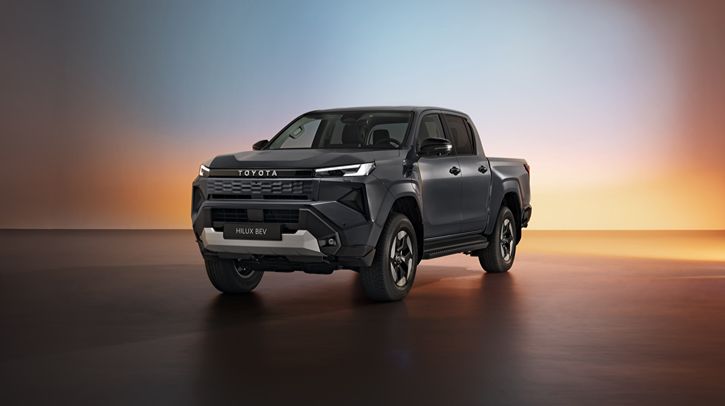
Toyota has unveiled the ninth-generation Hilux, marking the start of its electrified era with battery-electric and hydrogen fuel cell electric versions alongside 48V hybrid and diesel and petrol engines.
Hilux goes electric
The Hilux BEV powertrain features a 59.2kWh lithium-ion battery and front and rear e-axles providing permanent all-wheel drive, with 205Nm of torque generated at the front and 268.6Nm at the rear. Tentative, pre-homologation data indicates approximate figures of 715kg for the payload, and 1,600kg for the towing capacity, with a WLTP driving range of approximately 240km.
Toyota says the Hilux will appeal to fleet customers seeking a pickup that combines zero-emission performance with “everyday practicality”. It retains the signature body-on-frame construction and is engineered for rugged terrain, with specific measures to protect the battery from damage or water ingress. Notably, the wading depth matches that of the current internal combustion engine model, ensuring the same confidence in challenging conditions.
The Hilux BEV also features a Multi-Terrain Select system that adapts vehicle performance to suit different off-road terrains using brake and torque control, equivalent to driving in L4 range in a conventionally powered vehicle.
The Hilux hybrid 48V
The hybrid powertrain components have been designed for simple integration and to withstand harsh operating conditions. Notably, the motor-generator is positioned high up on the engine, so the vehicle retains its 700mm wading capability. Off-road performance is further improved with the Multi-Terrain Select system.
The system comprises a 48V lithium-ion battery – housed beneath the rear seats so interior space isn’t compromised – an electric motor-generator and a DC-DC converter. It supports the 2.8-liter engine to deliver smooth, quiet and refined performance in both on and off-road driving. The drive quality is particularly noticeable at start-up and under acceleration. The all-new Hilux can carry a payload of up to 1 ton and tow braked trailers up to 3,500kg, maintaining its reputation for practical utility and rugged capability.
Production of the Hilux 48V will begin in spring 2026.
Internal combustion engine
Internal combustion engines will continue to be offered in the Hilux range, but their availability will be focused on Toyota’s Eastern European markets to meet regional customer needs. The latest 2.8-liter diesel replaces the outgoing 2.4-liter unit, and the 2.7-liter petrol engine will remain, delivering a combination of muscular performance and efficiency.
Future production
Toyota has confirmed that a hydrogen fuel cell version of the Hilux is scheduled to arrive in 2028.
In related news, BMW Group, Solid Power and Samsung SDI partner to advance all-solid-state battery technology