

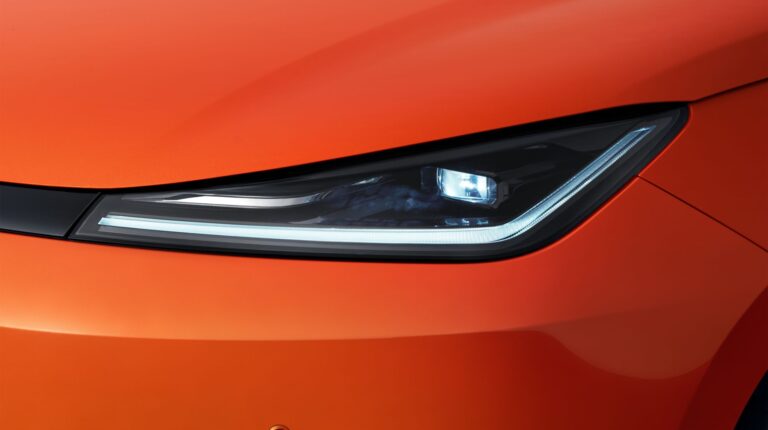
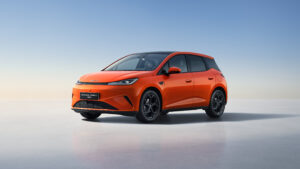
Powered by BYD’s Super Hybrid with DM Technology, the Dolphin G DM-i (the designation stands for dual mode intelligence) features compact dimensions, family-car practicality and the ability to travel up to 65 miles on electricity alone.
When it’s required to tackle longer journeys, the Dolphin G DM-i manages its hybrid system to “achieve flexibility beyond the capabilities of conventional ICE-powered superminis”, the auto maker said, achieving weighted fuel consumption (with the battery fully charged) of 201.7mpg and more than 1,000km of range on a full charge and a full tank of petrol.
BYD executive vice president Stella Li commented, “The European B-segment is one of the most important parts of the market, and with Dolphin G DM-i, we want to redefine what customers can expect from a compact car in the electric era.
“By bringing long electric range, intelligent hybrid technology and advanced digital features into an accessible compact vehicle, we are making sustainable mobility smarter, more practical and available to many more people across Europe.
“When we bring so many standout qualities and new features to such an important sector of the market here, you can see why we say, ‘It’s not a car, it’s a BYD!’.”
An EV experience with long-range backup
Unlike traditional plug-in hybrid systems, BYD’s DM architecture is EV-led, meaning the high-torque electric motor drives the wheels in most situations. This gives the car the quiet, responsive driving experience of a pure-electric vehicle, and enables the Xiaoyun 1.5-liter petrol engine to run as efficiently as possible and keep the Blade Battery charged.
The hybrid’s DM-i simplifies a configuration that includes two electric motors (one a drive motor, one a generator motor), a petrol engine and constant management by power control units to deliver the required mix of performance and efficiency.
In EV mode the car operates like a pure-electric vehicle. It uses only the electric drive motor – which can itself be used to recoup energy that would otherwise be lost during braking – to help recharge the battery.
In HEV or Hybrid mode, the intelligence systems take over to flick between five configurations, depending on factors including the state of charge and the driving situation.
First, when there’s a demand for efficient high-speed running, the electric drive motor can drive the wheels using power from not only the battery but also the generator motor, which is itself powered by the petrol engine.
When performance demands are lower and the battery charge is reduced, only part of the generator motor’s power is sent to the drive motor, with the remainder recharging the battery. A clutch between the engine and wheels enables three additional operating modes, all managed automatically by the vehicle’s intelligent control system without driver input.
The third option kicks in under hard acceleration, where the petrol engine combines with the electric drive motor to drive the wheels.
Equally, if the system decides the petrol engine is producing more power than required, it can use some of this to drive the wheels and divert the rest to the electric motor to feed back into the battery.
Finally, when the demand at the driven wheels is equal to the petrol engine’s power, it drives the wheels without the battery discharging or recharging at all.
Specifications and range options
In the Dolphin G DM-i, the permanent magnet synchronous electric motor produces 163ps (120kW) and 210Nm alone, enabling a 0-62mph acceleration sprint in just 8.3 seconds.
Two sizes of Blade Battery are offered in the Dolphin G DM-i. Active versions feature a 7.42kWh capacity for 24.8 miles of WLTP Combined pure-electric range and a combined total range of 633 miles. Boost, Comfort and Sport editions have an 18.3kWh Blade Battery, extending the pure-electric range to 105km and the combined total range to 646 miles, while also lowering CO2 emissions from 60g/km to just 32g/km.
Active models have a 3.3kW onboard charger that can refill the battery completely from 15% in just under three hours. Boost, Comfort and Sport versions increase this power to 6.6kW and include a 39kW DC charging capability that takes the 18.3kWh battery from 10% to 80% in just 26 minutes.
Recent news, Audi unveils 1,001ps Nuvolari hybrid supercar