

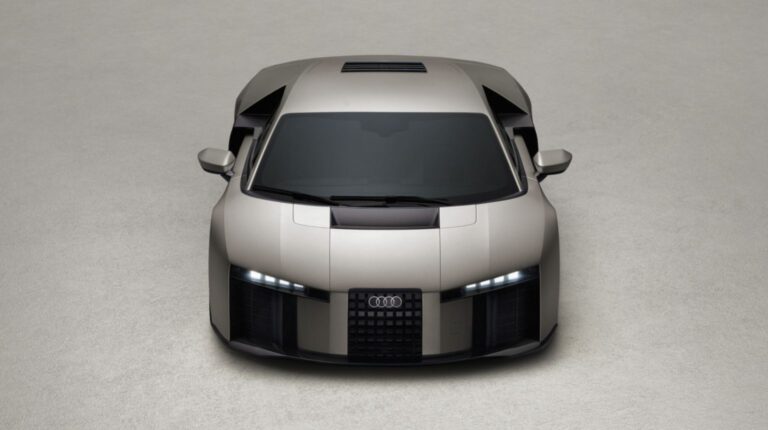
With 1,001ps and a top speed of more than 217mph (349km/h), the Audi Nuvolari hybrid supercar is the most powerful and fastest production vehicle in the history of the four rings, according to the auto maker.
Accelerating from 0-62mph (100km/h) in 2.6 seconds and reaching 124mph (200km/h) in 6.8 seconds, the Nuvolari features technologies inspired by Formula 1, such as the high-performance hybrid powertrain, quattro predictive ride, active aerodynamics and the new Audi Space Frame (ASF) with carbon exterior.
“With the Audi Nuvolari, we are accelerating technological progress,” said Gernot Döllner, chairman of the board of management of Audi.
Hybrid powertrain with four drive units
Powered by a hybrid high-performance powertrain with a maximum system output of 736kW (1,001ps), the Nuvolari combines a 4.0-liter V8 biturbo engine delivering 588kW (800hp) with three axial flux electric motors, each producing 110kW. The lithium-ion battery has a gross capacity of 7.3kWh. The combustion engine delivers a maximum torque of 730Nm and reaches up to 10,000rpm.
Two oil-cooled axial flux electric motors at the front axle deliver up to 2,150Nm of torque. As an integral part of the quattro system, they support variable torque distribution. A third electric motor between the V8 mid-engine and the transmission completes the drive concept.
“Our entire team has once again demonstrated its technical expertise, innovative strength and dedication,” said Rouven Mohr, CTO of Audi.
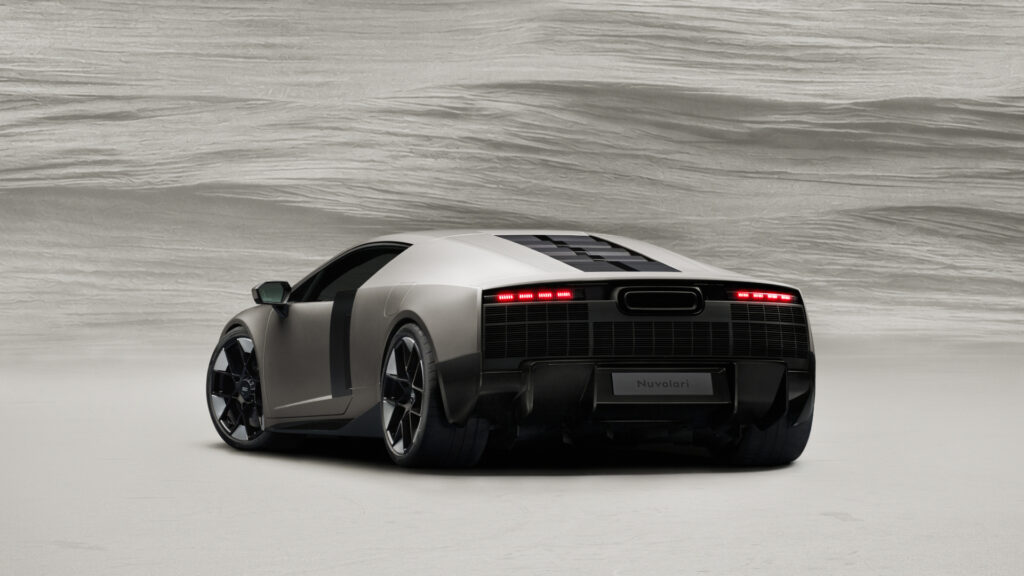 The quattro predictive ride
The quattro drive stands for “traction, control and driving dynamics in all conditions,” the German auto maker said, adding that in the Nuvolari, it had further developed this principle with the next generation of all-wheel drive with the quattro predictive ride.
Detailed sensor data – including steering angle, acceleration, yaw rate (rotation of the vehicle around its vertical axis, which determines steering response in corners) and current grip level – continuously feed into the control system, creating a highly precise vehicle state model.
If the system anticipates a potential loss of grip in a corner, it responds proactively as an integrated system. The drive units distribute torque in both longitudinal and lateral directions. The brakes stabilize the vehicle through targeted interventions and reduce slip. The aerodynamics adjust the downforce according to the situation.
Drivers can also influence the system with four driving modes: E-Hybrid (fully electric), Balanced (comfort, efficiency and performance), Dynamic (agility and precision) and Dynamic+ (driving experience). Vehicle dynamics can be further refined in Track Mode.
Audi Space Frame
The vehicle architecture is designed for lightweight construction and high torsional rigidity using Audi Space Frame technology with a carbon exterior, which combines low weight with high structural strength.
Almost all exterior components are made from carbon fiber-reinforced polymer (CFRP). All carbon fiber components have been developed using Formula 1 expertise, such as the prepreg autoclave technology, in which pre-impregnated carbon fibers are shaped and then cured under high pressure and temperature.
Active aerodynamics inspired by Formula 1
Each exterior element serves a clearly defined aerodynamic function, from the front splitter to the rear diffuser. Audi’s Formula 1 drivers provided targeted feedback during the development phase to fine-tune aerodynamic performance.
Front air intakes ensure effective brake cooling as well as efficient thermal management of the combustion engine and hybrid components. A vented front end, known as an S-duct, improves aerodynamic efficiency at the front axle, delivering additional downforce, reducing lift at high speeds and improving cooling of the powertrain.
The central element of the active aerodynamic system is the deployable adaptive rear wing. It controls downforce and drag across three configurations: closed, low downforce (LD) and high downforce (HD). A drag reduction system (DRS), familiar from Formula 1, can also be activated manually via a dedicated steering-wheel button to further lower the wing.
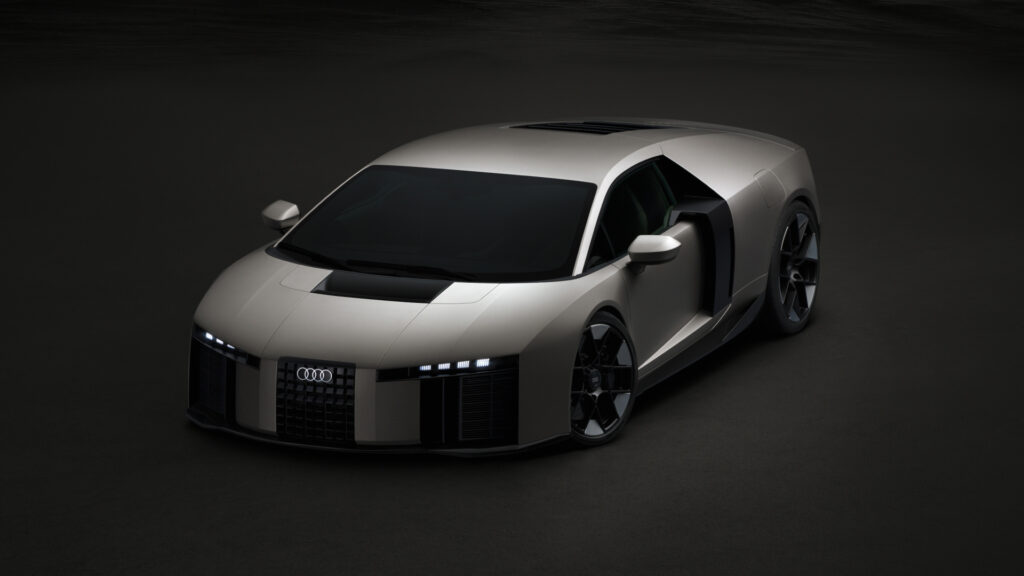 Dynamic energy management
The energy management system is also inspired by motorsport. Boost and recuperation strategies are closely linked to torque distribution. As an integrated system, it continuously manages the interaction between power delivery and energy recovery.
Adaptive strategies for coasting and brake recuperation extend energy recovery to nearly all driving phases. At the front axle, electric deceleration takes on a significant portion of braking, while at the rear axle, coasting, partial load and traction control phases are used for recuperation. Purely electric deceleration of up to 0.3g is possible.
Braking system
A motorsport-inspired brake-by-wire system enables variable distribution between recuperation and hydraulic braking. The brake pedal is functionally decoupled from actual braking force at the wheels to ensure a consistent and precise pedal feel.
At the core of the system is the new Audi Ceramic Pro braking system, designed for consistently high deceleration and precise control.
At the front axle, 10-piston fixed calipers work with 420 × 40mm brake discs, while at the rear, four-piston calipers are paired with 410 × 32mm discs. The brake discs, derived directly from Formula 1, are based on a long-fiber carbon structure designed to withstand extreme thermal loads without compromising structural integrity or consistent friction characteristics.
In related news, Lotus highlights motorsport heritage with all-new hybrid-V8 supercar