
Close Menu
  • News
      • Appointments
      • EV Powertrain
      • Emissions
      • Engine Components
      • Electronics
      • Facility Developments
      • Forced Induction
      • Fuel Cell Technologies
      • Fuels & Lubricants
      • Heavy-duty & Diesel Engine Technologies
      • Hybrid Powertrain Technologies
      • Industry Forecasting
      • Legislation
      • Materials & Surface Treatment
      • Metallurgy
      • Mild-hybrid & 48V Technologies
      • New powertrain
      • Partnerships, Investments & Acquisitions
      • Quality Control
      • Prototyping
      • Sustainable fuels
      • Testing
      • Traction Control Systems
      • Transmissions Technologies
      • Webinars
  • Features
  • Online Magazines
    • April 2026
    • January 2026
    • September 2025
    • June 2025
    • March 2025
    • January 2025
    • September 2024
    • Subscribe to Automotive Powertrain Technology
    • Transmission Technology International
    • Subscribe to Transmission Technology
  • Opinion
  • Events
  • Supplier Spotlight
  • Webinars
Facebook X (Twitter) Instagram
  • Automotive Interiors
  • Automotive Testing
  • Autonomous Vehicle
  • Professional Motorsport
  • Tire Technology
  • Media Pack
LinkedIn
Subscribe
Automotive Powertrain Technology International
  • News
      • Appointments
      • EV Powertrain
      • Emissions
      • Engine Components
      • Electronics
      • Facility Developments
      • Forced Induction
      • Fuel Cell Technologies
      • Fuels & Lubricants
      • Heavy-duty & Diesel Engine Technologies
      • Hybrid Powertrain Technologies
      • Industry Forecasting
      • Legislation
      • Materials & Surface Treatment
      • Metallurgy
      • Mild-hybrid & 48V Technologies
      • New powertrain
      • Partnerships, Investments & Acquisitions
      • Quality Control
      • Prototyping
      • Sustainable fuels
      • Testing
      • Traction Control Systems
      • Transmissions Technologies
      • Webinars
  • Features
  • Online Magazines
    1. April 2026
    2. January 2026
    3. September 2025
    4. June 2025
    5. March 2025
    6. January 2025
    7. September 2024
    8. Subscribe to Automotive Powertrain Technology
    9. Transmission Technology International
    10. Subscribe to Transmission Technology
    Featured

    In this Issue – April 2026

    By Web TeamMay 1, 2026
    Recent

    In this Issue – April 2026

    May 1, 2026

    In this Issue – January 2026

    December 3, 2025

    In this Issue – September 2025

    September 25, 2025
  • Opinion
  • Events
  • Supplier Spotlight
  • Webinars
LinkedIn Facebook
Subscribe
Automotive Powertrain Technology International
Fuels & Lubricants

Audi invests in development of CO₂ neutral e-diesel

Dean SlavnichBy Dean SlavnichNovember 10, 20172 Mins Read
LinkedIn Twitter Facebook Email
Audi, research, synthetic fuel, e-diesel, production facility, Ineratec, Energiedienst
Share
LinkedIn Twitter Facebook Email

Audi has stepped up its research into synthetic fuels, with the company set to develop a new Swiss e-diesel production facility in collaboration with Ineratec and Energiedienst. As the German OEM continues its drive to reduce emissions, the Laufenberg development, in Canton Aarau, will use hydropower to produce over 400,000 liters of e-diesel per year.

“Thanks to the new technology we are able to handle the production of e-diesel efficiently in compact units, making it more economical,” said Reiner Mangold, head of sustainable product development at Audi.

“The pilot facility offers scope for sector coupling, in other words, combining the energy sectors power, heat and mobility, and makes it possible to store renewable energy.”

While Audi has also been conducting research into climate-friendly, CO₂-based fuels such as e-gasoline, the company’s synthetically manufactured e-diesel has the potential to make the traditional IC engine operate almost CO₂-neutrally.

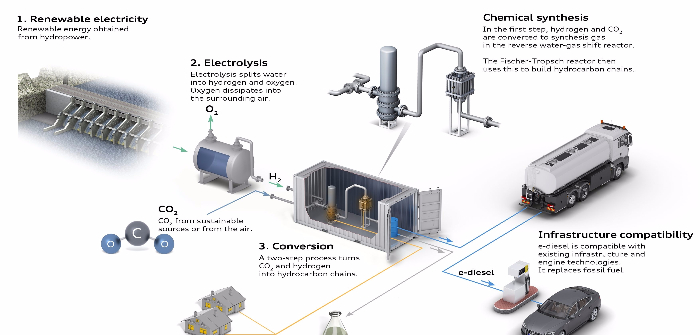
This is thanks to the facility’s power-to-liquid conversion. The green power generated in the hydroelectric power station produces hydrogen and oxygen from water by means of electrolysis. In the next step the hydrogen reacts with CO₂, thanks to microprocess technology. CO₂ is obtained from the atmosphere or from biogenous waste gases and is the only source of carbon. Long-chain hydrocarbon compounds are formed. The final step separates these into the end product, Audi e-diesel.

With a planning application for the development set to be submitted imminently, Audi hope to produce the first quantities of e-diesel in Laufenberg as early as 2018.

Share. LinkedIn Twitter Facebook Email

Related Posts

Alpine and Phinia continue Formula 1 and Alpenglow partnership

March 10, 2026

Caterham and Motul unite to power road and race cars

February 5, 2026

Sponsored: The first standard specification for EV fluids by TotalEnergies

December 5, 2025
LATEST NEWS

Renault introduces LPG bi-fuel Clio that delivers up to 1,450km range

May 7, 2026

UK consortium secures funding for ReCAM lithium-ion battery recycling project

May 7, 2026

BorgWarner wins turbocharger contracts with two European OEMs

May 7, 2026

Receive breaking stories and features in your inbox each week, for free


Enter your email address:


Supplier Spotlights
  • Gleason Corporation
Featured Listings
  • There are currently no listings to show.
Getting in Touch
  • Contact Us
  • Media Pack
  • Meet the Editors
  • Free Weekly E-Newsletter
Our Social Channels
  • LinkedIn
Related UKi Topics
  • Automotive Interiors
  • Automotive Testing
  • Autonomous Vehicle
  • Professional Motorsport
  • Tire Technology
  • Media Pack
© 2026 UKi Media & Events a division of UKIP Media & Events Ltd
  • Terms and Conditions
  • Privacy Policy
  • Cookie Policy
  • Notice and Takedown Policy

Type above and press Enter to search. Press Esc to cancel.