

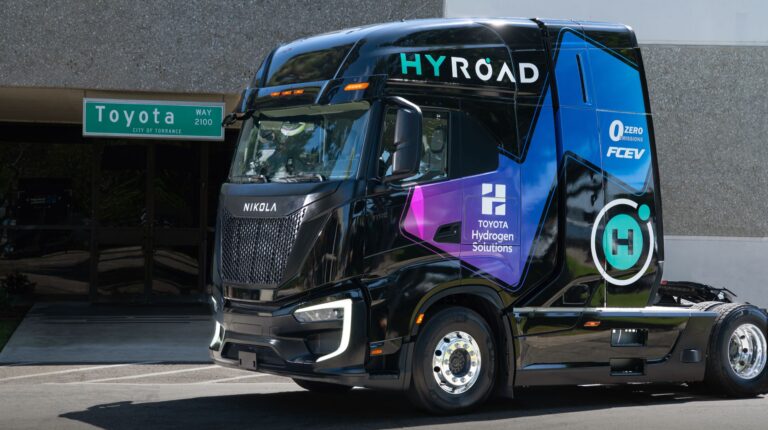
Toyota Motor North America has entered a definitive agreement with Hyroad Energy to deploy 40 hydrogen fuel cell Class 8 commercial trucks in Southern California.
Under the agreement, Hyroad will provide trucks, maintenance, data and software services to support Toyota’s logistics operations. Toyota will supply hydrogen fuel through its own refueling infrastructure, currently under development in Ontario, California.
The two companies are bringing together the interconnected pieces that a functioning hydrogen trucking ecosystem requires, including vehicles, software and fuel supply, under a single commercial framework.
“Accelerating the hydrogen economy requires collaboration, and Toyota is proud to work with Hyroad to move the heavy-duty sector forward,” said Jason Zahorik, general manager, Toyota Hydrogen Solutions. “By bringing the critical elements together, we’re demonstrating how fuel cells create tangible value across supply chains while advancing a foundational pillar of the hydrogen economy. With hydrogen, we share a vision for cleaner, more powerful and more energy independent mobility.”
Toyota is investing in the hydrogen value chain, including fuel cell development and refueling infrastructure and says it sees commercial trucking as a “critical proving ground for that ecosystem at scale”. For instance, in keeping supply and demand moving at a rapid pace, a fuel cell Class 8 truck is able to take up to 70kg of hydrogen on board.
Like a diesel semi-truck, a fuel cell Class 8 takes about 15-20 minutes to fill and has an approximate driving range of up to 500 miles between fill-ups. Unlike a diesel truck, however, the only local emission from a hydrogen-powered truck is water vapor.
Hyroad’s full-service model covers the truck, maintenance and fleet management software under a bundled commercial structure, removing the operational complexity that has historically slowed adoption of alternative-fuel commercial vehicles. As an OEM-agnostic operator rather than a manufacturer, Hyroad’s role is to assemble the pieces, such as vehicles from multiple sources, hydrogen supply, truck maintenance and software, and form a solution fleets can actually use.
“Toyota has done exactly what great allies do — they’ve brought genuine hydrogen expertise to the table and made thoughtful, strategic decisions,” said Dmitry Serov, founder and CEO of Hyroad Energy. “They’re not waiting for someone else to build this ecosystem. They’re investing in it directly, and that’s what makes this meaningful. When fueling, vehicles, software and operational commitment all come together, hydrogen trucking works.”
The announcement of the Hyroad agreement took place at the 2026 Advanced Clean Transportation (ACT) Expo. During its Hydrogen Workshop keynote at the event, Toyota outlined several hydrogen initiatives, including a fuel supply agreement with Air Liquide for its North American Parts Center California campus, where hydrogen fueling will begin later this year.
The company also highlighted its recent announcement that the company had achieved ANSI/CSA certification for its stationary fuel cell generators, and reiterated its dedication to the continued development of its Gen 3 fuel cell stacks for applications ranging from passenger vehicles and construction equipment to stationary power systems and heavy-duty trucks.
Related news, Partnership to advance hydrogen mobility and research at Georgia Institute of Technology