
Close Menu
  • News
      • Appointments
      • EV Powertrain
      • Emissions
      • Engine Components
      • Electronics
      • Facility Developments
      • Forced Induction
      • Fuel Cell Technologies
      • Fuels & Lubricants
      • Heavy-duty & Diesel Engine Technologies
      • Hybrid Powertrain Technologies
      • Industry Forecasting
      • Legislation
      • Materials & Surface Treatment
      • Metallurgy
      • Mild-hybrid & 48V Technologies
      • New powertrain
      • Partnerships, Investments & Acquisitions
      • Quality Control
      • Prototyping
      • Sustainable fuels
      • Testing
      • Traction Control Systems
      • Transmissions Technologies
      • Webinars
  • Features
  • Online Magazines
    • April 2026
    • January 2026
    • September 2025
    • June 2025
    • March 2025
    • January 2025
    • September 2024
    • Subscribe to Automotive Powertrain Technology
    • Transmission Technology International
    • Subscribe to Transmission Technology
  • Opinion
  • Events
  • Supplier Spotlight
  • Webinars
Facebook X (Twitter) Instagram
  • Automotive Interiors
  • Automotive Testing
  • Autonomous Vehicle
  • Professional Motorsport
  • Tire Technology
  • Media Pack
LinkedIn
Subscribe
Automotive Powertrain Technology International
  • News
      • Appointments
      • EV Powertrain
      • Emissions
      • Engine Components
      • Electronics
      • Facility Developments
      • Forced Induction
      • Fuel Cell Technologies
      • Fuels & Lubricants
      • Heavy-duty & Diesel Engine Technologies
      • Hybrid Powertrain Technologies
      • Industry Forecasting
      • Legislation
      • Materials & Surface Treatment
      • Metallurgy
      • Mild-hybrid & 48V Technologies
      • New powertrain
      • Partnerships, Investments & Acquisitions
      • Quality Control
      • Prototyping
      • Sustainable fuels
      • Testing
      • Traction Control Systems
      • Transmissions Technologies
      • Webinars
  • Features
  • Online Magazines
    1. April 2026
    2. January 2026
    3. September 2025
    4. June 2025
    5. March 2025
    6. January 2025
    7. September 2024
    8. Subscribe to Automotive Powertrain Technology
    9. Transmission Technology International
    10. Subscribe to Transmission Technology
    Featured

    In this Issue – April 2026

    By Web TeamMay 1, 2026
    Recent

    In this Issue – April 2026

    May 1, 2026

    In this Issue – January 2026

    December 3, 2025

    In this Issue – September 2025

    September 25, 2025
  • Opinion
  • Events
  • Supplier Spotlight
  • Webinars
LinkedIn Facebook
Subscribe
Automotive Powertrain Technology International
Forced Induction

Mercedes-AMG G 63 gets 4.0-liter biturbo engine

Sam PettersBy Sam PettersFebruary 14, 20182 Mins Read
LinkedIn Twitter Facebook Email
Mercedes-AMG G 63 gets 4.0-liter biturbo engine
Share
LinkedIn Twitter Facebook Email

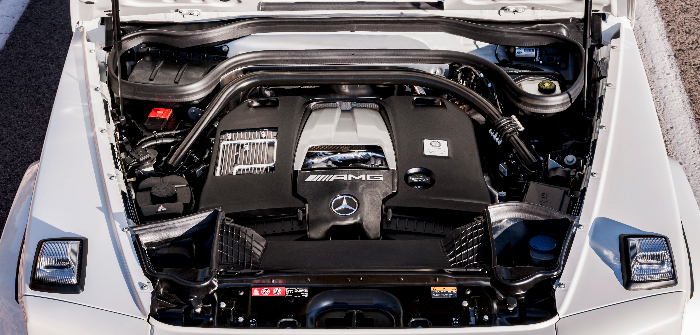
German OEM Mercedes-AMG has introduced its revamped G class with a new V8 biturbo engine. As the company continues the engine downsizing trend, the new powerplant replaces the 5.5-liter V8 biturbo from the previous iteration.

The G 63 generates 593ps and delivers a maximum torque of 850Nm, this is available across a rev range between 2,500 and 3,500rpm. This all means zero to 100 km/h in 4.5 seconds and limited maximum speed of 220km/h, or 240km/h with the AMG Driver‘s package.

This is thanks to two twin-scroll turbochargers that are inside the cylinder V, meaning a compact engine design, spontaneous response and optimal airflow to the near-engine catalysts.

The turbocharger housing is divided into two parallel flow channels. Combined with two separate exhaust ducts in the exhaust manifold, this makes it possible to control the exhaust gases on the turbine wheel separately.

The exhaust gas from the first and fourth cylinders of the cylinder bank is fed into one duct, then from the second and third cylinders to the other duct.

The aim is to prevent the individual cylinders from having mutually adverse effects on the gas cycle. This reduces the exhaust gas back pressure and improves gas exchange. The results are increased output by virtue of improved cylinder charging with fresh mixture, more torque at low revs and fast response times.

Spray-guided direct petrol injection with piezo injectors, the all-aluminum crankcase, the four-valve per cylinder design with camshaft adjustment, air-water intercooling, alternator management, the Eco start/stop function and the gliding mode have all been retained from the previous model.

Developed with efficiency in mind, the 4.0-liter motor features AMG’s Cylinder Management cylinder deactivation system. In the partial-load range, cylinders two, three, five and eight are deactivated. This means combined fuel consumption of 13.2 l/100km, and combined CO₂ emissions of 299 g/km.

Share. LinkedIn Twitter Facebook Email

Related Posts

BorgWarner wins turbocharger contracts with two European OEMs

May 7, 2026

Horse begins production of HR13 engine at Curitiba plant

February 3, 2025

Dodge launches Hellephant A30 426 and Drag Pak 354 crate engines

October 31, 2024
LATEST NEWS

Renault introduces LPG bi-fuel Clio that delivers up to 1,450km range

May 7, 2026

UK consortium secures funding for ReCAM lithium-ion battery recycling project

May 7, 2026

BorgWarner wins turbocharger contracts with two European OEMs

May 7, 2026

Receive breaking stories and features in your inbox each week, for free


Enter your email address:


Supplier Spotlights
  • SMT
Featured Listings
  • There are currently no listings to show.
Getting in Touch
  • Contact Us
  • Media Pack
  • Meet the Editors
  • Free Weekly E-Newsletter
Our Social Channels
  • LinkedIn
Related UKi Topics
  • Automotive Interiors
  • Automotive Testing
  • Autonomous Vehicle
  • Professional Motorsport
  • Tire Technology
  • Media Pack
© 2026 UKi Media & Events a division of UKIP Media & Events Ltd
  • Terms and Conditions
  • Privacy Policy
  • Cookie Policy
  • Notice and Takedown Policy

Type above and press Enter to search. Press Esc to cancel.