

Close Menu
  • News
      • Appointments
      • EV Powertrain
      • Emissions
      • Engine Components
      • Electronics
      • Facility Developments
      • Forced Induction
      • Fuel Cell Technologies
      • Fuels & Lubricants
      • Heavy-duty & Diesel Engine Technologies
      • Hybrid Powertrain Technologies
      • Industry Forecasting
      • Legislation
      • Materials & Surface Treatment
      • Metallurgy
      • Mild-hybrid & 48V Technologies
      • New powertrain
      • Partnerships, Investments & Acquisitions
      • Quality Control
      • Prototyping
      • Sustainable fuels
      • Testing
      • Traction Control Systems
      • Transmissions Technologies
      • Webinars
  • Features
  • Online Magazines
    • April 2026
    • January 2026
    • September 2025
    • June 2025
    • March 2025
    • January 2025
    • September 2024
    • Subscribe to Automotive Powertrain Technology
    • Transmission Technology International
    • Subscribe to Transmission Technology
  • Opinion
  • Supplier Spotlight
  • Webinars
Facebook X (Twitter) Instagram
  • Automotive Interiors
  • Automotive Testing
  • Autonomous Vehicle
  • Professional Motorsport
  • Tire Technology
  • Media Pack
LinkedIn
Subscribe
Automotive Powertrain Technology International
  • News
      • Appointments
      • EV Powertrain
      • Emissions
      • Engine Components
      • Electronics
      • Facility Developments
      • Forced Induction
      • Fuel Cell Technologies
      • Fuels & Lubricants
      • Heavy-duty & Diesel Engine Technologies
      • Hybrid Powertrain Technologies
      • Industry Forecasting
      • Legislation
      • Materials & Surface Treatment
      • Metallurgy
      • Mild-hybrid & 48V Technologies
      • New powertrain
      • Partnerships, Investments & Acquisitions
      • Quality Control
      • Prototyping
      • Sustainable fuels
      • Testing
      • Traction Control Systems
      • Transmissions Technologies
      • Webinars
  • Features
  • Online Magazines
    1. April 2026
    2. January 2026
    3. September 2025
    4. June 2025
    5. March 2025
    6. January 2025
    7. September 2024
    8. Subscribe to Automotive Powertrain Technology
    9. Transmission Technology International
    10. Subscribe to Transmission Technology
    Featured

    In this Issue – April 2026

    By Web TeamMay 1, 2026
    Recent

    In this Issue – April 2026

    May 1, 2026

    In this Issue – January 2026

    December 3, 2025

    In this Issue – September 2025

    September 25, 2025
  • Opinion
  • Supplier Spotlight
  • Webinars
LinkedIn Facebook
Subscribe
Automotive Powertrain Technology International
Opinion

The critical engineering area overlooked by OEMs

Paul Arkesden, CEO, HydrohertzBy Paul Arkesden, CEO, HydrohertzMay 20, 20263 Mins Read
LinkedIn Twitter Facebook Email
Paul Arkesden.
Share
LinkedIn Twitter Facebook Email

In the race to develop the next generation of electric vehicles, the automotive industry has invested billions in new battery chemistries. Yet while we wait for solid-state batteries and silicon anodes to reach the mass market (a process that could still take a decade), a critical area of technological development has been overlooked: thermal management

Cooling systems for EV batteries have been forgotten, becoming standardized across the automotive industry. Every major OEM uses essentially the same conventional solution, regardless of the drivetrain architecture. It’s an area where innovation has stalled, where tailored engineering excellence has given way to accepting a solution that is ‘good enough’ but nothing more.

In failing to focus and invest in this area, the industry has missed easy wins for efficiency and performance – at a time when the automotive sector has never been more competitive

The existing liquid cooling systems treat the entire battery pack uniformly, with no ability to control different parts of the pack, meaning that hot spots develop in certain modules while others remain cooler. As a result, the battery management system throttles power across the entire pack to protect the hottest cells, even though much of the battery could safely handle higher rates. This means there is slower charging, reduced efficiency and diminished overall performance.

The zonal cooling advantage

To date, OEMs haven’t considered modular cooling for batteries, but they should. If you have true independent zones, you can ensure that each module in a battery operates at optimum temperature, so charging power can be maximized and temperature differentials minimized. Splitting the battery pack into four modules is an ideal way to do this, enabling you to standardize modules and, in turn, standardize cells.

At Hydrohertz, we’ve developed the Dectravalve to enable more precise cooling. This compact, intelligent valve system delivers independent zone control while also reducing complexity and weight. It’s a game-changing piece of tech; a single, digitally controlled valve that can manage four or more cooling zones separately, optimizing them to transform efficiency for both charging and discharging.
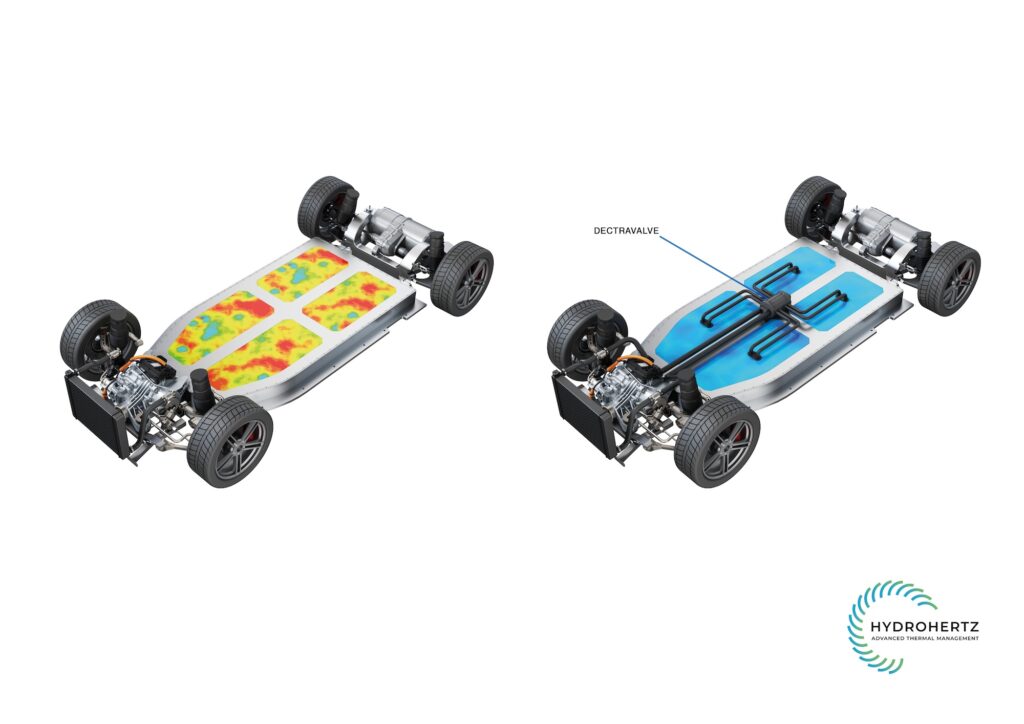
Hydroherz.

In testing with Warwick Manufacturing Group, we’ve demonstrated up to 68% reduction in fast-charging times, 10% improvement in range (48-64km more range for a typical EV), and a temperature difference of just 2.6°C across the pack (versus up to 12°C difference without Dectravalve). Dectravalve also brings an 83% weight reduction – 2kg versus 12kg for conventional systems – and saves approximately 10 parts compared with conventional systems, thus reducing cost and complexity.

Dectravalve is chemistry-agnostic, so whether you’re working with today’s NMC and LFP cells or future solid-state technologies, it can continue to offer precise thermal control. With transformative tech like Dectravalve, OEMs can improve existing batteries today and optimize whatever chemistry emerges tomorrow.

Thermal management has been the forgotten discipline in EV development. Yet it represents perhaps the most accessible path to dramatically improved performance: sub-10-minute charging, longer range, extended battery life and enhanced safety. An intelligent cooling valve like Dectravalve can be key to unlocking all these benefits and reaching ‘convenience parity’ with ICE vehicles.

While the automotive world waits for the next battery breakthrough, the easy win is already here. It’s time we paid attention to thermal management and recognized the role it has to play in unlocking the true potential of EVs.

About Paul Arkesden
Paul is a senior automotive executive and chartered engineer with over 30 years of leadership experience. A specialist in automotive engineering and vehicle design, he has led advanced engineering initiatives across ICE, hybrid and EV platforms, lightweight structures and next-generation manufacturing.

Share. LinkedIn Twitter Facebook Email

Related Posts

Opinion: Alexander Ertel-Morenstein, the unsung pinoneer of gear science

January 2, 2026

The role of testing in the future of electrified propulsion

December 15, 2025

Why Euro 6e-bis brings another pre-production challenge for OEMs

September 18, 2025
LATEST NEWS

The critical engineering area overlooked by OEMs

May 20, 2026

Audi A2 e-tron racks up the miles during validation testing

May 20, 2026

Mayr Power Transmission to highlight advanced drivetrain testing solutions at Automotive Testing Expo Europe 2026

May 15, 2026

Receive breaking stories and features in your inbox each week, for free


Enter your email address:


Supplier Spotlights
  • The Battery Show and Electric & Hybrid Vehicle Technology Expo
Featured Listings
  • There are currently no listings to show.
Getting in Touch
  • Contact Us
  • Media Pack
  • Meet the Editors
  • Free Weekly E-Newsletter
Our Social Channels
  • LinkedIn
Related UKi Topics
  • Automotive Interiors
  • Automotive Testing
  • Autonomous Vehicle
  • Professional Motorsport
  • Tire Technology
  • Media Pack
© 2026 UKi Media & Events a division of UKIP Media & Events Ltd
  • Terms and Conditions
  • Privacy Policy
  • Cookie Policy
  • Notice and Takedown Policy

Type above and press Enter to search. Press Esc to cancel.