
• News
      • Appointments
      • EV Powertrain
      • Emissions
      • Engine Components
      • Electronics
      • Facility Developments
      • Forced Induction
      • Fuel Cell Technologies
      • Fuels & Lubricants
      • Heavy-duty & Diesel Engine Technologies
      • Hybrid Powertrain Technologies
      • Industry Forecasting
      • Legislation
      • Materials & Surface Treatment
      • Metallurgy
      • Mild-hybrid & 48V Technologies
      • New powertrain
      • Partnerships, Investments & Acquisitions
      • Quality Control
      • Prototyping
      • Sustainable fuels
      • Testing
      • Traction Control Systems
      • Transmissions Technologies
      • Webinars
  • Features
  • Online Magazines
    • January 2026
    • September 2025
    • June 2025
    • March 2025
    • January 2025
    • September 2024
    • Subscribe to Automotive Powertrain Technology
    • Transmission Technology International
    • Subscribe to Transmission Technology
  • Opinion
  • Events
  • Supplier Spotlight
  • Webinars
Facebook Twitter Instagram
  • Automotive Interiors
  • Automotive Testing
  • Autonomous Vehicle
  • Professional Motorsport
  • Tire Technology
  • Media Pack
LinkedIn Facebook
Subscribe
Automotive Powertrain Technology International
  • News
      • Appointments
      • EV Powertrain
      • Emissions
      • Engine Components
      • Electronics
      • Facility Developments
      • Forced Induction
      • Fuel Cell Technologies
      • Fuels & Lubricants
      • Heavy-duty & Diesel Engine Technologies
      • Hybrid Powertrain Technologies
      • Industry Forecasting
      • Legislation
      • Materials & Surface Treatment
      • Metallurgy
      • Mild-hybrid & 48V Technologies
      • New powertrain
      • Partnerships, Investments & Acquisitions
      • Quality Control
      • Prototyping
      • Sustainable fuels
      • Testing
      • Traction Control Systems
      • Transmissions Technologies
      • Webinars
  • Features
  • Online Magazines
    1. January 2026
    2. September 2025
    3. June 2025
    4. March 2025
    5. January 2025
    6. September 2024
    7. Subscribe to Automotive Powertrain Technology
    8. Transmission Technology International
    9. Subscribe to Transmission Technology
    Featured

    In this Issue – January 2026

    By Web TeamDecember 3, 2025
    Recent

    In this Issue – January 2026

    December 3, 2025

    In this Issue – September 2025

    September 25, 2025

    In this Issue – June 2025

    June 25, 2025
  • Opinion
  • Events
  • Supplier Spotlight
  • Webinars
LinkedIn Facebook
Subscribe
Automotive Powertrain Technology International
Opinion

Opinion: Alexander Ertel-Morenstein, the unsung pinoneer of gear science

Calum DouglasBy Calum DouglasJanuary 2, 20265 Mins Read
LinkedIn Twitter Facebook Email
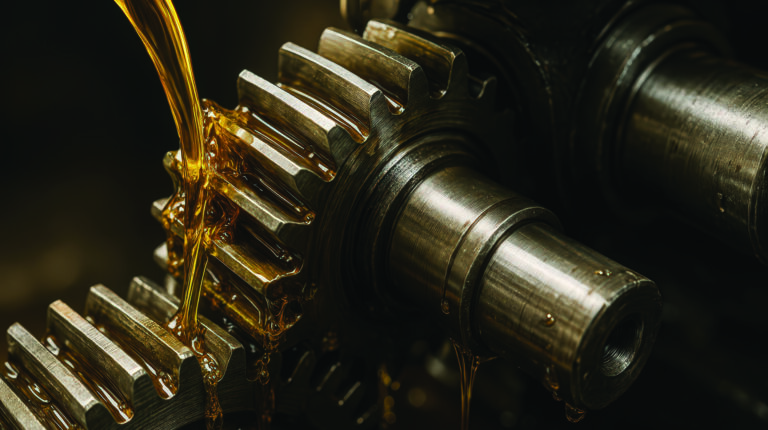
Detailed view of gears being lubricated with oil. Industrial machinery maintenance concept.
Share
LinkedIn Twitter Facebook Email

Gears were, in the early days, like bearings: very magical things. According to the scientific understanding of the time, they could not possibly work. The faces of two gears touching can be approximately represented as a single line contact of infinite ‘thin-ness’ along the faces of the gears. When you calculated the forces acting here, they were of course infinite (the line having no area, and the equation for stress being sigma=force/area). This was very upsetting for early gear pioneers, who were pleased when German physicist Heinrich Hertz published Über die Berührung fester elastischer Körper (On the contact of solid elastic bodies).1 

Hertz’s work accurately determined that two circles forced together actually ‘squidge’, resulting in a much larger contact area than might be expected. This became known as the Hertz Contact Theory, and is still used today.

Engineers were happy that the stresses in their gears now seemed to be below the level at which the gears ought to break. However, they were most vexed by the fact that their calculations showed that the gears which had worked for decades could not possibly work for any sustained length of time. This was because gears need a lubricant to stop the teeth rubbing together, and the calculations still stubbornly showed that even with the now much larger contact zone as predicted by Hertz, the level of the oil film was far below the rough surfaces of the teeth. This meant that the oil couldn’t keep the surfaces apart – they ought to tear themselves to shreds in hours.

In around 1893, Carl Barus came to the rescue with the theory now known as the Barus Law. This stated that – to everyone’s great surprise – the factor in an oil that stops it getting flattened by pressure (its viscosity) doesn’t just go up the more you press it between two contacts, it actually skyrockets. This meant that if you added Hertz’s realization that two cylinders touching don’t really contact as a ‘line’ to the fact that the oil viscosity in this wider contact was considerably higher than expected from simple lab tests on oils, suddenly gears and bearings made sense to those trying to calculate their behavior.

However, the engineering world took a while to start putting these pieces together. This was possibly because without the Barus Law being added to it, Hertz’s work didn’t make sense for gear contacts. Without the exponential increase in viscosity inside the contact zone, the oil film was not predicted to survive the pressures needed to deform the steel contacts elastically.

Then, at Moscow Central Institute for Mechanical Engineering, Alexander Ertel-Morenstein became the first to combine the work of Hertz (elastic deformation) with hydrodynamics and tribology (existing fluids laws added to the Barus Law). Thus, the field of elastohydrodynamics was born, where the correct contact width was known, due to Hertz; the correct fluid viscosity under pressure was known (thanks to Barus); and equations showed how all this combined in a gear contact, revealing that the real oil film thickness was higher than the roughness of the metal underneath. 

The problem was, Ertel had been doing much of this work in Russia during World War II. By now he was desperately sick with tuberculosis, and no one outside the country knew of his research. In 1945 he wrote The Calculation of Hydrodynamic Lubrication of Moving Curved Surfaces under High Loading, about which Dr A N Grubin, the head of the institute’s bearings department, stated, “The level of this work approaches that of the classical works of the lubrication theories by Petrov, Reynolds, Hertz.” Anyone who knows anything about Russians and mathematics understands that this meant it was very difficult work indeed.

By the time the war ended, Ertel was incredibly ill. Taking advantage of a posting to East Berlin, he reportedly faked his own death in a swimming accident and defected to the West, where he was welcomed and restored to health.

To keep his existence a secret from the Russian authorities, he assumed the alias Alexander von Mohrenstein (adding ‘von’ for a more convincing Germanic feel) and began work under Prof. Gustav Niemann at TH Braunschweig. His groundbreaking paper was published in 1949 under the name of his former head of department, Dr Grubin.

In 1966, Prof. M M Khrushchev at Moscow Central Institute for Mechanical Engineering received a letter from Ertel, which said, “In Grubin’s paper, there is no mention that the theory and calculations were conducted by me. I find this very indecent of him. However, should you see Grubin, tell him that I have forgiven him. With kind regards, your A Ertel (Dr A Morenstein).”

In my own undergraduate thesis I used the ‘Grubin’ method to calculate gear oil film thickness. It was only in the last few years that I discovered that it was not really Grubin who worked out how (and why) gears and bearings work.

Ertel lived a long life and died in 2001. Most people who have investigated the story believe that Grubin probably did not seek to plagiarize him. Aware of the importance of the work, he knew it had to be disseminated in the West. However, it could not be published under Ertel’s name for fear of bringing him to the attention of the NKVD (Russian security services), who would not be best pleased that one of the country’s top scientists had run away and been given a nice job working for the capitalists. Thus, Grubin published it under his own name to protect Ertel. The whole story was finally revealed after exhaustive research by the English tribologist Prof. A Cameron, published in the article Righting a 40-year-old wrong: A. M. Ertel – the true author of ‘Grubin’s EHL’ Solution, Tribology Int. 18, 92 (1985).

Calum Douglas

1) https://home.uni-leipzig.de/pwm/web/download/Hertz1881.pdf

Share. LinkedIn Twitter Facebook Email

Related Posts

The role of testing in the future of electrified propulsion

December 15, 2025

Why Euro 6e-bis brings another pre-production challenge for OEMs

September 18, 2025

Battery innovation – Why virtual testing is the future

March 26, 2024
LATEST NEWS

Opinion: Alexander Ertel-Morenstein, the unsung pinoneer of gear science

January 2, 2026

Onsemi to develop next-gen GaN devices with Global Foundries

January 2, 2026

Real-world testing of Smart’s all-new electric city car advances

January 2, 2026

Receive breaking stories and features in your inbox each week, for free


Enter your email address:


Supplier Spotlights
  • Japan Metal Gasket
Featured Listings
  • There are currently no listings to show.
Getting in Touch
  • Contact Us
  • Download Media Pack
  • Meet the Editors
  • Free Weekly E-Newsletter
Our Social Channels
  • Facebook
  • LinkedIn
Related UKi Topics
  • Automotive Interiors
  • Automotive Testing
  • Autonomous Vehicle
  • Professional Motorsport
  • Tire Technology
  • Media Pack
© 2025 UKi Media & Events a division of UKIP Media & Events Ltd
  • Terms and Conditions
  • Privacy Policy
  • Cookie Policy
  • Notice and Takedown Policy

Type above and press Enter to search. Press Esc to cancel.

We use cookies on our website to give you the most relevant experience by remembering your preferences and repeat visits. By clicking “Accept”, you consent to the use of ALL the cookies.
Cookie settingsACCEPT
Manage consent

Privacy Overview

This website uses cookies to improve your experience while you navigate through the website. Out of these, the cookies that are categorized as necessary are stored on your browser as they are essential for the working of basic functionalities of the website. We also use third-party cookies that help us analyze and understand how you use this website. These cookies will be stored in your browser only with your consent. You also have the option to opt-out of these cookies. But opting out of some of these cookies may affect your browsing experience.
Necessary
Always Enabled

Necessary cookies are absolutely essential for the website to function properly. These cookies ensure basic functionalities and security features of the website, anonymously.

CookieDurationDescription
cookielawinfo-checbox-analytics11 monthsThis cookie is set by GDPR Cookie Consent plugin. The cookie is used to store the user consent for the cookies in the category "Analytics".
cookielawinfo-checbox-functional11 monthsThe cookie is set by GDPR cookie consent to record the user consent for the cookies in the category "Functional".
cookielawinfo-checbox-others11 monthsThis cookie is set by GDPR Cookie Consent plugin. The cookie is used to store the user consent for the cookies in the category "Other.
cookielawinfo-checkbox-necessary11 monthsThis cookie is set by GDPR Cookie Consent plugin. The cookies is used to store the user consent for the cookies in the category "Necessary".
cookielawinfo-checkbox-performance11 monthsThis cookie is set by GDPR Cookie Consent plugin. The cookie is used to store the user consent for the cookies in the category "Performance".
viewed_cookie_policy11 monthsThe cookie is set by the GDPR Cookie Consent plugin and is used to store whether or not user has consented to the use of cookies. It does not store any personal data.

Functional

Functional cookies help to perform certain functionalities like sharing the content of the website on social media platforms, collect feedbacks, and other third-party features.

Performance

Performance cookies are used to understand and analyze the key performance indexes of the website which helps in delivering a better user experience for the visitors.

Analytics

Analytical cookies are used to understand how visitors interact with the website. These cookies help provide information on metrics the number of visitors, bounce rate, traffic source, etc.

Advertisement

Advertisement cookies are used to provide visitors with relevant ads and marketing campaigns. These cookies track visitors across websites and collect information to provide customized ads.

Others

Other uncategorized cookies are those that are being analyzed and have not been classified into a category as yet.

SAVE & ACCEPT
Powered by