

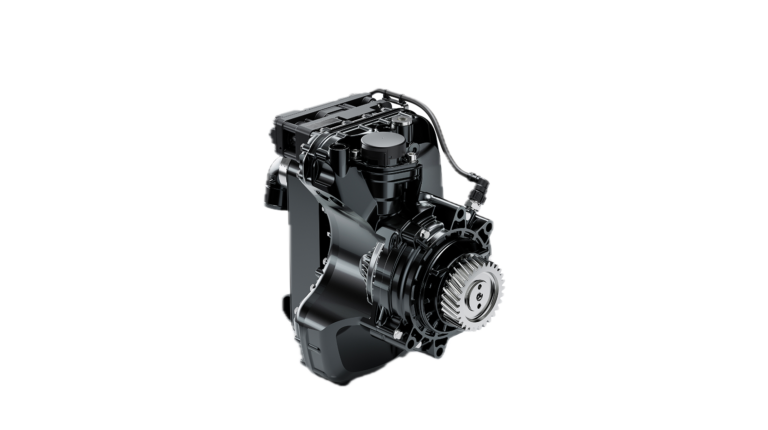
Ford Trucks has extended its partnership with Driventic for retarder technology, coinciding with the expansion of its F-Line series, launched in 2024, and the arrival of the F-Max Gen 2.0. The focus is on mid-sized companies and the construction sector in markets including Germany. Driventic, a spin-off from the drive systems division of Voith, has been Ford’s exclusive retarder supplier since the F-Max launched in 2021, a partnership that has so far equipped over 10,000 trucks. The retarders integrate into the Ecotorq transmission, developed in-house by Ford Trucks.
For many years, the hydrodynamic retarders developed by Voith/Driventic have enabled buses and trucks to perform around 90% of all braking operations without wear. With continuous braking function, the retarders reduce the stress on service brakes and thus cut the costs for spare parts and maintenance.
In addition, they offer a significant safety advantage for everyday vehicle use. In demanding operations such as adaptive braking on the highway or long downhill stretches, conventional friction brakes can quickly reach temperatures of up to 1,000°C, which causes their braking effect to diminish rapidly. When braking with the retarder, however, the service brakes remain cool during normal driving and can operate at full capacity in emergencies. This is why continuous brakes are now required by law in buses and trucks throughout Europe.
The retarder also offers economic advantages – and not only because the longer operating life of the service brakes means fewer visits to the workshop and therefore lower maintenance costs. Retarders also allow vehicles to operate at higher and more consistent average speeds. This increases payload capacity, which improves the efficiency of buses and trucks.
More consistent speeds also mean lower fuel consumption and, consequently, more environmentally friendly driving. A retarder prevents not only CO2 emissions but also 80% of all brake dust emissions.
Like all Driventic retarders, those used in the new F-Line models are a low-weight design. This allows vehicle operators to make optimum use of payload limits. Ford Trucks offers three segments in this product line, each with several variants: tow trucks, construction trucks and road trucks. These are all customized to the needs of the specific segments and are also available with 13-liter engines (Euro 6) and with Driventic retarders as an option.
In related news, Volkswagen launches ID Cross compact electric SUV built on MEB+ platform