

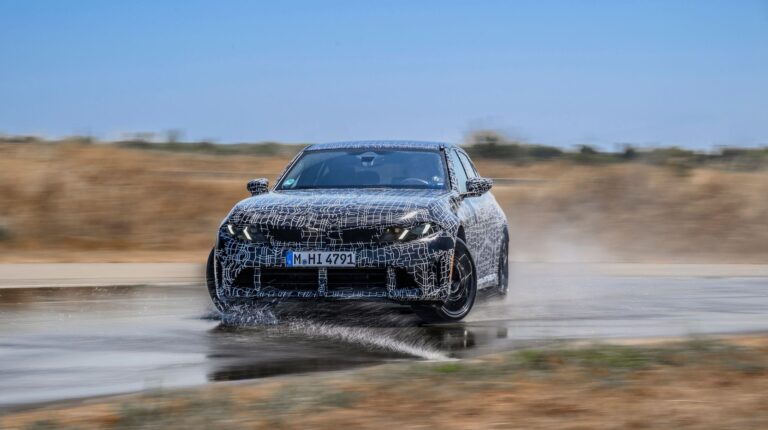
The next generation of the BMW 3 Series powered by internal combustion engines (ICE) is entering the final phase of series production development, with camouflaged prototypes completing testing at BMW Group’s proving grounds in southern France.
A technology-open drive system concept is a key feature of the new BMW 3 Series. Alongside the fully electric BMW i3, which celebrated its design premiere in March 2026, there will be a line-up of new BMW 3 Series models with four- and six-cylinder engines. The power units are “extremely efficient”, the auto maker said, and have 48V mild hybrid technology.
The new BMW 3 Series is undergoing a final round of driving dynamics testing at the BMW Group’s test centre near Miramas in southern France. The facility offers a range of track types, from a high-speed oval to handling courses, as well as different road surfaces, enabling engineers to assess and optimize the vehicle’s driving behavior. Before arriving in Miramas, the new 3 Series had already completed an extensive testing program, including trials at the BMW Group’s winter testing center in Arjeplog, Sweden, and on the Nürburgring in Germany.
“The BMW 3 Series has set standards for driving dynamics for several decades now, and thus serves as a symbol of ‘sheer driving pleasure’,” explained Dr Mihiar Ayoubi, senior vice president – driving experience development, BMW.
“With the new generation, we are building on this strength once again through the perfect interplay of chassis hardware and a continuously optimized and intelligent BMW Driving Stack. In this way, we are elevating the driving experience in the new BMW 3 Series to a new level – precise, assured und unmistakably BMW.”
Six-cylinder engine
The BMW M350 xDrive is the performance variant of the new BMW 3 Series range, and has an internal combustion engine – a 3.0-liter BMW TwinPower Turbo six-cylinder in-line developing 326kW/443hp.
It is the only 3 Series variant offered with a six-cylinder engine and features specific chassis tuning, increased torsional and vertical stiffness, an 8-speed Steptronic transmission and BMW xDrive all-wheel drive. Like the four-cylinder models, it uses 48V mild-hybrid technology. Adaptive M suspension, an M Sport differential and variable sport steering are fitted as standard. The M350 xDrive accelerates from 0-100 km/h (62mph) in 4.1 seconds.
The BMW M350 xDrive will introduce a Drift Moment function during 2027, enabling drive from the engine to be directed entirely to the rear wheels when activated via the central display. Combined with M-specific control of the multidisc clutch and DSC switched off, the function enables rear-wheel-drive drift behavior.
Chassis development
The new BMW 3 Series combines near-even weight distribution between the axles with a longer wheelbase and wider front and rear tracks. Digital driving dynamics systems are integrated across the vehicle, with updates including an upgraded integrated braking system and revised steering ratio aimed at improving handling precision.
It has a double-joint spring strut front axle and a five-link rear axle, while anti-roll bar mounts with high preload on both axles improve roll control and stabilization.
The intelligent BMW driving stack
The new BMW 3 Series features model-specific chassis and control systems adapted to each drive system, alongside a newly developed electronics and software architecture. At its core is the BMW Driving Stack, an integrated hardware and software system that coordinates driving-related functions across the vehicle.
In the fully electric BMW i3, the Heart of Joy central computer works with the BMW Dynamic Performance Control Driving Stack to manage the vehicle’s driving dynamics. Developed for BMW’s sixth-generation electric drive architecture, the system coordinates driving-related functions across the vehicle. The ICE models use an optimized BMW Driving Stack tailored to their drive system, with transverse dynamics management integrating agility-related functions including the all-wheel-drive system. Stabilization and engine management remain distributed across specialized control units, building on BMW’s existing control architecture.
Both Driving Stacks are tailored to their respective drive systems, with future BMW 3 Series variants set to use driving dynamics management systems configured for their specific powertrain.
Related news, BMW iX5 Hydrogen enters next development phase ahead of series production