

Close Menu
  • News
      • Appointments
      • EV Powertrain
      • Emissions
      • Engine Components
      • Electronics
      • Expo
      • Facility Developments
      • Forced Induction
      • Fuel Cell Technologies
      • Fuels & Lubricants
      • Heavy-duty & Diesel Engine Technologies
      • Hybrid Powertrain Technologies
      • Industry Forecasting
      • Legislation
      • Materials & Surface Treatment
      • Metallurgy
      • Mild-hybrid & 48V Technologies
      • New powertrain
      • Partnerships, Investments & Acquisitions
      • Quality Control
      • Prototyping
      • Sustainable fuels
      • Testing
      • Traction Control Systems
      • Transmissions Technologies
      • Webinars
  • Features
  • Online Magazines
    • April 2026
    • January 2026
    • September 2025
    • June 2025
    • March 2025
    • January 2025
    • September 2024
    • Subscribe to Automotive Powertrain Technology
    • Transmission Technology International
    • Subscribe to Transmission Technology
  • Opinion
  • Supplier Spotlight
  • Webinars
Facebook X (Twitter) Instagram
  • Automotive Interiors
  • Automotive Testing
  • Autonomous Vehicle
  • Professional Motorsport
  • Tire Technology
  • Media Pack
LinkedIn
Subscribe
Automotive Powertrain Technology International
  • News
      • Appointments
      • EV Powertrain
      • Emissions
      • Engine Components
      • Electronics
      • Expo
      • Facility Developments
      • Forced Induction
      • Fuel Cell Technologies
      • Fuels & Lubricants
      • Heavy-duty & Diesel Engine Technologies
      • Hybrid Powertrain Technologies
      • Industry Forecasting
      • Legislation
      • Materials & Surface Treatment
      • Metallurgy
      • Mild-hybrid & 48V Technologies
      • New powertrain
      • Partnerships, Investments & Acquisitions
      • Quality Control
      • Prototyping
      • Sustainable fuels
      • Testing
      • Traction Control Systems
      • Transmissions Technologies
      • Webinars
  • Features
  • Online Magazines
    1. April 2026
    2. January 2026
    3. September 2025
    4. June 2025
    5. March 2025
    6. January 2025
    7. September 2024
    8. Subscribe to Automotive Powertrain Technology
    9. Transmission Technology International
    10. Subscribe to Transmission Technology
    Featured

    In this Issue – April 2026

    By Web TeamMay 1, 2026
    Recent

    In this Issue – April 2026

    May 1, 2026

    In this Issue – January 2026

    December 3, 2025

    In this Issue – September 2025

    September 25, 2025
  • Opinion
  • Supplier Spotlight
  • Webinars
LinkedIn Facebook
Subscribe
Automotive Powertrain Technology International
EV Powertrain

JLR launches Range Rover Electric with twin 260kW permanent-magnet motors

Zahra AwanBy Zahra AwanSeptember 4, 20263 Mins Read
LinkedIn Twitter Facebook Email
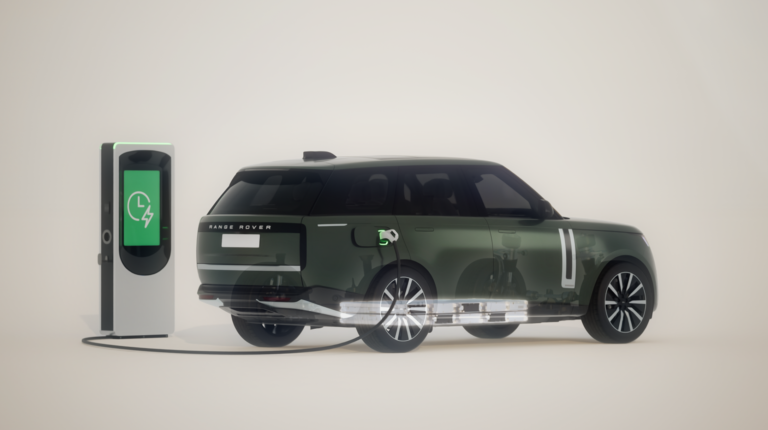
A range Rover Electric parked beside an electric charging station on a grey background.
Share
LinkedIn Twitter Facebook Email

Range Rover is now available with electric propulsion, marking a major milestone for the brand.

Built in Solihull, the Range Rover Electric SUV features twin permanent magnet 260kW electric motors generating up to 550ps and 850Nm of torque. It has a range of up to 372 miles (WLTP), and, according to the company, a real world range of up to 333 miles (535km).

“Electric propulsion is perfectly suited to the exquisite refinement of Range Rover, elevating the sense of calm and secluded sanctuary for occupants,” said Martin Limpert, managing director, Range Rover. “We took our testing and development programs even further than originally intended to ensure Range Rover Electric is genuinely the most accomplished Range Rover ever.”

New technologies enable precise control in all environments, such as Intelligent Driveline Dynamics (IDD), which distributes rear torque from 100% to zero% to prevent loss of traction, and Integrated Traction Management (ITM), which controls motor speed within 50ms and manages slip up to 100 times quicker than an ICE vehicle equivalent.

Integrated Traction Management works in concert with the new Single Pedal mode, providing owners control to smoothly pull away on slopes up to 33° or complete a rolling climb on slopes up to 45°.

“The defining characteristic of Range Rover Electric is its ability to perform across every surface, with effortless comfort and refinement,” said Matt Becker, vehicle engineering director, JLR.

Using the fastest available 350kW rapid DC public chargers, Range Rover Electric can charge from 10‑80% in around 22 minutes or add 220km in 10 minutes (WLTP) when the vehicle is charging at its maximum charge rate.

The vehicle is powered by a usable 118.5kWh lithium‑ion double‑stack battery consisting of 344 prismatic cells delivering outstanding energy density. The advanced 800V architecture provides fast, adaptable split‑charging capability.

Twin permanent magnet 260kW electric motors feature silicon carbide semiconductors that enable switching speeds measured in microseconds. The SUV, the company said, will complete 0-60 mph in 4.3 seconds, with power enabling overtaking speeds from 50‑75mph in as little as 2.7 seconds.

Testing the Range Rover Electric

The Electric SUV has undergone virtual and physical testing and development around the world to ensure a customary Range Rover experience. Tested in ‑40°C temperatures in Arjeplog, Sweden, the heat of the Dubai desert and JLR’s own Eastnor Castle facility in the UK, Range Rover Electric has completed over 1,500,000km and over a quarter of a million hours of testing.

JLR’s new battery testing laboratory subjects complete battery systems to multi-axis vibration and shock testing at temperatures ranging from −40°C to +90°C. which, combined with the a high-strength aluminum enclosure, means that the Range Rover Electric’s battery can withstand impacts and harsh conditions, with safety systems that exceed industry standards.

New technologies have been designed to improve the Range Rover Electric’s efficiency and performance, including range prediction features and the ThermAssist thermal management system, which optimizes battery temperature to support driving range, charging speeds and battery longevity in extreme temperatures, with claimed gains of up to 25 miles of range and a 40% reduction in heating energy use. More than 300 patent applications have been filed for the vehicle.

Facilities 

To support production of Range Rover Electric, JLR has transformed its Solihull manufacturing facility, combining advanced manufacturing, digital technology and a major investment in electrification skills.

JLR’s wider manufacturing network, including its Electric Propulsion Manufacturing Centre in Wolverhampton, will support Range Rover Electric production.

Related news, Ford Hypercar completes first track tests

Share. LinkedIn Twitter Facebook Email

Related Posts

Lepas confirms UK specification for L6 electric SUV

August 27, 2026

Tech Insider: Mercedes-AMG One – Part 2

August 10, 2026

Andretti selects Nissan GEN4 Formula E powertrain

July 28, 2026
LATEST NEWS

JLR launches Range Rover Electric with twin 260kW permanent-magnet motors

September 4, 2026

Ten-Nine Technologies scales production of Tenix additive as manganese-rich batteries gain momentum

September 3, 2026

Q&A: Tony Mancina, Stellantis Canada

September 1, 2026

Receive breaking stories and features in your inbox each week, for free


Enter your email address:


Supplier Spotlights
  • Valvoline Europe (Ellis Enterprises B.V.)
Featured Listings
  • There are currently no listings to show.
Getting in Touch
  • Contact Us
  • Media Pack
  • Meet the Editors
  • Free Weekly E-Newsletter
Our Social Channels
  • LinkedIn
Related UKi Topics
  • Automotive Interiors
  • Automotive Testing
  • Autonomous Vehicle
  • Professional Motorsport
  • Tire Technology
  • Media Pack
© 2026 UKi Media & Events a division of UKIP Media & Events Ltd
  • Terms and Conditions
  • Privacy Policy
  • Cookie Policy
  • Notice and Takedown Policy

Type above and press Enter to search. Press Esc to cancel.