

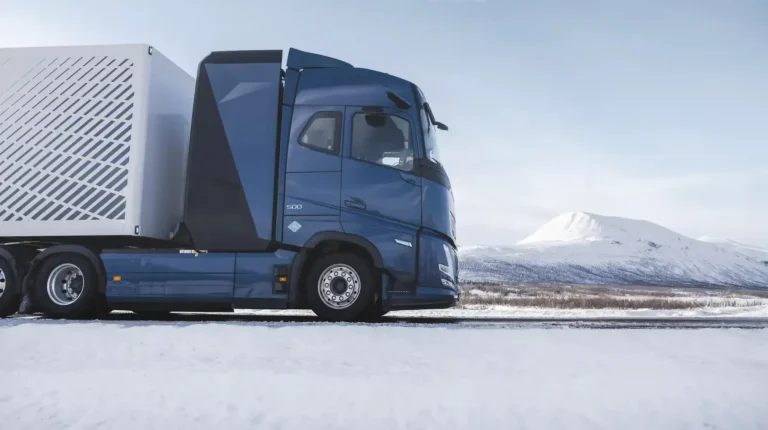
Volvo Trucks has begun on-road testing of heavy trucks powered by hydrogen combustion engines en route to the planned commercial launch of its hydrogen solution by 2030.
The hydrogen-powered trucks use high-pressure, direct injection (HPDI) technology, which the company says improves energy efficiency, reduces fuel consumption and increases engine power compared with conventional hydrogen combustion engines. HPDI works by injecting a small amount of ignition fuel at high pressure to enable compression ignition before hydrogen is added. Volvo already uses this technology in its gas-powered trucks, with over 10,000 units sold worldwide.
The hydrogen engine technology is derived from its diesel powertrain, delivering “diesel-like performance” while substantially cutting CO2 emissions, the auto maker said.
“On-road testing is an important milestone for our hydrogen combustion engine trucks. I feel confident that they will be the best in the industry if you look at fuel efficiency, power, torque and drivability,” said Jan Hjelmgren, head of product management at Volvo Trucks. “Customers will be able to operate them just like diesel trucks. Our experience with HPDI technology in more than 10,000 gas-powered trucks is strong proof of its performance.”
Hydrogen combustion engine trucks will be especially suitable over longer distances and in regions where there is limited charging infrastructure or time for the recharging of battery-electric trucks.
Volvo trucks with combustion engines powered by green hydrogen have the potential to deliver net-zero CO2 well-to-wheel when using renewable HVO as ignition fuel. They are categorized as Zero Emission Vehicles (ZEV) under the agreed EU CO2 emission standards.
The hydrogen-powered combustion engine trucks will complement the company’s offering of other alternatives, such as battery electric trucks, fuel cell electric trucks and trucks that run on renewable fuels, like biogas and HVO (hydrotreated vegetable oil).
“We see great potential for hydrogen combustion engine trucks and they will have a role to play in the transformation to zero-emission transport,” said Hjelmgren. “Several technologies will be needed to decarbonize. As a global truck manufacturer we offer a variety of decarbonization solutions and help our customers choose the best alternative based on transport assignment, available infrastructure and green energy prices.”
Related news, Hydrogen fuel cell trucks help decarbonize freight in Uruguay