

Close Menu
  • News
      • Appointments
      • EV Powertrain
      • Emissions
      • Engine Components
      • Electronics
      • Facility Developments
      • Forced Induction
      • Fuel Cell Technologies
      • Fuels & Lubricants
      • Heavy-duty & Diesel Engine Technologies
      • Hybrid Powertrain Technologies
      • Industry Forecasting
      • Legislation
      • Materials & Surface Treatment
      • Metallurgy
      • Mild-hybrid & 48V Technologies
      • New powertrain
      • Partnerships, Investments & Acquisitions
      • Quality Control
      • Prototyping
      • Sustainable fuels
      • Testing
      • Traction Control Systems
      • Transmissions Technologies
      • Webinars
  • Features
  • Online Magazines
    • April 2026
    • January 2026
    • September 2025
    • June 2025
    • March 2025
    • January 2025
    • September 2024
    • Subscribe to Automotive Powertrain Technology
    • Transmission Technology International
    • Subscribe to Transmission Technology
  • Opinion
  • Supplier Spotlight
  • Webinars
Facebook X (Twitter) Instagram
  • Automotive Interiors
  • Automotive Testing
  • Autonomous Vehicle
  • Professional Motorsport
  • Tire Technology
  • Media Pack
LinkedIn
Subscribe
Automotive Powertrain Technology International
  • News
      • Appointments
      • EV Powertrain
      • Emissions
      • Engine Components
      • Electronics
      • Facility Developments
      • Forced Induction
      • Fuel Cell Technologies
      • Fuels & Lubricants
      • Heavy-duty & Diesel Engine Technologies
      • Hybrid Powertrain Technologies
      • Industry Forecasting
      • Legislation
      • Materials & Surface Treatment
      • Metallurgy
      • Mild-hybrid & 48V Technologies
      • New powertrain
      • Partnerships, Investments & Acquisitions
      • Quality Control
      • Prototyping
      • Sustainable fuels
      • Testing
      • Traction Control Systems
      • Transmissions Technologies
      • Webinars
  • Features
  • Online Magazines
    1. April 2026
    2. January 2026
    3. September 2025
    4. June 2025
    5. March 2025
    6. January 2025
    7. September 2024
    8. Subscribe to Automotive Powertrain Technology
    9. Transmission Technology International
    10. Subscribe to Transmission Technology
    Featured

    In this Issue – April 2026

    By Web TeamMay 1, 2026
    Recent

    In this Issue – April 2026

    May 1, 2026

    In this Issue – January 2026

    December 3, 2025

    In this Issue – September 2025

    September 25, 2025
  • Opinion
  • Supplier Spotlight
  • Webinars
LinkedIn Facebook
Subscribe
Automotive Powertrain Technology International
New Engine

Audi details 2024 SQ8 e-tron; three-motor quattro drivetrain delivers 503ps

Callum Brook-JonesBy Callum Brook-JonesAugust 4, 20232 Mins Read
LinkedIn Twitter Facebook Email
Share
LinkedIn Twitter Facebook Email

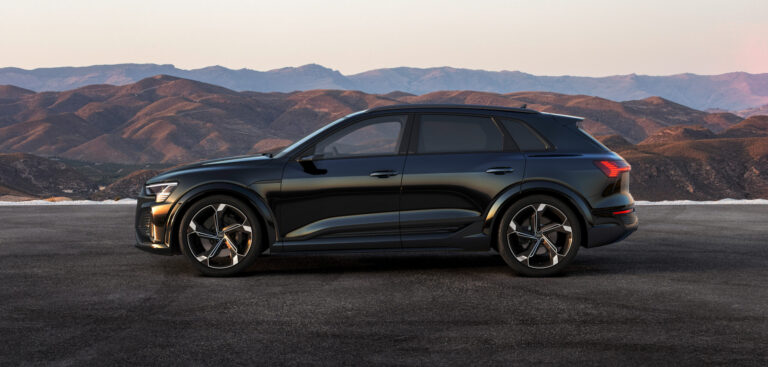
German OEM Audi has revealed additional details on the three-motor quattro drivetrain fitted to the 2024 Audi SQ8 e-tron. With one e-motor on the front axle and two on the rear, the SQ8 e-tron delivers 95ps and 309Nm more torque than its less powerful counterpart, the 2024 Q8 e-tron, and is designed for additional straight-line performance, dynamics and traction.

The SQ8 e-tron’s front axle is driven by an asynchronous electric motor which induces no drag when unpowered, resulting in added efficiency. Two asynchronous e-motors are fitted to the rear axle to power each wheel.

When boost mode is activated, the front e-motor delivers up to 213ps (157kW), while the rear motors provide 188ps (138kW) each. With a combined, all-electric boost power of 503ps (370kW), the Audi SUV is capable of completing 0-100km/h in 4.6 seconds and can go onto a top speed of 209km/h.

Through the use of electric torque vectoring, the two e-motors on the rear are capable of distributing drive torque to each individual wheel for improved handling. Despite there being no physical connection between the rear wheels, the vehicle’s system can direct drive force to the wheels in five milliseconds or less. To enhance acceleration out of corners, Audi’s electric torque vectoring can deliver 220Nm more torque to the outside rear wheel than the inside. If multiplied by the e-motors’ gearing, the difference equates to approximately 2,100Nm at the wheels.

The three-motor drivetrain also delivers improved traction when accelerating on low-friction surfaces. If one rear wheel is on grass for example, torque can be distributed efficiently between the other two e-motors. The higher-traction wheel receives most of the available torque, while the lower-traction wheel can receive almost none.

Share. LinkedIn Twitter Facebook Email

Related Posts

Maserati Nettuno engine transformed into 480kW hydrogen race unit

May 29, 2026

BYD enters UK eLCV market with Dolphin Cargo e-Van

May 29, 2026

Mercedes‑AMG presents all-electric GT 4‑Door Coupe

May 21, 2026
LATEST NEWS

Ferrari unveils all-electric Luce

May 29, 2026

Scania under-cab battery module and Megawatt Charging System available for order

May 29, 2026

Maserati Nettuno engine transformed into 480kW hydrogen race unit

May 29, 2026

Receive breaking stories and features in your inbox each week, for free


Enter your email address:


Supplier Spotlights
  • The Institute for Advanced Automotive Propulsion Systems
Featured Listings
  • There are currently no listings to show.
Getting in Touch
  • Contact Us
  • Media Pack
  • Meet the Editors
  • Free Weekly E-Newsletter
Our Social Channels
  • LinkedIn
Related UKi Topics
  • Automotive Interiors
  • Automotive Testing
  • Autonomous Vehicle
  • Professional Motorsport
  • Tire Technology
  • Media Pack
© 2026 UKi Media & Events a division of UKIP Media & Events Ltd
  • Terms and Conditions
  • Privacy Policy
  • Cookie Policy
  • Notice and Takedown Policy

Type above and press Enter to search. Press Esc to cancel.