

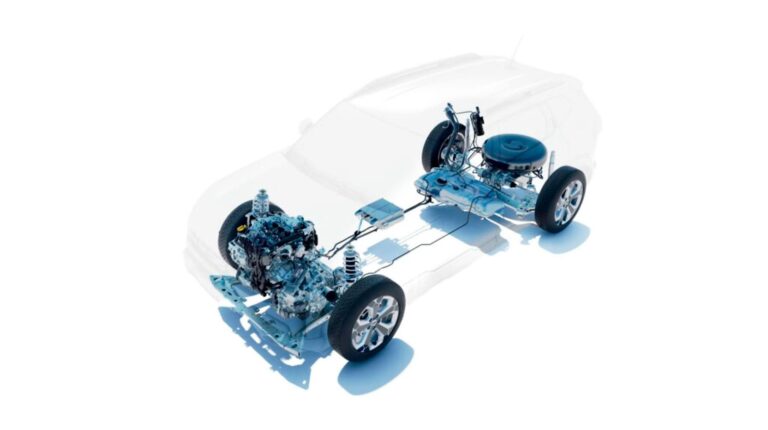
Dacia has been a firm believer in liquefied petroleum gas (LPG) since 2010. Following this, the company has developed an LPG/4×4 hybrid powertrain with an automatic gearbox suited for its Bigster and Duster.
The G 150 4X4 hybrid powertrain, first unveiled in October 2025, is said to be the first to combine hybrid and flex-fuel petrol/LPG technology on a four-wheel-drive vehicle.
The powertrain features a 1.2l mild-hybrid 48V combustion engine producing 103kW (140hp) and 230Nm of torque to drive the front wheels. An electric motor on the rear axle delivers up to 23kW (31hp peak) with maximum torque of 87Nm to drive the rear wheels.
The internal combustion engine (ICE) and electric motor have a combined output of 113kW (153hp), and are not mechanically linked. The four-wheel drive operation is controlled electronically by the electronic control units (ECUs) of the engine and braking module, with no transmission.
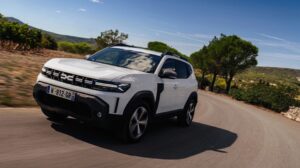
The automatic gearbox associated with the powertrain is technically twinned. The ICE is mated to a wet dual clutch 6-speed gearbox with steering wheel gear selection. The electric motor on the rear axle is mated to a 2-speed gearbox with a neutral mode.
The first gear on the rear gearbox delivers a maximum 1,800Nm of torque to both rear wheels. The second gear activates the electric motor at low speed to deliver maximum traction to the rear wheels at speeds of up to 140km/h.
Finally, the neutral gear reduces fuel consumption. By decoupling the rear axle, it cancels electrical losses and reduces friction losses at the rear in 2-wheel drive mode. The gear shift technology is based on Renault Group’s full hybrid E-Tech powertrain.
Drivers can select from several drive modes to optimize the off-road capabilities of the Duster and Bigster: Eco for improved fuel efficiency, Auto, Snow for slippery surfaces, Mud/Sand for loose terrain and Lock for off-road driving.
The G 150 4×4 powertrain gives the Dacia Duster and Bigster a driving range of up to 1,500km using two 50-liter fuel tanks, while reducing running costs by up to 30% and CO2 emissions by 20g/km compared with the previous generation. A 48V, 0.84kWh lithium-ion battery enables all-electric operation for up to 60% of urban driving. Fuel consumption and emissions remain moderate, with Duster consumption from 7.3 l/100km (LPG) and 6.0l/100km (petrol), and CO2 emissions from 117g/km (LPG) and 135g/km (petrol). For the Bigster, consumption starts at 7.2l/100km (LPG) and 5.9l/100km (petrol), with CO2 emissions from 115g/km (LPG) and 133g/km (petrol).
In related news, Honda expands 2026 line-up with 15 on-road models featuring the CB750 Hornet E-Clutch