

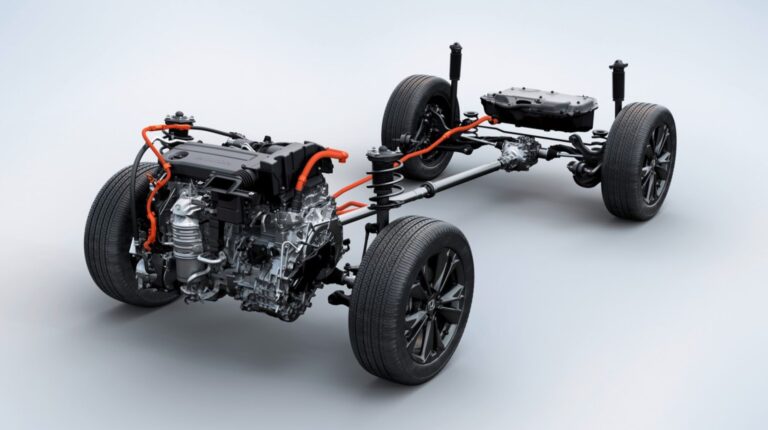
Honda has given more information about its fourth-generation two-motor hybrid system. First introduced in 2014, the system has evolved over four generations and will now pair with a 2.0-liter inline engine in the 2026 Prelude. According to the company, it is designed to maximize fuel efficiency and reduce emissions without compromising performance or vehicle packaging.
Core components
The Honda two-motor hybrid system consists of five key components. The electric generator motor produces electricity for the hybrid battery, while the electric propulsion motor drives the wheels directly. An Atkinson-cycle gasoline engine is connected to the generator/starter motor, which can supply power to the battery or propulsion motor and also drive the wheels via a lockup clutch during highway cruising to optimize efficiency. The Intelligent Power Unit (IPU) houses the battery and its controlling hardware, and the Power Control Unit (PCU) acts as the system’s brain, managing all hybrid functions.
Fourth-generation innovations
The first three generations of the Honda hybrid system used two electric motors mounted in-line with each other, with the generator motor connected directly to the engine, and the propulsion motor connected to the drive wheels. The 2023 CR-V and 2023 Accord introduced the fourth-generation system, with the two electric motors positioned parallel to each other (side by side).
This configuration enabled the use of a larger and more powerful propulsion motor, which now has an increased torque output of 335Nm (+20Nm). It also maintains its 181hp over a broader range of motor RPM, thereby improving response.
This propulsion motor uses high-performance magnets that, as before, are made without heavy rare earth metals. Internally, the motor uses a multi-ring structure that helps enable a higher peak motor speed of 14,500rpm, an improvement of 11.5%. This higher motor speed also contributes to a higher sustained top speed capability for CR-V hybrid models (Sport and Sport Touring) of 185km/h, 28% faster than its predecessor.
The side-by-side arrangement also enables the use of an additional direct-drive gearset with a new low-speed lock-up clutch (deployed in CR-V only), allowing engine drive at urban speeds and supporting the ability to tow up to 454kg, a first for the two-motor hybrid system.
Now seen in the 2026 Prelude
For the 2025 model year, the Honda Civic Sedan and Hatchback introduced a new variation of the fourth-generation system. Due to its smaller size and lighter weight, the Civic uses an in-line motor arrangement, as does the 2026 Prelude.
Honda retained an in-line motor layout, optimizing for space and weight. A high-speed lockup clutch prioritizes engine drive at highway speeds, while the IPU and PCU are smaller and lighter, preserving cargo space. The latest 2.0-liter Atkinson-cycle engine with direct multistage fuel injection can now be seen producing 141hp at 6,000rpm, and 182Nm torque at 4,500rpm, significantly reducing emissions.
In related news, Honda ends joint fuel cell production with GM