

A longstanding partnership between Mahle Powertrain and the University of Nottingham is advancing the development of ammonia combustion technology for applications where full electrification may not be practical.
Ammonia is receiving increasing attention as a potential zero-carbon fuel. However, it is known to pose significant technical challenges that have stalled its commercialization to date. These include poor combustion characteristics, NOX emissions and ammonia slip – a term used to describe unreacted ammonia (NH3) that escapes exhaust gas treatment systems without being fully used to convert harmful nitrogen oxides into harmless nitrogen and water. In addition, the fuel is as yet unproven for long-term durability at engine scale. Through five years of collaborative research, Mahle Powertrain and the University of Nottingham have made substantial progress in addressing and overcoming these issues, moving the technology beyond proof of concept and closer to practical deployment.
The partners have demonstrated stable combustion using pure ammonia in spark-ignited engines, while combining hydrogen co-fueling, ammonia cracking (a chemical process that breaks down ammonia into its basic parts: nitrogen and hydrogen) and advanced after-treatment to reduce NOX and ammonia slip to extremely low levels. The program is now progressing beyond laboratory-scale testing, with work underway on larger-capacity engines for real-world applications across marine, rail, stationary power generation and other heavy-duty sectors.
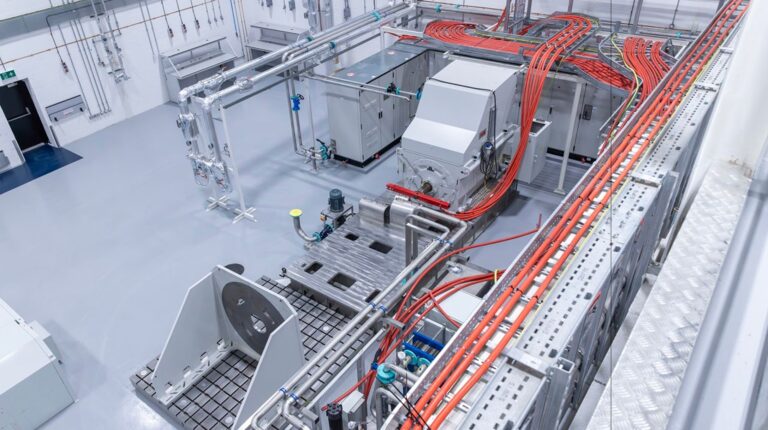
The university’s newly opened Hybrid Propulsion Systems Laboratory expands the capabilities of the University of Nottingham and Mahle Powertrain for industry-led propulsion research. The facility brings together advanced engine testing, hydrogen technologies, electrification and hybrid powertrain integration to support the transition from academic research to commercial development.
The partnership has evolved into a fully integrated engineering program, combining academic expertise with Mahle Powertrain’s experience of developing commercially viable propulsion systems. The two organizations say that the research program is proof of how collaborative research and development can accelerate technology readiness and reduce development risk for future OEM adoption.
Ammonia combustion is progressing from laboratory research toward commercially relevant heavy-duty applications, with Mahle Powertrain and the University of Nottingham addressing challenges including slow combustion, NOX emissions and ammonia slip. The work combines combustion development, hydrogen co-fueling, ammonia cracking and advanced after-treatment, with testing expanding from single-cylinder engines to larger platforms for applications including marine, rail, stationary power and off-highway machinery.
In related news, Horiba and UCL expand advanced propulsion research partnership