

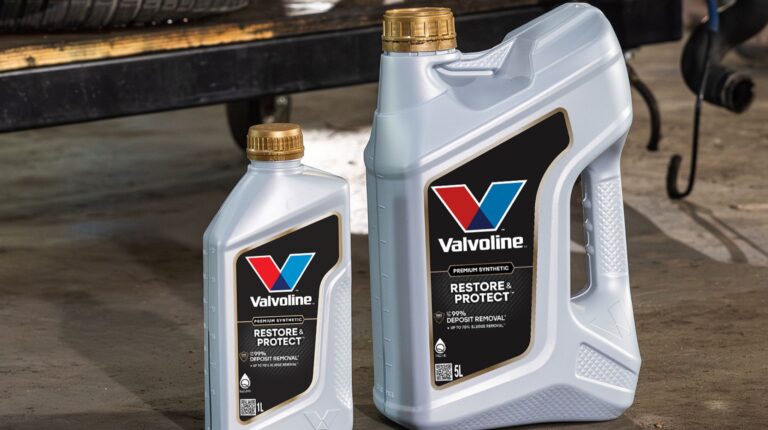
As Europeans are keeping their vehicles on the road longer, maintaining vehicle performance is a key cost-saving measure. Over time, everyday driving can lead to the buildup of deposits and sludge inside an engine, affecting efficiency, responsiveness and long-term reliability. In response, Valvoline has announced the European launch of its Restore & Protect lubricant.
Able to remove up to 99% of engine-killing deposits and 78% of sludge, Restore & Protect addresses deposits already inside the engine while protecting against future build-up, offering “active engine renewal”, the company said, adding that with continuous use, Restore & Protect can help renew engines.
The lubricant’s Active-Clean Technology targets and removes existing engine deposits over time, and its Liqui-Shield Technology works to prevent new deposits from forming.
Formulated for European roads and drivers
After successful debuts in other global markets, Valvoline has adapted Restore & Protect for the needs and requirements of both gasoline and diesel engines. The European formulation has been validated through rigorous testing and meets key ACEA and API performance standards and is suitable for use across a wide range of vehicles and multiple OEM applications dependent on viscosity grade.
“By choosing Restore & Protect as part of routine care, drivers can help keep engines performing at their best today, while supporting long-term performance for many more journeys to come,” said Samuel Raudales, Valvoline global senior vice president and general manager, Europe, Middle East and Africa.
“We developed Restore & Protect to give drivers confidence that their engines are not only protected, but actively cared for throughout their ownership journey, helping to turn back time on their engine by removing sludge and deposits that can build up over miles.
“For 160 years, Valvoline has defined the boundaries of what is possible and Restore & Protect proves again our commitment to never stop innovating.”
Related news, How modular testing is supporting the shift to hydrogen, methanol and ammonia