

Close Menu
  • News
      • Appointments
      • EV Powertrain
      • Emissions
      • Engine Components
      • Electronics
      • Facility Developments
      • Forced Induction
      • Fuel Cell Technologies
      • Fuels & Lubricants
      • Heavy-duty & Diesel Engine Technologies
      • Hybrid Powertrain Technologies
      • Industry Forecasting
      • Legislation
      • Materials & Surface Treatment
      • Metallurgy
      • Mild-hybrid & 48V Technologies
      • New powertrain
      • Partnerships, Investments & Acquisitions
      • Quality Control
      • Prototyping
      • Sustainable fuels
      • Testing
      • Traction Control Systems
      • Transmissions Technologies
      • Webinars
  • Features
  • Online Magazines
    • April 2026
    • January 2026
    • September 2025
    • June 2025
    • March 2025
    • January 2025
    • September 2024
    • Subscribe to Automotive Powertrain Technology
    • Transmission Technology International
    • Subscribe to Transmission Technology
  • Opinion
  • Supplier Spotlight
  • Webinars
Facebook X (Twitter) Instagram
  • Automotive Interiors
  • Automotive Testing
  • Autonomous Vehicle
  • Professional Motorsport
  • Tire Technology
  • Media Pack
LinkedIn
Subscribe
Automotive Powertrain Technology International
  • News
      • Appointments
      • EV Powertrain
      • Emissions
      • Engine Components
      • Electronics
      • Facility Developments
      • Forced Induction
      • Fuel Cell Technologies
      • Fuels & Lubricants
      • Heavy-duty & Diesel Engine Technologies
      • Hybrid Powertrain Technologies
      • Industry Forecasting
      • Legislation
      • Materials & Surface Treatment
      • Metallurgy
      • Mild-hybrid & 48V Technologies
      • New powertrain
      • Partnerships, Investments & Acquisitions
      • Quality Control
      • Prototyping
      • Sustainable fuels
      • Testing
      • Traction Control Systems
      • Transmissions Technologies
      • Webinars
  • Features
  • Online Magazines
    1. April 2026
    2. January 2026
    3. September 2025
    4. June 2025
    5. March 2025
    6. January 2025
    7. September 2024
    8. Subscribe to Automotive Powertrain Technology
    9. Transmission Technology International
    10. Subscribe to Transmission Technology
    Featured

    In this Issue – April 2026

    By Web TeamMay 1, 2026
    Recent

    In this Issue – April 2026

    May 1, 2026

    In this Issue – January 2026

    December 3, 2025

    In this Issue – September 2025

    September 25, 2025
  • Opinion
  • Supplier Spotlight
  • Webinars
LinkedIn Facebook
Subscribe
Automotive Powertrain Technology International
Forced Induction

BorgWarner develops world’s largest twin turbo for Corvette ZR1

Adithya GopalBy Adithya GopalSeptember 25, 20242 Mins Read
LinkedIn Twitter Facebook Email
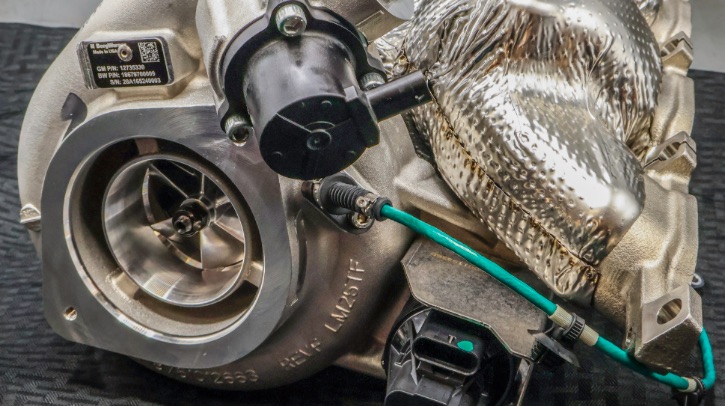
BorgWarner develops world’s largest twin turbo for Corvette ZR1.
Share
LinkedIn Twitter Facebook Email

As per an agreement, BorgWarner is to deliver its turbochargers for the Chevrolet Corvette ZR1. The twin turbo in question is the largest passenger car turbocharger in the world.

The turbos will be coupled with GM’s 5.5-liter flat-plane crankshaft V8 engine, producing 1,064hp and 828 lb-ft of torque (1,122Nm) in the Corvette ZR1. According to BorgWarner, GM’s decision to select its twin ball-bearing turbochargers was influenced by BorgWarner’s involvement in the NTT IndyCar Series.

The turbo features a 76mm forged milled compressor wheel with ported shroud and a 67mm turbine wheel inside a mono scroll turbine housing for maximum efficiency. The turbocharger integrates an exhaust manifold with equal-length runners to amplify engine performance and sound.

“We are proud to secure this contract and support General Motors in making the most powerful Corvette ever built. This technology has been in the works for some time now and to see it come to fruition is both exciting and fulfilling,” said Dr Volker Weng, vice president of BorgWarner Inc. and president and general manager of turbos and thermal technologies.

Thanks to a compressor-mounted blade pass speed sensor, Chevrolet can monitor the turbo’s operation, helping to achieve the best performance without compromising its health.  The turbo also makes use of a patented decoupled ball-bearing system for faster response time while limiting noise transmission and maximizing durability.

Designed and manufactured in the US, these turbochargers can withstand extremely high temperatures with zero-clearance heat shielding on the turbine housing to improve thermal efficiency. The turbochargers also feature an electronically actuated wastegate system for anti-lag calibration.

In homage to NASA’s Project Gemini missions in the 1960s and the astronauts’ relationship with the Corvette, the turbochargers feature a small Gemini rocket insignia cast on the face.

Share. LinkedIn Twitter Facebook Email

Related Posts

BorgWarner wins turbocharger contracts with two European OEMs

May 7, 2026

Horse begins production of HR13 engine at Curitiba plant

February 3, 2025

Dodge launches Hellephant A30 426 and Drag Pak 354 crate engines

October 31, 2024
LATEST NEWS

BYD enters UK eLCV market with Dolphin Cargo e-Van

May 29, 2026

TotalEnergies and Stellantis expand engine oil partnership

May 29, 2026

Mercedes‑AMG presents all-electric GT 4‑Door Coupe

May 21, 2026

Receive breaking stories and features in your inbox each week, for free


Enter your email address:


Supplier Spotlights
  • Flexible Circuit Technologies, Inc.
Featured Listings
  • There are currently no listings to show.
Getting in Touch
  • Contact Us
  • Media Pack
  • Meet the Editors
  • Free Weekly E-Newsletter
Our Social Channels
  • LinkedIn
Related UKi Topics
  • Automotive Interiors
  • Automotive Testing
  • Autonomous Vehicle
  • Professional Motorsport
  • Tire Technology
  • Media Pack
© 2026 UKi Media & Events a division of UKIP Media & Events Ltd
  • Terms and Conditions
  • Privacy Policy
  • Cookie Policy
  • Notice and Takedown Policy

Type above and press Enter to search. Press Esc to cancel.