

Close Menu
  • News
      • Appointments
      • EV Powertrain
      • Emissions
      • Engine Components
      • Electronics
      • Facility Developments
      • Forced Induction
      • Fuel Cell Technologies
      • Fuels & Lubricants
      • Heavy-duty & Diesel Engine Technologies
      • Hybrid Powertrain Technologies
      • Industry Forecasting
      • Legislation
      • Materials & Surface Treatment
      • Metallurgy
      • Mild-hybrid & 48V Technologies
      • New powertrain
      • Partnerships, Investments & Acquisitions
      • Quality Control
      • Prototyping
      • Sustainable fuels
      • Testing
      • Traction Control Systems
      • Transmissions Technologies
      • Webinars
  • Features
  • Online Magazines
    • April 2026
    • January 2026
    • September 2025
    • June 2025
    • March 2025
    • January 2025
    • September 2024
    • Subscribe to Automotive Powertrain Technology
    • Transmission Technology International
    • Subscribe to Transmission Technology
  • Opinion
  • Supplier Spotlight
  • Webinars
Facebook X (Twitter) Instagram
  • Automotive Interiors
  • Automotive Testing
  • Autonomous Vehicle
  • Professional Motorsport
  • Tire Technology
  • Media Pack
LinkedIn
Subscribe
Automotive Powertrain Technology International
  • News
      • Appointments
      • EV Powertrain
      • Emissions
      • Engine Components
      • Electronics
      • Facility Developments
      • Forced Induction
      • Fuel Cell Technologies
      • Fuels & Lubricants
      • Heavy-duty & Diesel Engine Technologies
      • Hybrid Powertrain Technologies
      • Industry Forecasting
      • Legislation
      • Materials & Surface Treatment
      • Metallurgy
      • Mild-hybrid & 48V Technologies
      • New powertrain
      • Partnerships, Investments & Acquisitions
      • Quality Control
      • Prototyping
      • Sustainable fuels
      • Testing
      • Traction Control Systems
      • Transmissions Technologies
      • Webinars
  • Features
  • Online Magazines
    1. April 2026
    2. January 2026
    3. September 2025
    4. June 2025
    5. March 2025
    6. January 2025
    7. September 2024
    8. Subscribe to Automotive Powertrain Technology
    9. Transmission Technology International
    10. Subscribe to Transmission Technology
    Featured

    In this Issue – April 2026

    By Web TeamMay 1, 2026
    Recent

    In this Issue – April 2026

    May 1, 2026

    In this Issue – January 2026

    December 3, 2025

    In this Issue – September 2025

    September 25, 2025
  • Opinion
  • Supplier Spotlight
  • Webinars
LinkedIn Facebook
Subscribe
Automotive Powertrain Technology International
Electric motors

Yasa unveils record-setting motor at core of in-wheel EV powertrain

Zahra AwanBy Zahra AwanDecember 5, 20253 Mins Read
LinkedIn Twitter Facebook Email
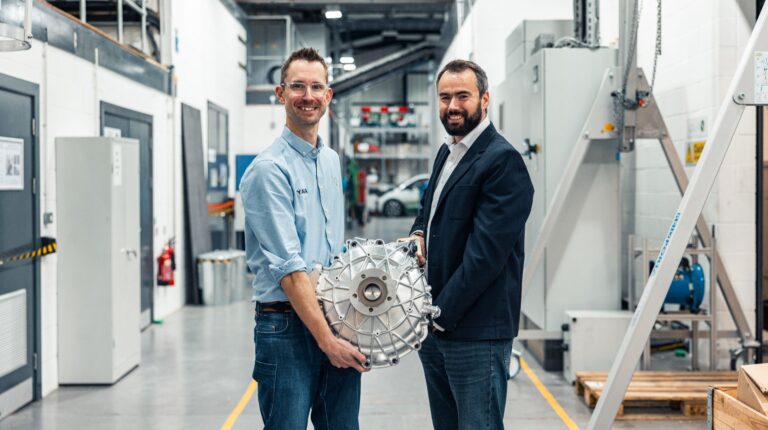
Tim Woolmer, founder and CTO, and Simon Odling, chief of new technology, Yasa, hold the prototype in-wheel electric powertrain system
Simon Odling, chief of new technology, and Tim Woolmer, founder and CTO, Yasa, hold the prototype in-wheel electric powertrain system
Share
LinkedIn Twitter Facebook Email

Yasa has revealed that the advanced electric motor that recently set an unofficial power-density record is the key component in its latest breakthrough – a state-of-the-art prototype in-wheel electric powertrain system.

“In-wheel motors are the major challenge and opportunity for EVs, but until now, technology has been too heavy, limited in torque and not powerful enough,” said Tim Woolmer, Yasa‘s founder and CTO. “This concept technology breakthrough is compact, powerful and light enough to be positioned inside the wheel of an EV, and it is the world’s first mass-neutral in-wheel motor, enabling up to 750kW (>1,000bhp) per wheel. Combined with a new Yasa-developed inverter, it results in a fully integrated prototype in-wheel electric vehicle powertrain, which will bring about a step change in weight reduction, performance and efficiency.”

Hitting a 750kW (>1,000bhp) peak in testing just a few months ago, Yasa’s prototype 12.7kg electric motor set an unofficial electric motor power-density world record of 59kW/kg, with the capability to also deliver all-important continuous power of 350-400kW (469-536bhp). Now it has been paired with a next-generation 15kg, 1,500kW, 100kW/kg Yasa-designed and developed dual inverter – another first, pushing control and power electronics beyond current state-of-the-art (50-70kW/kg) benchmarks. Yasa says its latest in-wheel electric powertrain, which is currently undergoing further testing and development, offers a host of game-changing benefits for future electric vehicles.

With its high regenerative capability, Yasa’s latest system is designed to enable substantial reduction – or possible removal– of rear braking components, including discs and driveshafts. This could reduce vehicle mass by around 200kg in modified existing platforms, with up to about 500kg possible in ground-up designs.

“Thanks to its exceptional regenerative capability, this system has the potential to dramatically downsize rear brakes on an EV – or even remove them entirely in certain architectures,” said Simon Odling, Yasa’s chief of new technology. “And by capturing a much greater proportion of regenerative braking energy, this technology can also deliver a significant increase in EV range. What’s more, our new in-wheel motor powertrain not only enables significantly lighter, more efficient and higher performance EVs, but also dramatically creates space within the architecture of an EV, giving car makers unprecedented freedom to redesign and optimize the packaging, aerodynamics and kinematics of their next-generation vehicles.”

Set to encompass a range of powertrains, from 750kW (>1,000bhp) to lower outputs, Yasa’s in-wheel technology is not just for ultra-powerful hypercars but for all performance EV applications. Compact, scalable and designed with cost efficiency in mind, a fully functional in-wheel prototype powertrain system has already been undergoing extensive development, with support from the Advanced Propulsion Centre in the UK.

“Our new in-wheel electric powertrain is a first for Yasa and another example of how we are continuing to push the electrification envelope,” said Jörg Miska, the CEO of Yasa. “Thanks to the combination of our world record-breaking power-dense motor and a new Yasa-designed and developed inverter, our revolutionary technology addresses the challenges of current existing in-wheel motor systems. It is the gateway to lighter, more efficient and higher-performance electric vehicles.”

Yasa says that further details on the development of the in-wheel powertrain will be shared in 2026.

In related news, Horse Powertrain supplies range extender for Scania electric timber truck pilot

Share. LinkedIn Twitter Facebook Email

Related Posts

Mercedes‑AMG presents all-electric GT 4‑Door Coupe

May 21, 2026

Jaguar reveals Type 01 electric four-door GT

May 21, 2026

Modular design strategy drives Hyundai Mobis electric power systems

May 14, 2026
LATEST NEWS

BYD enters UK eLCV market with Dolphin Cargo e-Van

May 29, 2026

TotalEnergies and Stellantis expand engine oil partnership

May 29, 2026

Mercedes‑AMG presents all-electric GT 4‑Door Coupe

May 21, 2026

Receive breaking stories and features in your inbox each week, for free


Enter your email address:


Supplier Spotlights
  • Robertshaw® Controls Company
Featured Listings
  • There are currently no listings to show.
Getting in Touch
  • Contact Us
  • Media Pack
  • Meet the Editors
  • Free Weekly E-Newsletter
Our Social Channels
  • LinkedIn
Related UKi Topics
  • Automotive Interiors
  • Automotive Testing
  • Autonomous Vehicle
  • Professional Motorsport
  • Tire Technology
  • Media Pack
© 2026 UKi Media & Events a division of UKIP Media & Events Ltd
  • Terms and Conditions
  • Privacy Policy
  • Cookie Policy
  • Notice and Takedown Policy

Type above and press Enter to search. Press Esc to cancel.