
Close Menu
  • News
      • Appointments
      • EV Powertrain
      • Emissions
      • Engine Components
      • Electronics
      • Facility Developments
      • Forced Induction
      • Fuel Cell Technologies
      • Fuels & Lubricants
      • Heavy-duty & Diesel Engine Technologies
      • Hybrid Powertrain Technologies
      • Industry Forecasting
      • Legislation
      • Materials & Surface Treatment
      • Metallurgy
      • Mild-hybrid & 48V Technologies
      • New powertrain
      • Partnerships, Investments & Acquisitions
      • Quality Control
      • Prototyping
      • Sustainable fuels
      • Testing
      • Traction Control Systems
      • Transmissions Technologies
      • Webinars
  • Features
  • Online Magazines
    • April 2026
    • January 2026
    • September 2025
    • June 2025
    • March 2025
    • January 2025
    • September 2024
    • Subscribe to Automotive Powertrain Technology
    • Transmission Technology International
    • Subscribe to Transmission Technology
  • Opinion
  • Events
  • Supplier Spotlight
  • Webinars
Facebook X (Twitter) Instagram
  • Automotive Interiors
  • Automotive Testing
  • Autonomous Vehicle
  • Professional Motorsport
  • Tire Technology
  • Media Pack
LinkedIn
Subscribe
Automotive Powertrain Technology International
  • News
      • Appointments
      • EV Powertrain
      • Emissions
      • Engine Components
      • Electronics
      • Facility Developments
      • Forced Induction
      • Fuel Cell Technologies
      • Fuels & Lubricants
      • Heavy-duty & Diesel Engine Technologies
      • Hybrid Powertrain Technologies
      • Industry Forecasting
      • Legislation
      • Materials & Surface Treatment
      • Metallurgy
      • Mild-hybrid & 48V Technologies
      • New powertrain
      • Partnerships, Investments & Acquisitions
      • Quality Control
      • Prototyping
      • Sustainable fuels
      • Testing
      • Traction Control Systems
      • Transmissions Technologies
      • Webinars
  • Features
  • Online Magazines
    1. April 2026
    2. January 2026
    3. September 2025
    4. June 2025
    5. March 2025
    6. January 2025
    7. September 2024
    8. Subscribe to Automotive Powertrain Technology
    9. Transmission Technology International
    10. Subscribe to Transmission Technology
    Featured

    In this Issue – April 2026

    By Web TeamMay 1, 2026
    Recent

    In this Issue – April 2026

    May 1, 2026

    In this Issue – January 2026

    December 3, 2025

    In this Issue – September 2025

    September 25, 2025
  • Opinion
  • Events
  • Supplier Spotlight
  • Webinars
LinkedIn Facebook
Subscribe
Automotive Powertrain Technology International
Engine Components

Freudenberg Sealing Technologies presents sealing solution for EV power electronics

Mark SmythBy Mark SmythSeptember 22, 20233 Mins Read
LinkedIn Twitter Facebook Email
Share
LinkedIn Twitter Facebook Email

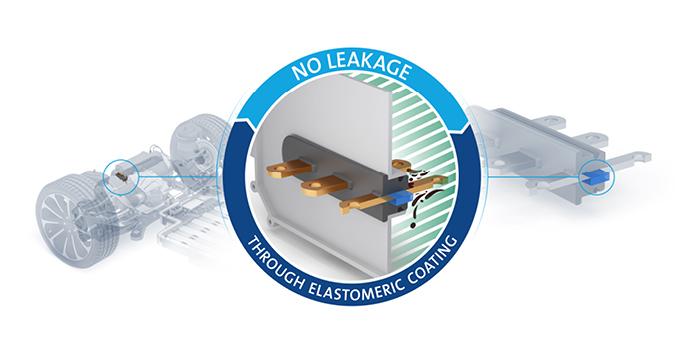
Freudenberg Sealing Technologies used the recent Battery Show in Detroit, Michigan, to launch an impermeable rectangular busbar overmold that helps prevent damage to an electric vehicle’s (EV) power electronics. The company says its new solution also reduces assembly complexity by combining the busbars, seal and guide in one complete package that is ready for installation on a vehicle assembly line.

“We are proud to offer our customers a solution that is not only technically advanced, but also saves time and space, and is cost efficient,” said Parisa Burger, business development manager and project manager at the company. “This solution provides a wide range of benefits and application options. In particular, the inverter’s sensitive power electronics can now be reliably protected from liquids originating from the electric motor.”

Oil-cooled electric motors are commonly employed in various EVs. To maintain reliable vehicle operations, it is crucial to protect sensitive power electronics within the inverter from exposure to motor oil by sealing around the busbar motor/inverter interface. Additionally, other electrical busbars with rectangular geometries, like those found in immersion cooled batteries and oil pumps, also require sealing along their metallic cables. This necessity underscores the importance of establishing a permanent seal for the current-carrying rectangular conductors, often referred to as ‘busbars’.

However, achieving tight seals with busbars with rectangular geometries poses challenges. Traditional busbars are die-cut from copper or aluminum sheets and then bent to the desired shape. The resulting rectangular busbar is not ideal for standard sealing, as the corners prevent effective compression of the sealing material. Even attempts to enhance the contact surface with partially embossed edges or press-on structures might not yield satisfactory sealing results. Post-processing methods like potting can be used but are time-consuming and impractical for large-scale industrial applications. They also require additional space, limiting busbar design flexibility.

The company’s recently patented, sealed, rectangular busbar overmold includes an elastomeric layer, which is applied to the rectangular busbar and bonds firmly with the metallic conductor and the surrounding plastic later in the manufacturing process.

“Sealing rectangular shapes is considered the pinnacle in sealing technology, as leakage points often occur in the corners,” said Burger. “Thanks to an elastomer layer between the metal and plastic we can now produce sealed busbars – and in a way that saves valuable space, as component and seal virtually become one. This new solution enables our customers to seal their busbars even more reliably, while at the same time offering a high degree of design latitude.”

The new busbar seal configuration enables an impermeable bond to be created by chemically pretreating the conductor surface with a primer and applying a special elastomeric coating. This creates a firmly bonded intermediate layer, which is followed by thermoplastic injection molding. The elastic material should preferably be based on vulcanizable elastomers such as FKM, AEM, ACM, HNBR, NBR, EPDM, but thermoplastic elastomers (TPE) can also be used.

At the same time, the flexible coating reduces stress on the threshold between the copper and the thermoplastic matrix. The elastic coating reduces the notch effect at the conductor edges, which minimizes the susceptibility of the electronic component to stress cracking.

Share. LinkedIn Twitter Facebook Email

Related Posts

BorgWarner wins turbocharger contracts with two European OEMs

May 7, 2026

New chassis and powertrain event to launch at Vehicle Tech Week North America 2026

May 6, 2026

Evonik opens lab to develop EV motor materials for Asia-Pacific market

April 30, 2026
LATEST NEWS

Renault introduces LPG bi-fuel Clio that delivers up to 1,450km range

May 7, 2026

UK consortium secures funding for ReCAM lithium-ion battery recycling project

May 7, 2026

BorgWarner wins turbocharger contracts with two European OEMs

May 7, 2026

Receive breaking stories and features in your inbox each week, for free


Enter your email address:


Supplier Spotlights
  • ECONAMIQ
Featured Listings
  • There are currently no listings to show.
Getting in Touch
  • Contact Us
  • Media Pack
  • Meet the Editors
  • Free Weekly E-Newsletter
Our Social Channels
  • LinkedIn
Related UKi Topics
  • Automotive Interiors
  • Automotive Testing
  • Autonomous Vehicle
  • Professional Motorsport
  • Tire Technology
  • Media Pack
© 2026 UKi Media & Events a division of UKIP Media & Events Ltd
  • Terms and Conditions
  • Privacy Policy
  • Cookie Policy
  • Notice and Takedown Policy

Type above and press Enter to search. Press Esc to cancel.