

Close Menu
  • News
      • Appointments
      • EV Powertrain
      • Emissions
      • Engine Components
      • Electronics
      • Facility Developments
      • Forced Induction
      • Fuel Cell Technologies
      • Fuels & Lubricants
      • Heavy-duty & Diesel Engine Technologies
      • Hybrid Powertrain Technologies
      • Industry Forecasting
      • Legislation
      • Materials & Surface Treatment
      • Metallurgy
      • Mild-hybrid & 48V Technologies
      • New powertrain
      • Partnerships, Investments & Acquisitions
      • Quality Control
      • Prototyping
      • Sustainable fuels
      • Testing
      • Traction Control Systems
      • Transmissions Technologies
      • Webinars
  • Features
  • Online Magazines
    • April 2026
    • January 2026
    • September 2025
    • June 2025
    • March 2025
    • January 2025
    • September 2024
    • Subscribe to Automotive Powertrain Technology
    • Transmission Technology International
    • Subscribe to Transmission Technology
  • Opinion
  • Supplier Spotlight
  • Webinars
Facebook X (Twitter) Instagram
  • Automotive Interiors
  • Automotive Testing
  • Autonomous Vehicle
  • Professional Motorsport
  • Tire Technology
  • Media Pack
LinkedIn
Subscribe
Automotive Powertrain Technology International
  • News
      • Appointments
      • EV Powertrain
      • Emissions
      • Engine Components
      • Electronics
      • Facility Developments
      • Forced Induction
      • Fuel Cell Technologies
      • Fuels & Lubricants
      • Heavy-duty & Diesel Engine Technologies
      • Hybrid Powertrain Technologies
      • Industry Forecasting
      • Legislation
      • Materials & Surface Treatment
      • Metallurgy
      • Mild-hybrid & 48V Technologies
      • New powertrain
      • Partnerships, Investments & Acquisitions
      • Quality Control
      • Prototyping
      • Sustainable fuels
      • Testing
      • Traction Control Systems
      • Transmissions Technologies
      • Webinars
  • Features
  • Online Magazines
    1. April 2026
    2. January 2026
    3. September 2025
    4. June 2025
    5. March 2025
    6. January 2025
    7. September 2024
    8. Subscribe to Automotive Powertrain Technology
    9. Transmission Technology International
    10. Subscribe to Transmission Technology
    Featured

    In this Issue – April 2026

    By Web TeamMay 1, 2026
    Recent

    In this Issue – April 2026

    May 1, 2026

    In this Issue – January 2026

    December 3, 2025

    In this Issue – September 2025

    September 25, 2025
  • Opinion
  • Supplier Spotlight
  • Webinars
LinkedIn Facebook
Subscribe
Automotive Powertrain Technology International
Electric Powertrain Technologies

VisIC Technologies demonstrates efficient gallium nitride-based three-phase traction inverter with an automotive-grade PMSM motor

Callum Brook-JonesBy Callum Brook-JonesFebruary 15, 20232 Mins Read
LinkedIn Twitter Facebook Email
Share
LinkedIn Twitter Facebook Email

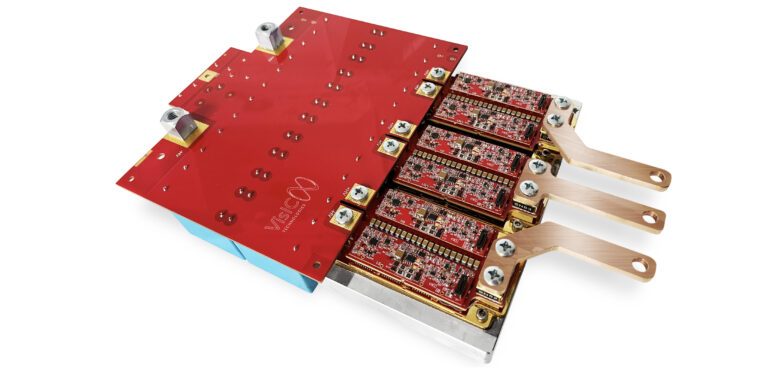
A 2.2mΩ 650V half-bridge power module, consisting of four parallel 8mΩ power FETs has been successfully tested by VisIC Technologies in a three-phase configuration on a dyno test bench using a PMSM motor at a major automotive OEM’s facility.

By conducting the test, VisIC Technologies has proved that its Direct Drive D-Mode Gallium-Nitride (D³GaN) semiconductor technology is well-suited for high-power automotive applications. Furthermore, additional concerns about parallelization and oscillations caused by fast-switching transients have also been addressed.

The inverter phase current reached 350Arms (500A peak) at 400V, although test system setup limitations prevented higher currents, which the 2.2mΩ power module can handle.

Worldwide Harmonized Light Vehicles Test Procedure driving cycle testing was carried out and achieved comparable efficiency with commercial silicon carbide-based modules, despite using early non-optimized module prototypes. As a result, the company’s D³GaN can provide the highest efficiency to improve vehicle costs due to lighter and more compact power systems with a smaller battery size, without compromising the driving range. Furthermore, VisIC Technologies’ D³GaN (which is based on the GaN-on-silicon semiconductor process) is providing a performance level that is better than silicon carbide (SiC) at a more competitive silicon cost level.

“With this great accomplishment, acknowledged by a leading automotive OEM, VisIC Technologies has provided overwhelming evidence for higher-efficiency at lower-cost future EV traction inverters for the automotive world,” said Dr Tamara Baksht, CEO and co-founder of VisIC Technologies. “The automotive market demands high-power, high-voltage, high-reliability GaN, and our D3GaN die and module solutions are the answer.”

Share. LinkedIn Twitter Facebook Email

Related Posts

Ferrari unveils all-electric Luce

May 29, 2026

BYD enters UK eLCV market with Dolphin Cargo e-Van

May 29, 2026

Mercedes‑AMG presents all-electric GT 4‑Door Coupe

May 21, 2026
LATEST NEWS

Ferrari unveils all-electric Luce

May 29, 2026

Scania under-cab battery module and Megawatt Charging System available for order

May 29, 2026

Maserati Nettuno engine transformed into 480kW hydrogen race unit

May 29, 2026

Receive breaking stories and features in your inbox each week, for free


Enter your email address:


Supplier Spotlights
  • Robertshaw® Controls Company
Featured Listings
  • There are currently no listings to show.
Getting in Touch
  • Contact Us
  • Media Pack
  • Meet the Editors
  • Free Weekly E-Newsletter
Our Social Channels
  • LinkedIn
Related UKi Topics
  • Automotive Interiors
  • Automotive Testing
  • Autonomous Vehicle
  • Professional Motorsport
  • Tire Technology
  • Media Pack
© 2026 UKi Media & Events a division of UKIP Media & Events Ltd
  • Terms and Conditions
  • Privacy Policy
  • Cookie Policy
  • Notice and Takedown Policy

Type above and press Enter to search. Press Esc to cancel.