

Close Menu
  • News
      • Appointments
      • EV Powertrain
      • Emissions
      • Engine Components
      • Electronics
      • Facility Developments
      • Forced Induction
      • Fuel Cell Technologies
      • Fuels & Lubricants
      • Heavy-duty & Diesel Engine Technologies
      • Hybrid Powertrain Technologies
      • Industry Forecasting
      • Legislation
      • Materials & Surface Treatment
      • Metallurgy
      • Mild-hybrid & 48V Technologies
      • New powertrain
      • Partnerships, Investments & Acquisitions
      • Quality Control
      • Prototyping
      • Sustainable fuels
      • Testing
      • Traction Control Systems
      • Transmissions Technologies
      • Webinars
  • Features
  • Online Magazines
    • April 2026
    • January 2026
    • September 2025
    • June 2025
    • March 2025
    • January 2025
    • September 2024
    • Subscribe to Automotive Powertrain Technology
    • Transmission Technology International
    • Subscribe to Transmission Technology
  • Opinion
  • Events
  • Supplier Spotlight
  • Webinars
Facebook X (Twitter) Instagram
  • Automotive Interiors
  • Automotive Testing
  • Autonomous Vehicle
  • Professional Motorsport
  • Tire Technology
  • Media Pack
LinkedIn
Subscribe
Automotive Powertrain Technology International
  • News
      • Appointments
      • EV Powertrain
      • Emissions
      • Engine Components
      • Electronics
      • Facility Developments
      • Forced Induction
      • Fuel Cell Technologies
      • Fuels & Lubricants
      • Heavy-duty & Diesel Engine Technologies
      • Hybrid Powertrain Technologies
      • Industry Forecasting
      • Legislation
      • Materials & Surface Treatment
      • Metallurgy
      • Mild-hybrid & 48V Technologies
      • New powertrain
      • Partnerships, Investments & Acquisitions
      • Quality Control
      • Prototyping
      • Sustainable fuels
      • Testing
      • Traction Control Systems
      • Transmissions Technologies
      • Webinars
  • Features
  • Online Magazines
    1. April 2026
    2. January 2026
    3. September 2025
    4. June 2025
    5. March 2025
    6. January 2025
    7. September 2024
    8. Subscribe to Automotive Powertrain Technology
    9. Transmission Technology International
    10. Subscribe to Transmission Technology
    Featured

    In this Issue – April 2026

    By Web TeamMay 1, 2026
    Recent

    In this Issue – April 2026

    May 1, 2026

    In this Issue – January 2026

    December 3, 2025

    In this Issue – September 2025

    September 25, 2025
  • Opinion
  • Events
  • Supplier Spotlight
  • Webinars
LinkedIn Facebook
Subscribe
Automotive Powertrain Technology International
Electric Powertrain Technologies

Hyundai harnesses active aero to push EV efficiency

Lawrence ButcherBy Lawrence ButcherJanuary 23, 20242 Mins Read
LinkedIn Twitter Facebook Email
Share
LinkedIn Twitter Facebook Email

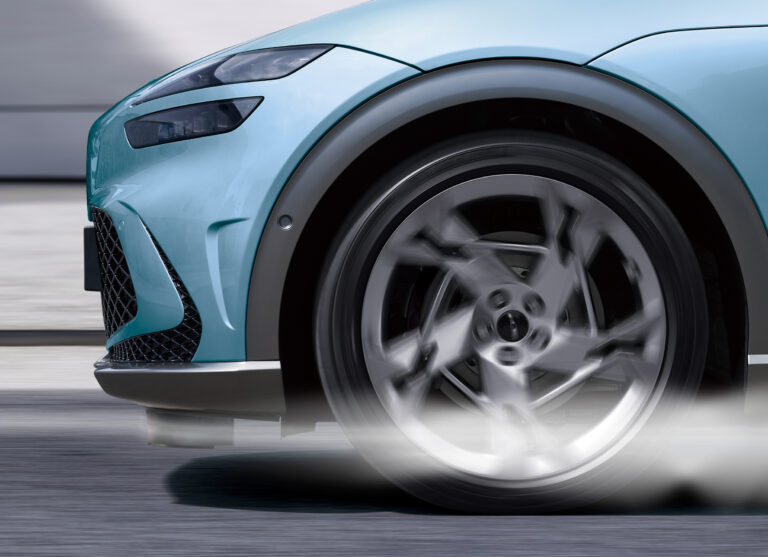
Efficiency is king in the world of BEVs, as witnessed by Hyundai’s recent unveiling of its Active Air Skirt (AAS) system, an active drag reduction system.

It is intended to control the flow of air entering the lower bumper area to control turbulence around the front wheels depending on speed. The AAS is installed between the front bumper and the front wheels of the vehicle and is hidden during normal operation. It comes into operation at speeds over 80km/h when the aerodynamic resistance becomes greater than the rolling resistance, and is stowed again at 70km/h. The reason for the difference in deployment and storage speeds is to prevent frequent operation in this transient area.

The AAS only covers the front part of the tires without shrouding the entire front of the vehicle, due to the flat floor layout of Hyundai’s E-GMP chassis. According to Hyundai, this layout also helps reduce lift, thereby improving vehicle traction and high-speed stability.

AAS can operate at speeds of over 200km/h thanks to the use of a rubber material on the lower part, which reduces the risk of damage due to road debris.

During testing, the device was shown to reduce the drag coefficient (Cd) by 0.008, improving drag by 2.8% when fitted to a Genesis GV60. This equates to an expected range improvement of about 6km.

“This technology is expected to have a greater effect on models such as SUVs where it is difficult to improve aerodynamic performance,” said Sun Hyung Cho, VP and head of the Mobility Body Development Group at Hyundai. “We will continue to strive to improve the driving performance and stability of electric vehicles through improvements in aerodynamics.”

The system will work in unison with other aerodynamic devices already in use by Hyundai, such as rear spoilers, active air flaps, wheel air curtains, wheel gap reducers and separation traps.

For more electric powertrain technologies news, please click here.

Share. LinkedIn Twitter Facebook Email

Related Posts

New chassis and powertrain event to launch at Vehicle Tech Week North America 2026

May 6, 2026

AI-defined vehicles and expanded electrification shape Nissan’s future mobility strategy

April 20, 2026

Nissan launches electric Juke

April 16, 2026
LATEST NEWS

Renault introduces LPG bi-fuel Clio that delivers up to 1,450km range

May 7, 2026

UK consortium secures funding for ReCAM lithium-ion battery recycling project

May 7, 2026

BorgWarner wins turbocharger contracts with two European OEMs

May 7, 2026

Receive breaking stories and features in your inbox each week, for free


Enter your email address:


Supplier Spotlights
  • The Institute for Advanced Automotive Propulsion Systems
Featured Listings
  • There are currently no listings to show.
Getting in Touch
  • Contact Us
  • Media Pack
  • Meet the Editors
  • Free Weekly E-Newsletter
Our Social Channels
  • LinkedIn
Related UKi Topics
  • Automotive Interiors
  • Automotive Testing
  • Autonomous Vehicle
  • Professional Motorsport
  • Tire Technology
  • Media Pack
© 2026 UKi Media & Events a division of UKIP Media & Events Ltd
  • Terms and Conditions
  • Privacy Policy
  • Cookie Policy
  • Notice and Takedown Policy

Type above and press Enter to search. Press Esc to cancel.