

Close Menu
  • News
      • Appointments
      • EV Powertrain
      • Emissions
      • Engine Components
      • Electronics
      • Facility Developments
      • Forced Induction
      • Fuel Cell Technologies
      • Fuels & Lubricants
      • Heavy-duty & Diesel Engine Technologies
      • Hybrid Powertrain Technologies
      • Industry Forecasting
      • Legislation
      • Materials & Surface Treatment
      • Metallurgy
      • Mild-hybrid & 48V Technologies
      • New powertrain
      • Partnerships, Investments & Acquisitions
      • Quality Control
      • Prototyping
      • Sustainable fuels
      • Testing
      • Traction Control Systems
      • Transmissions Technologies
      • Webinars
  • Features
  • Online Magazines
    • April 2026
    • January 2026
    • September 2025
    • June 2025
    • March 2025
    • January 2025
    • September 2024
    • Subscribe to Automotive Powertrain Technology
    • Transmission Technology International
    • Subscribe to Transmission Technology
  • Opinion
  • Supplier Spotlight
  • Webinars
Facebook X (Twitter) Instagram
  • Automotive Interiors
  • Automotive Testing
  • Autonomous Vehicle
  • Professional Motorsport
  • Tire Technology
  • Media Pack
LinkedIn
Subscribe
Automotive Powertrain Technology International
  • News
      • Appointments
      • EV Powertrain
      • Emissions
      • Engine Components
      • Electronics
      • Facility Developments
      • Forced Induction
      • Fuel Cell Technologies
      • Fuels & Lubricants
      • Heavy-duty & Diesel Engine Technologies
      • Hybrid Powertrain Technologies
      • Industry Forecasting
      • Legislation
      • Materials & Surface Treatment
      • Metallurgy
      • Mild-hybrid & 48V Technologies
      • New powertrain
      • Partnerships, Investments & Acquisitions
      • Quality Control
      • Prototyping
      • Sustainable fuels
      • Testing
      • Traction Control Systems
      • Transmissions Technologies
      • Webinars
  • Features
  • Online Magazines
    1. April 2026
    2. January 2026
    3. September 2025
    4. June 2025
    5. March 2025
    6. January 2025
    7. September 2024
    8. Subscribe to Automotive Powertrain Technology
    9. Transmission Technology International
    10. Subscribe to Transmission Technology
    Featured

    In this Issue – April 2026

    By Web TeamMay 1, 2026
    Recent

    In this Issue – April 2026

    May 1, 2026

    In this Issue – January 2026

    December 3, 2025

    In this Issue – September 2025

    September 25, 2025
  • Opinion
  • Supplier Spotlight
  • Webinars
LinkedIn Facebook
Subscribe
Automotive Powertrain Technology International
Electric Powertrain Technologies

Breakthrough massless battery solution from Chalmers University of Technology

Callum Brook-JonesBy Callum Brook-JonesMarch 23, 20213 Mins Read
LinkedIn Twitter Facebook Email
Share
LinkedIn Twitter Facebook Email

Chalmers University of Technology in Gothenburg, Sweden, has announced the production of a structural battery that performs 10 times better that previous versions.

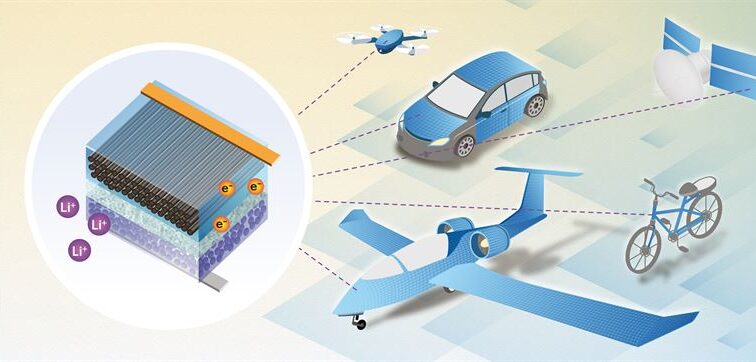
The newly designed battery contains carbon fiber material that acts as an electrode, a load-bearing material and also a conductor. The latest technology from the university could see ‘massless’ energy storage being introduced to vehicles and other sectors.

Unlike traditional batteries found in vehicles that contribute to an increase in weight, massless batteries are defined as a structural battery that can provide both power to the proposed vehicle and also be part of the vehicle’s structure. In turn, this causes weight to be lost as it becomes part of the automobile’s load-bearing structure. Research has shown that manufacturers and OEMs adopting this battery type could greatly reduce EV weight.

Structural batteries were first made in 2007 but production and development faced multiple hurdles in terms of creating a power source that had good mechanical and electrical attributes. Following years of research, Chalmers University has concluded that carbon fiber has the correct qualities for use in massless batteries due to the material’s ability to store electrical energy chemically while also being strong enough to use as part of a structure.

Researchers at Chalmers, who worked in collaboration with the KTH Royal Institute of Technology in Stockholm, have announced that the massless battery has improved electrical energy storage, stiffness and strength compared with battery predecessors, and stated that the power source has a multifunctional performance 10 times higher than other structural battery prototypes.

At present, the new battery has an energy density of 24Wh/kg, around 20% of the capacity of a current lithium-ion battery. Due to the weight reduction however, less energy is required to propel an electric vehicle when a massless battery is fitted. Stiffness of the unit is measured at 25GPa making it a viable option for creating a sturdy and safe vehicle architecture. Inside the unit, carbon fiber makes up the negative electrode, and lithium-iron phosphate-coated aluminum foil is used for the positive electrode. These are then separated by a fiberglass fabric in an electrolyte matrix.

“Previous attempts to make structural batteries have resulted in cells with either good mechanical properties, or good electrical properties,” commented Leif Asp, professor at Chalmers and leader of the battery project. “But here, using carbon fiber, we have succeeded in designing a structural battery with both competitive energy storage capacity and rigidity.”

Following the success of the current project, a new project financed by the Swedish National Space Agency will seek to improve massless battery performance again by replacing the positive electrode with carbon fiber to increase energy density and stiffness. The fiberglass separator will also be replaced with a revised thinner version to aim at reducing charge time. Asp estimates that an energy density of 75WH/kg and a stiffness of 75GPa may be achieved, making the unit as strong as aluminum.

“The next generation structural battery has fantastic potential. If you look at consumer technology, it could be quite possible within a few years to manufacture smartphones, laptops or electric bicycles that weigh half as much as today and are much more compact,” said Asp.

“We are really only limited by our imaginations here. We have received a lot of attention from many different types of companies in connection with the publication of our scientific articles in the field. There is understandably a great amount of interest in these lightweight, multifunctional materials.”

Share. LinkedIn Twitter Facebook Email

Related Posts

New chassis and powertrain event to launch at Vehicle Tech Week North America 2026

May 6, 2026

BorgWarner secures long-term supply agreement with off-highway OEM

April 23, 2026

Project Cavendish: Mahle hydrogen-fueled 13-liter engine matches diesel performance

April 23, 2026
LATEST NEWS

Renault introduces LPG bi-fuel Clio that delivers up to 1,450km range

May 7, 2026

UK consortium secures funding for ReCAM lithium-ion battery recycling project

May 7, 2026

BorgWarner wins turbocharger contracts with two European OEMs

May 7, 2026

Receive breaking stories and features in your inbox each week, for free


Enter your email address:


Supplier Spotlights
  • TLX Technologies
Featured Listings
  • There are currently no listings to show.
Getting in Touch
  • Contact Us
  • Media Pack
  • Meet the Editors
  • Free Weekly E-Newsletter
Our Social Channels
  • LinkedIn
Related UKi Topics
  • Automotive Interiors
  • Automotive Testing
  • Autonomous Vehicle
  • Professional Motorsport
  • Tire Technology
  • Media Pack
© 2026 UKi Media & Events a division of UKIP Media & Events Ltd
  • Terms and Conditions
  • Privacy Policy
  • Cookie Policy
  • Notice and Takedown Policy

Type above and press Enter to search. Press Esc to cancel.