

Close Menu
  • News
      • Appointments
      • EV Powertrain
      • Emissions
      • Engine Components
      • Electronics
      • Facility Developments
      • Forced Induction
      • Fuel Cell Technologies
      • Fuels & Lubricants
      • Heavy-duty & Diesel Engine Technologies
      • Hybrid Powertrain Technologies
      • Industry Forecasting
      • Legislation
      • Materials & Surface Treatment
      • Metallurgy
      • Mild-hybrid & 48V Technologies
      • New powertrain
      • Partnerships, Investments & Acquisitions
      • Quality Control
      • Prototyping
      • Sustainable fuels
      • Testing
      • Traction Control Systems
      • Transmissions Technologies
      • Webinars
  • Features
  • Online Magazines
    • April 2026
    • January 2026
    • September 2025
    • June 2025
    • March 2025
    • January 2025
    • September 2024
    • Subscribe to Automotive Powertrain Technology
    • Transmission Technology International
    • Subscribe to Transmission Technology
  • Opinion
  • Events
  • Supplier Spotlight
  • Webinars
Facebook X (Twitter) Instagram
  • Automotive Interiors
  • Automotive Testing
  • Autonomous Vehicle
  • Professional Motorsport
  • Tire Technology
  • Media Pack
LinkedIn
Subscribe
Automotive Powertrain Technology International
  • News
      • Appointments
      • EV Powertrain
      • Emissions
      • Engine Components
      • Electronics
      • Facility Developments
      • Forced Induction
      • Fuel Cell Technologies
      • Fuels & Lubricants
      • Heavy-duty & Diesel Engine Technologies
      • Hybrid Powertrain Technologies
      • Industry Forecasting
      • Legislation
      • Materials & Surface Treatment
      • Metallurgy
      • Mild-hybrid & 48V Technologies
      • New powertrain
      • Partnerships, Investments & Acquisitions
      • Quality Control
      • Prototyping
      • Sustainable fuels
      • Testing
      • Traction Control Systems
      • Transmissions Technologies
      • Webinars
  • Features
  • Online Magazines
    1. April 2026
    2. January 2026
    3. September 2025
    4. June 2025
    5. March 2025
    6. January 2025
    7. September 2024
    8. Subscribe to Automotive Powertrain Technology
    9. Transmission Technology International
    10. Subscribe to Transmission Technology
    Featured

    In this Issue – April 2026

    By Web TeamMay 1, 2026
    Recent

    In this Issue – April 2026

    May 1, 2026

    In this Issue – January 2026

    December 3, 2025

    In this Issue – September 2025

    September 25, 2025
  • Opinion
  • Events
  • Supplier Spotlight
  • Webinars
LinkedIn Facebook
Subscribe
Automotive Powertrain Technology International
Battery technology

FEV and ProLogium develop advanced vehicle battery

Adithya GopalBy Adithya GopalDecember 6, 20242 Mins Read
LinkedIn Twitter Facebook Email
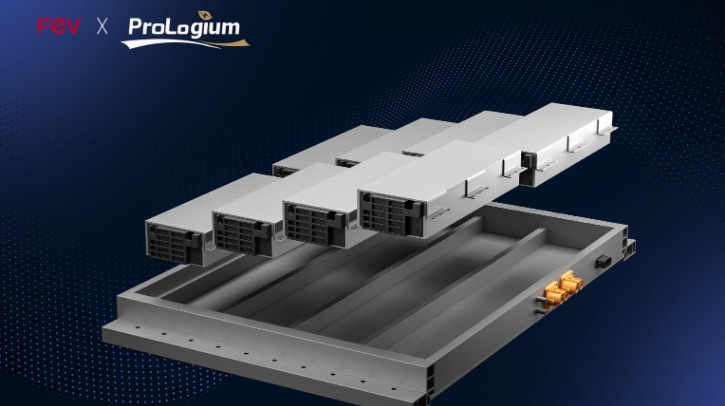
FEV and ProLogium develops advanced vehicle battery.
Share
LinkedIn Twitter Facebook Email

A new vehicle battery that offers 10 times more capacity density and weight savings than a conventional battery has been debuted by FEV and ProLogium.

It uses LLCB technology (large-footprint lithium ceramic battery) featuring an anode made of 100% silicon composite material. Depending on the vehicle segment, the LLCB allows weight savings of up to 300kg or a maximum range of 1,000km. In contrast to current liquid electrolytes, the solid-state electrolyte is non-flammable and guards against thermal runaway. It also prevents potential short circuits caused by leaking electrolyte fluid in the event of a spill.

“For the LLCB solution, we have successfully combined ProLogium’s know-how in the field of cell development with our development, system and testing expertise,” said Dr Thomas Hülshorst, global vice president of electric powertrain at FEV.

Compared with current fast charging intervals of around 30 minutes, the silicon anode enables ultra-fast charging, reducing the charging time by over 80%. This means the battery can be charged from 5% to 60% within five minutes, providing a range of 300km. After a further three minutes, the battery can be charged to 80% and cover an additional 100km. In this way, the LLCB claims to bring charging times closer to the duration of a refueling process.

Another highlight of the new battery is its slim cell shape, which can result in space-saving designs, opening additional options for OEMs. “The modular design of the battery also makes maintenance much easier, saves costs and allows individual cells to be replaced and recycled,” said Hülshorst.

Share. LinkedIn Twitter Facebook Email

Related Posts

Gen6 battery cell technology reduces BMW’s CO₂e footprint

April 16, 2026

Advanced cylindrical cell battery technology powers next-generation electric BMW i7

April 7, 2026

University of Surrey develops lithium-ion battery anode that delivers increased energy storage

April 1, 2026
LATEST NEWS

Renault introduces LPG bi-fuel Clio that delivers up to 1,450km range

May 7, 2026

UK consortium secures funding for ReCAM lithium-ion battery recycling project

May 7, 2026

BorgWarner wins turbocharger contracts with two European OEMs

May 7, 2026

Receive breaking stories and features in your inbox each week, for free


Enter your email address:


Supplier Spotlights
  • Hillcrest
Featured Listings
  • There are currently no listings to show.
Getting in Touch
  • Contact Us
  • Media Pack
  • Meet the Editors
  • Free Weekly E-Newsletter
Our Social Channels
  • LinkedIn
Related UKi Topics
  • Automotive Interiors
  • Automotive Testing
  • Autonomous Vehicle
  • Professional Motorsport
  • Tire Technology
  • Media Pack
© 2026 UKi Media & Events a division of UKIP Media & Events Ltd
  • Terms and Conditions
  • Privacy Policy
  • Cookie Policy
  • Notice and Takedown Policy

Type above and press Enter to search. Press Esc to cancel.