

Close Menu
  • News
      • Appointments
      • EV Powertrain
      • Emissions
      • Engine Components
      • Electronics
      • Facility Developments
      • Forced Induction
      • Fuel Cell Technologies
      • Fuels & Lubricants
      • Heavy-duty & Diesel Engine Technologies
      • Hybrid Powertrain Technologies
      • Industry Forecasting
      • Legislation
      • Materials & Surface Treatment
      • Metallurgy
      • Mild-hybrid & 48V Technologies
      • New powertrain
      • Partnerships, Investments & Acquisitions
      • Quality Control
      • Prototyping
      • Sustainable fuels
      • Testing
      • Traction Control Systems
      • Transmissions Technologies
      • Webinars
  • Features
  • Online Magazines
    • April 2026
    • January 2026
    • September 2025
    • June 2025
    • March 2025
    • January 2025
    • September 2024
    • Subscribe to Automotive Powertrain Technology
    • Transmission Technology International
    • Subscribe to Transmission Technology
  • Opinion
  • Supplier Spotlight
  • Webinars
Facebook X (Twitter) Instagram
  • Automotive Interiors
  • Automotive Testing
  • Autonomous Vehicle
  • Professional Motorsport
  • Tire Technology
  • Media Pack
LinkedIn
Subscribe
Automotive Powertrain Technology International
  • News
      • Appointments
      • EV Powertrain
      • Emissions
      • Engine Components
      • Electronics
      • Facility Developments
      • Forced Induction
      • Fuel Cell Technologies
      • Fuels & Lubricants
      • Heavy-duty & Diesel Engine Technologies
      • Hybrid Powertrain Technologies
      • Industry Forecasting
      • Legislation
      • Materials & Surface Treatment
      • Metallurgy
      • Mild-hybrid & 48V Technologies
      • New powertrain
      • Partnerships, Investments & Acquisitions
      • Quality Control
      • Prototyping
      • Sustainable fuels
      • Testing
      • Traction Control Systems
      • Transmissions Technologies
      • Webinars
  • Features
  • Online Magazines
    1. April 2026
    2. January 2026
    3. September 2025
    4. June 2025
    5. March 2025
    6. January 2025
    7. September 2024
    8. Subscribe to Automotive Powertrain Technology
    9. Transmission Technology International
    10. Subscribe to Transmission Technology
    Featured

    In this Issue – April 2026

    By Web TeamMay 1, 2026
    Recent

    In this Issue – April 2026

    May 1, 2026

    In this Issue – January 2026

    December 3, 2025

    In this Issue – September 2025

    September 25, 2025
  • Opinion
  • Supplier Spotlight
  • Webinars
LinkedIn Facebook
Subscribe
Automotive Powertrain Technology International
Features

Supplier insight: Bearing optimization

Lawrence ButcherBy Lawrence ButcherNovember 17, 20233 Mins Read
LinkedIn Twitter Facebook Email
Share
LinkedIn Twitter Facebook Email

Rolling bearings are indispensable in all fields of mechanical engineering, enabling precise, low-friction and cost-effective solutions for rotating components. The standard for calculating bearing service life is ISO/TS 16281, which assumes an ideal raceway geometry with perfect alignment – a theoretical scenario that is rarely seen in practice. In reality, geometric deviations from manufacturing and assembly are expressed as a static distribution. Furthermore, the loads can cause deformations during operation, which influence the operating behavior of the bearings.

Reliable calculation of bearing service life
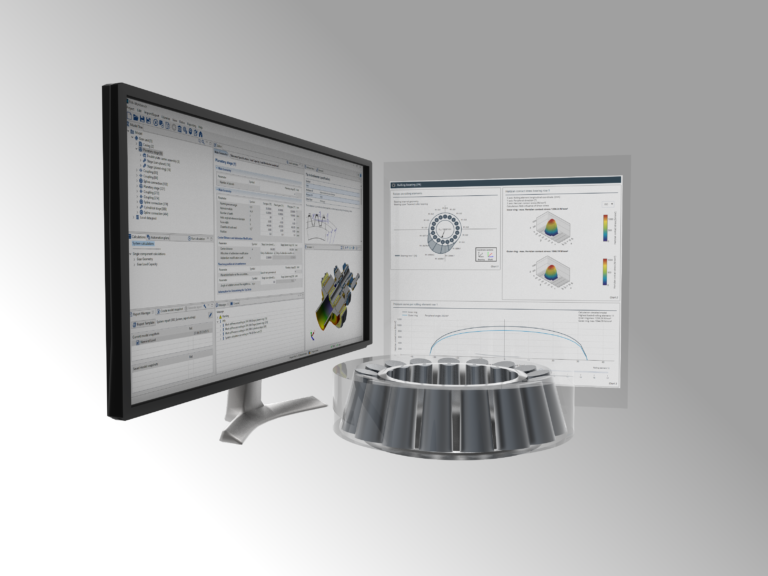
The consideration of deviations and their statically distributed characteristics in rolling bearing calculations leads to a more accurate representation and more reliable results. The FVA-Workbench software enables engineers to account for these geometric deviations in their rolling bearing designs. The software’s advanced features, including a JavaScript-based scripting interface, can be used to integrate and tailor user-defined routines, further enhancing the precision and flexibility of the calculations.

Effortless bearing design
The FVA-Workbench design software streamlines the modeling, configuration and calculation of transmission systems. With a simple and intuitive workflow, engineers can import complex CAD files for elements such as casings and effortlessly couple them with the bearing outer ring to model the entire system accurately. In addition to using bearing data according to manufacturer specifications (such as from rolling bearing catalogs), the rolling bearing geometry can also be directly specified, including the profiling of the rolling elements and raceways. Both rolling bearing catalogs as well as proprietary bearing specifications can provide data to determine the influence of geometric deviations on service life.

Easily define and vary tolerances
The first step is to determine which tolerances are to be investigated and within which limits. Deviations on the outer ring raceway can be defined as radial deviations from the ideal circular form. For example, this can be used to define ovalization of the outer bearing ring. Form and geometrical tolerances in the bearing seat can also be considered. In the next step, the tolerances can be easily varied to simulate their individual influences on the service life.

The easiest way to do this is by using the FVA-Workbench’s integrated scripting feature – a powerful tool that enables users to execute complex stack operations with just a few mouse clicks via intuitive text instructions. The result is a meticulous statistical analysis of the tolerances, dynamically varied within the specified tolerance ranges.

The influence of geometric deviations on the service life
Geometric deviations of the bearing raceways have a significant influence on the service life. In testing, we have observed that certain combinations can even triple the calculated service life. On the other hand, unfavorable tolerance combinations can reduce the bearing life to 1/3 of the original value. Among other factors, the roundness of the bearing seat relative to the main force direction is decisive for achieving the desired service life. In practice, this can be a result of deformation of the bearing rings during mounting due to bearing seat geometries that are not ideally cylindrical. The effect depends on the bearing type and size as well as the operating conditions. The FVA-Workbench provides a solution to account for geometric deviations within the bearing design phase, making it possible to achieve reliable results on the service life of bearings.

Share. LinkedIn Twitter Facebook Email

Related Posts

Mayr Power Transmission to highlight advanced drivetrain testing solutions at Automotive Testing Expo Europe 2026

May 15, 2026

“Interest alone doesn’t guarantee adoption” – what next for BEVs?

May 14, 2026

Real-world validation in high-pressure motorsport sealing applications

May 13, 2026
LATEST NEWS

Mayr Power Transmission to highlight advanced drivetrain testing solutions at Automotive Testing Expo Europe 2026

May 15, 2026

Modular design strategy drives Hyundai Mobis electric power systems

May 14, 2026

“Interest alone doesn’t guarantee adoption” – what next for BEVs?

May 14, 2026

Receive breaking stories and features in your inbox each week, for free


Enter your email address:


Supplier Spotlights
  • Ionic Mineral Technologies (Ionic MT)
Featured Listings
  • There are currently no listings to show.
Getting in Touch
  • Contact Us
  • Media Pack
  • Meet the Editors
  • Free Weekly E-Newsletter
Our Social Channels
  • LinkedIn
Related UKi Topics
  • Automotive Interiors
  • Automotive Testing
  • Autonomous Vehicle
  • Professional Motorsport
  • Tire Technology
  • Media Pack
© 2026 UKi Media & Events a division of UKIP Media & Events Ltd
  • Terms and Conditions
  • Privacy Policy
  • Cookie Policy
  • Notice and Takedown Policy

Type above and press Enter to search. Press Esc to cancel.