

Close Menu
  • News
      • Appointments
      • EV Powertrain
      • Emissions
      • Engine Components
      • Electronics
      • Facility Developments
      • Forced Induction
      • Fuel Cell Technologies
      • Fuels & Lubricants
      • Heavy-duty & Diesel Engine Technologies
      • Hybrid Powertrain Technologies
      • Industry Forecasting
      • Legislation
      • Materials & Surface Treatment
      • Metallurgy
      • Mild-hybrid & 48V Technologies
      • New powertrain
      • Partnerships, Investments & Acquisitions
      • Quality Control
      • Prototyping
      • Sustainable fuels
      • Testing
      • Traction Control Systems
      • Transmissions Technologies
      • Webinars
  • Features
  • Online Magazines
    • April 2026
    • January 2026
    • September 2025
    • June 2025
    • March 2025
    • January 2025
    • September 2024
    • Subscribe to Automotive Powertrain Technology
    • Transmission Technology International
    • Subscribe to Transmission Technology
  • Opinion
  • Supplier Spotlight
  • Webinars
Facebook X (Twitter) Instagram
  • Automotive Interiors
  • Automotive Testing
  • Autonomous Vehicle
  • Professional Motorsport
  • Tire Technology
  • Media Pack
LinkedIn
Subscribe
Automotive Powertrain Technology International
  • News
      • Appointments
      • EV Powertrain
      • Emissions
      • Engine Components
      • Electronics
      • Facility Developments
      • Forced Induction
      • Fuel Cell Technologies
      • Fuels & Lubricants
      • Heavy-duty & Diesel Engine Technologies
      • Hybrid Powertrain Technologies
      • Industry Forecasting
      • Legislation
      • Materials & Surface Treatment
      • Metallurgy
      • Mild-hybrid & 48V Technologies
      • New powertrain
      • Partnerships, Investments & Acquisitions
      • Quality Control
      • Prototyping
      • Sustainable fuels
      • Testing
      • Traction Control Systems
      • Transmissions Technologies
      • Webinars
  • Features
  • Online Magazines
    1. April 2026
    2. January 2026
    3. September 2025
    4. June 2025
    5. March 2025
    6. January 2025
    7. September 2024
    8. Subscribe to Automotive Powertrain Technology
    9. Transmission Technology International
    10. Subscribe to Transmission Technology
    Featured

    In this Issue – April 2026

    By Web TeamMay 1, 2026
    Recent

    In this Issue – April 2026

    May 1, 2026

    In this Issue – January 2026

    December 3, 2025

    In this Issue – September 2025

    September 25, 2025
  • Opinion
  • Supplier Spotlight
  • Webinars
LinkedIn Facebook
Subscribe
Automotive Powertrain Technology International
Testing

Sakor supplies variable cam timing validation rig

Lawrence ButcherBy Lawrence ButcherJune 17, 20222 Mins Read
LinkedIn Twitter Facebook Email
Share
LinkedIn Twitter Facebook Email

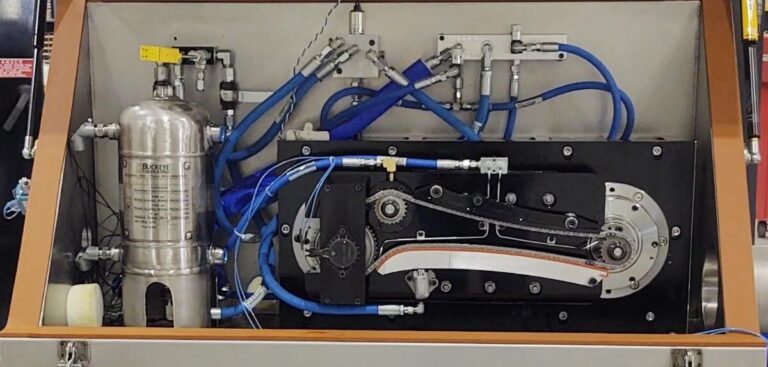
Dynamometer supplier Sakor Technologies has recently provided a performance test stand for validating designs for new hydraulic variable timing cam phaser systems for a major international provider of powertrain components. The cam phaser test stand will be used for research and development on engine timing designs in order improve engine fuel efficiency.

Sakor says that the custom-built system is designed for use with cam phasers driven by oil pressure. The test system simulates different engine designs, simulating cam torque pulses using two high-speed, low-inertia AccuDyne AC Dynamometers coupled with a DynoLAB data acquisition and control system. One dynamometer drives the timing chain as if it were the engine, while the other simulates cam shaft torque pulses. Parts for testing are mounted in a thermal chamber that can be run at temperatures ranging from -40 to 150°C. This enables engineers to simulate temperatures encountered by those starting engines in all climates. The system controls oil pressure to advance or retard timing of the cam shaft relative to the engine.

The system features a 60kWdynamometers that can operate at up to ,8500 revolutions per minute (rpm) to simulate the engine. A 235kW ultra-low inertia dynamometer is used to simulate the high-frequency torque pulses found on a cam shaft. The test stand can be easily adjusted, so it can accommodate a wide range of cam phaser designs. The DynoLAB data acquisition and control system provides fully automated test procedures for all customer testing protocols.

“Sakor is dedicated to helping customers design the next generation of fuel-efficient engines in ways that do not require huge expensive facilities to conduct testing of components,” said Randal Beattie, president of Sakor. “To the best of our knowledge, ours is the first system capable of simulating dynamic cam shaft torque pulsing in real time and in a clean lab environment.”

Share. LinkedIn Twitter Facebook Email

Related Posts

New chassis and powertrain event to launch at Vehicle Tech Week North America 2026

May 6, 2026

Kistler releases new water-cooled adapter for miniature absolute pressure sensor

April 30, 2026

Project Cavendish: Mahle hydrogen-fueled 13-liter engine matches diesel performance

April 23, 2026
LATEST NEWS

Real-world validation in high-pressure motorsport sealing applications

May 13, 2026

Lotus highlights motorsport heritage with all-new hybrid-V8 supercar

May 12, 2026

Renault introduces LPG bi-fuel Clio that delivers up to 1,450km range

May 7, 2026

Receive breaking stories and features in your inbox each week, for free


Enter your email address:


Supplier Spotlights
  • ÖVK (Austrian Society of Automotive Engineers)
Featured Listings
  • There are currently no listings to show.
Getting in Touch
  • Contact Us
  • Media Pack
  • Meet the Editors
  • Free Weekly E-Newsletter
Our Social Channels
  • LinkedIn
Related UKi Topics
  • Automotive Interiors
  • Automotive Testing
  • Autonomous Vehicle
  • Professional Motorsport
  • Tire Technology
  • Media Pack
© 2026 UKi Media & Events a division of UKIP Media & Events Ltd
  • Terms and Conditions
  • Privacy Policy
  • Cookie Policy
  • Notice and Takedown Policy

Type above and press Enter to search. Press Esc to cancel.