

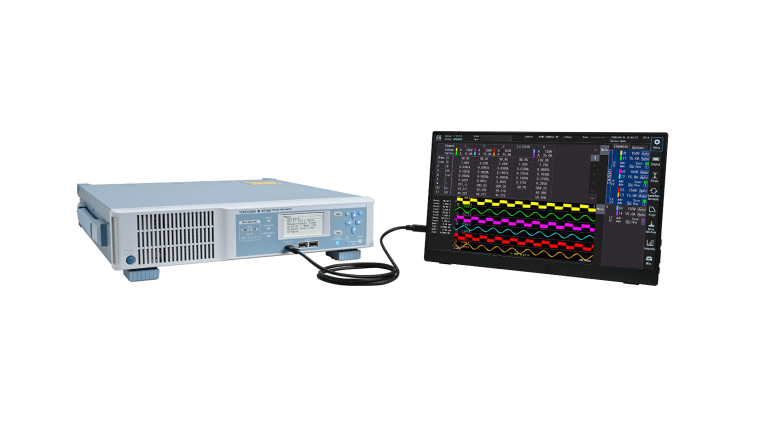
The WT1500 by Yokogawa Test & Measurement is a high-precision power analyzer for renewable energy, electrified vehicle (xEV), semiconductor and battery testing applications. The instrument offers four measurement channels in a 2U, 19in rack-mount chassis. It supports input voltages of up to 2,000V DC and includes resolver signal input for motor evaluation without additional equipment. Yokogawa says upcoming multi-unit synchronization will enable up to five WT1500 units to be connected, providing up to 20 power measurement channels.
Development background
Continued growth in xEV technologies and renewable energy is accelerating demand for evaluation, testing and production capabilities built around high-voltage equipment. Target voltages within these systems can reach the thousands, requiring specialized high-voltage divider equipment in typical analysis setups. These dividers can introduce measurement errors, reducing overall accuracy while complicating wiring and equipment installations. Additionally, conventional motor efficiency measurements require separately measured power and resolver signals to be synchronized on a PC.
Existing power analyzer models lacked the required voltage input range for energy storage systems (ESS), power conversion systems (PCS) and resolver support motor testing, or were too large to fit within conventional rack-mounted or desk-based setups. The WT1500 reportedly addresses this gap, delivering the necessary capabilities and functionality while eliminating the need for high-voltage dividers for systems up to 2,000V, all within a compact 19in-wide, 2U height design.
High performance
The WT1500 achieves a total power accuracy of ±0.038% (DC, 50/60Hz) and low-power-factor accuracy of ±0.07% of S at 50/60Hz, the best DC accuracy figures of the WT series, and supports two types of input elements: high voltage (HV) and wide bandwidth (WB). The HV element supports direct measurement up to 2,000V DC and 300kHz, ideal for high-voltage PCS and ESS applications. The WB element supports up to 1,000V with a 2MHz bandwidth, crucial for measuring the complex, high-frequency waveforms generated in modern xEV motors. Both inputs share a common sensor input and can be mixed in a single unit.
System integration and a space-saving design
The WT1500’s compact 2U height (approximately 88mm) design supports four power measurements and four motor evaluations, including encoder and resolver signal inputs, IEEE 1588 time synchronization and data output to CAN/CAN FD buses, and low-latency data transmission via UDP communication. It is equipped with a variety of interfaces for remote control via PC, external monitor or tablet and features a small front panel for straightforward connection setup or even to be used as a standalone instrument. The WT1500’s space efficiency allows easy integration into evaluation system racks.
Scalable measurements
For measurements requiring more than four channels, up to five WT1500 units can be synchronized, enabling 20-channel power measurement. One unit acts as the main controller, directing subunit configuration and consolidating data acquisition. Multi-unit synchronization support will be released soon.
The WT1500 also features four unique current input terminals, alongside its voltage terminals, providing power for current sensors. These, in combination with a series of new current adapters that are provided as accessories, enable the WT1500 to accommodate a wide variety of sensors: the CT Series solid-core (D-sub Terminal, 60A to 2,000A, AC-DC), the CT1000S split-core (BNC, 1,000A, AC-DC) and AC-only current clamp probes (BNC, 50A and 200A class).
The WT1500 is designed for a range of power measurement applications, including four-channel measurement of single-phase and three-phase systems with PC-based configuration and data acquisition. It also supports testing of two-system inverter motors and e-axle systems using dual- or single-unit configurations, as well as multi-unit simultaneous measurement and high-voltage testing of energy storage and power conversion systems.
In related news, Cortec study examines corrosion control during engine hot testing