

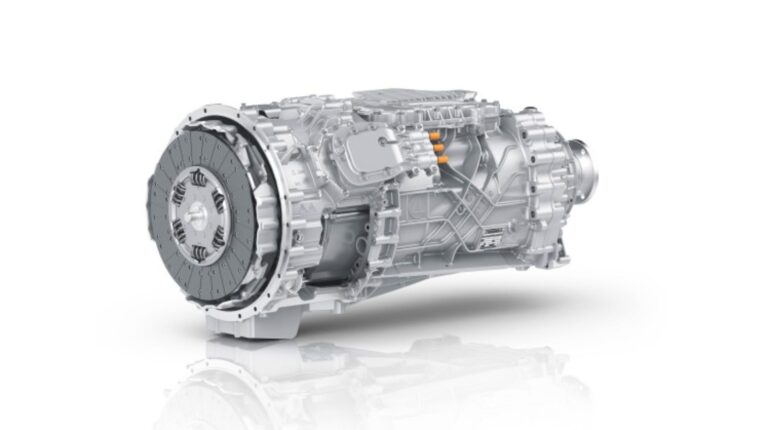
ZF Commercial Vehicle Solutions (CVS) has completed a dedicated testing event for the TraXon 2 Hybrid, its next-generation hybrid transmission for heavy commercial vehicles. The system demonstrated its potential to reduce emissions while maintaining operational flexibility, meeting the practical needs of logistics companies.
“TraXon 2 Hybrid delivers a clear advantage for high‑mileage operations by substantially reducing CO2 emissions while maintaining cost efficiency,” said Christian Feldhaus, vice president of transmissions and hybrids at ZF Commercial Vehicle Solutions. “Based on our ongoing discussions with vehicle manufacturers, fleet operators and industry bodies, we see hybrid technologies providing a clear and practical pathway toward significant emissions reduction in future heavy‑duty transport.”
Emissions-saving technology
The TraXon 2 Hybrid builds on the all-electric TraXon 2 platform. The hybrid system enables electric-only driving in urban zones while retaining combustion operation for long-distance transportation.
ZF test evaluations confirmed that the system supports substantial CO2 reductions in long-haul and distribution applications when operated with consistent recharging. The PHEV system can reduce CO2 emissions by up to 47% in long-haul transportation and up to 73% in distribution transportation. This supports the European fleet emissions targets for 2030 and provides flexibility for future toll and tax regulations.
The TraXon 2 Hybrid builds on ZF’s e-mobility platform, which includes electric central drives such as CeTrax 2 and AxTrax 2 e-axles, and supports applications where full electrification is not yet practical across all routes. For fleets with limited investment capacity, it also enables a gradual transition to electrification, including operational, dispatch and charging adjustments.
The hybrid platform integrates an in-house-developed electric motor and operates at 600-800V, with 190kW continuous power and higher peak output. Positioned in a P2 layout between the clutch and transmission, the electric motor enables pure electric driving up to 12th gear and supports regenerative braking for improved efficiency. The combustion engine operates according to the vehicle’s driving strategy and provides range for long-haul applications. The system is designed to improve overall efficiency and reduce CO2 emissions while retaining the range and refueling flexibility of a combustion engine. It can be combined with diesel, HVO/e-fuels, CNG/LPG and hydrogen combustion engines.
In related news, Volvo begins on-road testing of hydrogen ICE heavy trucks