
Close Menu
  • News
      • Appointments
      • EV Powertrain
      • Emissions
      • Engine Components
      • Electronics
      • Facility Developments
      • Forced Induction
      • Fuel Cell Technologies
      • Fuels & Lubricants
      • Heavy-duty & Diesel Engine Technologies
      • Hybrid Powertrain Technologies
      • Industry Forecasting
      • Legislation
      • Materials & Surface Treatment
      • Metallurgy
      • Mild-hybrid & 48V Technologies
      • New powertrain
      • Partnerships, Investments & Acquisitions
      • Quality Control
      • Prototyping
      • Sustainable fuels
      • Testing
      • Traction Control Systems
      • Transmissions Technologies
      • Webinars
  • Features
  • Online Magazines
    • April 2026
    • January 2026
    • September 2025
    • June 2025
    • March 2025
    • January 2025
    • September 2024
    • Subscribe to Automotive Powertrain Technology
    • Transmission Technology International
    • Subscribe to Transmission Technology
  • Opinion
  • Supplier Spotlight
  • Webinars
Facebook X (Twitter) Instagram
  • Automotive Interiors
  • Automotive Testing
  • Autonomous Vehicle
  • Professional Motorsport
  • Tire Technology
  • Media Pack
LinkedIn
Subscribe
Automotive Powertrain Technology International
  • News
      • Appointments
      • EV Powertrain
      • Emissions
      • Engine Components
      • Electronics
      • Facility Developments
      • Forced Induction
      • Fuel Cell Technologies
      • Fuels & Lubricants
      • Heavy-duty & Diesel Engine Technologies
      • Hybrid Powertrain Technologies
      • Industry Forecasting
      • Legislation
      • Materials & Surface Treatment
      • Metallurgy
      • Mild-hybrid & 48V Technologies
      • New powertrain
      • Partnerships, Investments & Acquisitions
      • Quality Control
      • Prototyping
      • Sustainable fuels
      • Testing
      • Traction Control Systems
      • Transmissions Technologies
      • Webinars
  • Features
  • Online Magazines
    1. April 2026
    2. January 2026
    3. September 2025
    4. June 2025
    5. March 2025
    6. January 2025
    7. September 2024
    8. Subscribe to Automotive Powertrain Technology
    9. Transmission Technology International
    10. Subscribe to Transmission Technology
    Featured

    In this Issue – April 2026

    By Web TeamMay 1, 2026
    Recent

    In this Issue – April 2026

    May 1, 2026

    In this Issue – January 2026

    December 3, 2025

    In this Issue – September 2025

    September 25, 2025
  • Opinion
  • Supplier Spotlight
  • Webinars
LinkedIn Facebook
Subscribe
Automotive Powertrain Technology International
New Engine

Bentley fires up first new blower engine

Lawrence ButcherBy Lawrence ButcherSeptember 10, 20203 Mins Read
LinkedIn Twitter Facebook Email
Share
LinkedIn Twitter Facebook Email

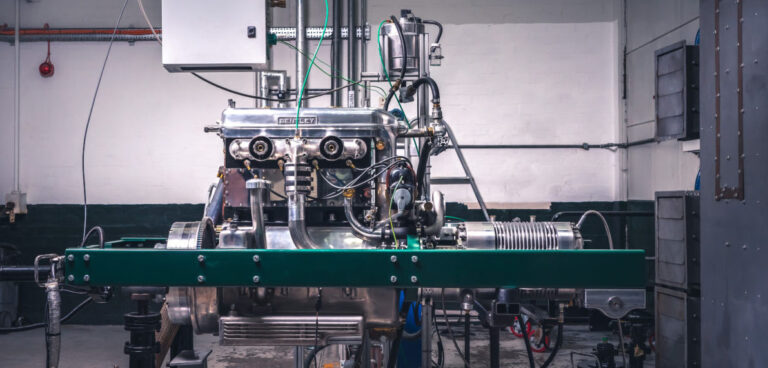
According to Bentley, the first newly built engine for its Blower Continuation Series has been fired up on a dedicated testbed at the company’s Crewe factory.

The Blower Continuation Series is a run of 12 recreations of one of the most famous Bentleys of all time – the supercharged 4.5-liter ‘Blower’ created for racing by Sir Tim Birkin in the late 1920s. Forming the world’s first pre-war continuation series, these 12 cars have all been pre-sold to Bentley collectors and enthusiasts around the world.

While the first engine was being built, a team of Bentley engineers began work to prepare one of the four engine development testbeds at its headquarters to receive the engine. The engine test facility has been at Bentley since the factory was built in 1938, and the cells were originally used to run-in and power-test Merlin V12 aero engines.

Preparing the testbed involved making a replica Blower front chassis to hold the engine, which could then be mounted to the dynamometer. Hinting at the company’s long heritage, due to the Blower engine being considerably different in size and shape to Bentley’s modern production engines, a number of original Merlin testbed fixtures – still in storage at the facility – were utilized to adapt the testbed to accommodate the engines.

With the engine fully installed, first fire-up took place in late August and according to Bentley, the engine is now proceeding through its defined schedule of run-in before a full power test. The engines will be tested across a 20-hour cycle, gradually increasing both engine speed and load conditions from idle up to 3,500 rpm. Once each engine is fully run-in, a full-load power curve will be measured.

The newly created Blower engines are exact recreations of the engines that powered Tim Birkin’s four Team Blowers that raced in the late 1920s – including the use of magnesium for the crankcase.

The Blower engine started life as the naturally aspirated 4.5-liter engine, designed by WO Bentley himself. Like Bentley’s 3-liter before it, the 4.5-liter brought together the latest individual engine technologies of the time – a single overhead camshaft, twin-spark ignition, four valves per cylinder and, of course, Bentley’s now legendary aluminum pistons. The racing version of WO’s 4.5-liter engine developed approximately 130bhp, but Bentley Boy Sir Tim Birkin wanted more. WO’s focus was always on reliability and refinement ahead of absolute power, so his solution to finding more power was always to increase engine capacity. Birkin had a different plan – he wanted to supercharge the 4.5, an idea that WO thought ‘corrupted’ his design.

With funding from his wealthy financier Dorothy Paget, and the technical skills of Clive Gallop, Birkin commissioned supercharger specialist Amherst Villiers to create a supercharger for the 4.5. The Roots-type supercharger – colloquially known as a blower – was fitted ahead of the engine and radiator and driven directly from the crankshaft. Internal modifications to the engine included a new, stronger crankshaft, reinforced connecting rods, and a modified oil system.

In racing tune, Birkin’s new supercharged 4.5-liter engine was mighty for its time– outputting around 240bhp. The ‘Blower Bentleys’ were therefore extremely fast – but as WO predicted, also somewhat fragile. The Blowers played their part in Bentley history, but over the 12 races that the Blowers contested, including Le Mans, a victory was never secured.

Share. LinkedIn Twitter Facebook Email

Related Posts

Maserati Nettuno engine transformed into 480kW hydrogen race unit

May 29, 2026

BYD enters UK eLCV market with Dolphin Cargo e-Van

May 29, 2026

Mercedes‑AMG presents all-electric GT 4‑Door Coupe

May 21, 2026
LATEST NEWS

Ferrari unveils all-electric Luce

May 29, 2026

Scania under-cab battery module and Megawatt Charging System available for order

May 29, 2026

Maserati Nettuno engine transformed into 480kW hydrogen race unit

May 29, 2026

Receive breaking stories and features in your inbox each week, for free


Enter your email address:


Supplier Spotlights
  • Idemitsu Lubricants America (ILA)
Featured Listings
  • There are currently no listings to show.
Getting in Touch
  • Contact Us
  • Media Pack
  • Meet the Editors
  • Free Weekly E-Newsletter
Our Social Channels
  • LinkedIn
Related UKi Topics
  • Automotive Interiors
  • Automotive Testing
  • Autonomous Vehicle
  • Professional Motorsport
  • Tire Technology
  • Media Pack
© 2026 UKi Media & Events a division of UKIP Media & Events Ltd
  • Terms and Conditions
  • Privacy Policy
  • Cookie Policy
  • Notice and Takedown Policy

Type above and press Enter to search. Press Esc to cancel.