
Close Menu
  • News
      • Appointments
      • EV Powertrain
      • Emissions
      • Engine Components
      • Electronics
      • Facility Developments
      • Forced Induction
      • Fuel Cell Technologies
      • Fuels & Lubricants
      • Heavy-duty & Diesel Engine Technologies
      • Hybrid Powertrain Technologies
      • Industry Forecasting
      • Legislation
      • Materials & Surface Treatment
      • Metallurgy
      • Mild-hybrid & 48V Technologies
      • New powertrain
      • Partnerships, Investments & Acquisitions
      • Quality Control
      • Prototyping
      • Sustainable fuels
      • Testing
      • Traction Control Systems
      • Transmissions Technologies
      • Webinars
  • Features
  • Online Magazines
    • April 2026
    • January 2026
    • September 2025
    • June 2025
    • March 2025
    • January 2025
    • September 2024
    • Subscribe to Automotive Powertrain Technology
    • Transmission Technology International
    • Subscribe to Transmission Technology
  • Opinion
  • Events
  • Supplier Spotlight
  • Webinars
Facebook X (Twitter) Instagram
  • Automotive Interiors
  • Automotive Testing
  • Autonomous Vehicle
  • Professional Motorsport
  • Tire Technology
  • Media Pack
LinkedIn
Subscribe
Automotive Powertrain Technology International
  • News
      • Appointments
      • EV Powertrain
      • Emissions
      • Engine Components
      • Electronics
      • Facility Developments
      • Forced Induction
      • Fuel Cell Technologies
      • Fuels & Lubricants
      • Heavy-duty & Diesel Engine Technologies
      • Hybrid Powertrain Technologies
      • Industry Forecasting
      • Legislation
      • Materials & Surface Treatment
      • Metallurgy
      • Mild-hybrid & 48V Technologies
      • New powertrain
      • Partnerships, Investments & Acquisitions
      • Quality Control
      • Prototyping
      • Sustainable fuels
      • Testing
      • Traction Control Systems
      • Transmissions Technologies
      • Webinars
  • Features
  • Online Magazines
    1. April 2026
    2. January 2026
    3. September 2025
    4. June 2025
    5. March 2025
    6. January 2025
    7. September 2024
    8. Subscribe to Automotive Powertrain Technology
    9. Transmission Technology International
    10. Subscribe to Transmission Technology
    Featured

    In this Issue – April 2026

    By Web TeamMay 1, 2026
    Recent

    In this Issue – April 2026

    May 1, 2026

    In this Issue – January 2026

    December 3, 2025

    In this Issue – September 2025

    September 25, 2025
  • Opinion
  • Events
  • Supplier Spotlight
  • Webinars
LinkedIn Facebook
Subscribe
Automotive Powertrain Technology International
New Engine

Audi Sport reworks 2.5 TFSI for updated RS Q3

Sam PettersBy Sam PettersOctober 2, 20192 Mins Read
LinkedIn Twitter Facebook Email
Audi RS Q3
Share
LinkedIn Twitter Facebook Email

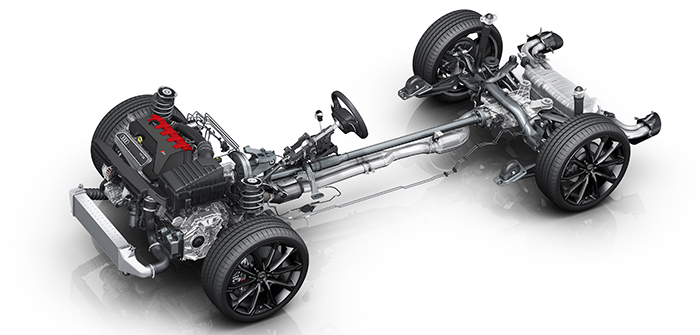
Audi Sport unveiled its latest edition of the RS Q3. Equipped with a revised version of the company’s renowned 2.5-liter five-cylinder engine, the SUV will generate peak power of 405ps and 480Nm of torque over 1,950rpm and 5,850rpm.

At less than 50cm in length, the revised unit is compact and 26kg (57 lb) lighter than the previous model. Fitting the engine with an aluminium crankcase alone allowed Audi Sport to achieve an 18kg (40 lb) weight saving.

Internal friction has also been reduced, thanks to plasma-coated cylinder liners and a 6mm reduction in crankshaft main bearing size. The crankshaft is hollow bored and is therefore 1kg (2.2 lb) lighter, while the aluminium pistons have integrated channels for oil cooling.

In the short warm-up phase after a cold-start, the switchable water pump does not circulate the coolant in the cylinder head meaning the motor reaches its operating temperature more quickly. This lowers the coefficient of friction and reduces fuel consumption.

Audi also applied a 1-2-4-5-3 firing order to the five-cylinder, alternating between adjacent cylinders and those far apart from one another. This sequence and the odd number of cylinders ensures a unique engine sound.

The turbocharged engine is paired with a 7-speed S tronic transmission. Thanks to the revised design, the multi-IEOTYA-winning unit gains a 17% power increase. This means the RS Q3 will reach 100km/h in 4.5 seconds and on to a regulated top speed of 250km/h (155mph).

Audi’s latest RS Q3 offers combined fuel consumption of between 8.9 and 8.8l /100km, and combined CO2 emissions of between 202g/km and 203g/km.

Share. LinkedIn Twitter Facebook Email

Related Posts

New chassis and powertrain event to launch at Vehicle Tech Week North America 2026

May 6, 2026

AI-defined vehicles and expanded electrification shape Nissan’s future mobility strategy

April 20, 2026

911 GT3 S/C debuts as lightweight open-top driver’s car with 510ps flat-six engine

April 16, 2026
LATEST NEWS

Renault introduces LPG bi-fuel Clio that delivers up to 1,450km range

May 7, 2026

UK consortium secures funding for ReCAM lithium-ion battery recycling project

May 7, 2026

BorgWarner wins turbocharger contracts with two European OEMs

May 7, 2026

Receive breaking stories and features in your inbox each week, for free


Enter your email address:


Supplier Spotlights
  • REWITEC GmbH
Featured Listings
  • There are currently no listings to show.
Getting in Touch
  • Contact Us
  • Media Pack
  • Meet the Editors
  • Free Weekly E-Newsletter
Our Social Channels
  • LinkedIn
Related UKi Topics
  • Automotive Interiors
  • Automotive Testing
  • Autonomous Vehicle
  • Professional Motorsport
  • Tire Technology
  • Media Pack
© 2026 UKi Media & Events a division of UKIP Media & Events Ltd
  • Terms and Conditions
  • Privacy Policy
  • Cookie Policy
  • Notice and Takedown Policy

Type above and press Enter to search. Press Esc to cancel.