

Close Menu
  • News
      • Appointments
      • EV Powertrain
      • Emissions
      • Engine Components
      • Electronics
      • Facility Developments
      • Forced Induction
      • Fuel Cell Technologies
      • Fuels & Lubricants
      • Heavy-duty & Diesel Engine Technologies
      • Hybrid Powertrain Technologies
      • Industry Forecasting
      • Legislation
      • Materials & Surface Treatment
      • Metallurgy
      • Mild-hybrid & 48V Technologies
      • New powertrain
      • Partnerships, Investments & Acquisitions
      • Quality Control
      • Prototyping
      • Sustainable fuels
      • Testing
      • Traction Control Systems
      • Transmissions Technologies
      • Webinars
  • Features
  • Online Magazines
    • April 2026
    • January 2026
    • September 2025
    • June 2025
    • March 2025
    • January 2025
    • September 2024
    • Subscribe to Automotive Powertrain Technology
    • Transmission Technology International
    • Subscribe to Transmission Technology
  • Opinion
  • Supplier Spotlight
  • Webinars
Facebook X (Twitter) Instagram
  • Automotive Interiors
  • Automotive Testing
  • Autonomous Vehicle
  • Professional Motorsport
  • Tire Technology
  • Media Pack
LinkedIn
Subscribe
Automotive Powertrain Technology International
  • News
      • Appointments
      • EV Powertrain
      • Emissions
      • Engine Components
      • Electronics
      • Facility Developments
      • Forced Induction
      • Fuel Cell Technologies
      • Fuels & Lubricants
      • Heavy-duty & Diesel Engine Technologies
      • Hybrid Powertrain Technologies
      • Industry Forecasting
      • Legislation
      • Materials & Surface Treatment
      • Metallurgy
      • Mild-hybrid & 48V Technologies
      • New powertrain
      • Partnerships, Investments & Acquisitions
      • Quality Control
      • Prototyping
      • Sustainable fuels
      • Testing
      • Traction Control Systems
      • Transmissions Technologies
      • Webinars
  • Features
  • Online Magazines
    1. April 2026
    2. January 2026
    3. September 2025
    4. June 2025
    5. March 2025
    6. January 2025
    7. September 2024
    8. Subscribe to Automotive Powertrain Technology
    9. Transmission Technology International
    10. Subscribe to Transmission Technology
    Featured

    In this Issue – April 2026

    By Web TeamMay 1, 2026
    Recent

    In this Issue – April 2026

    May 1, 2026

    In this Issue – January 2026

    December 3, 2025

    In this Issue – September 2025

    September 25, 2025
  • Opinion
  • Supplier Spotlight
  • Webinars
LinkedIn Facebook
Subscribe
Automotive Powertrain Technology International
Facility Developments

Volkswagen opens laboratory for battery cell research and development

Callum Brook-JonesBy Callum Brook-JonesSeptember 14, 20213 Mins Read
LinkedIn Twitter Facebook Email
Share
LinkedIn Twitter Facebook Email

A laboratory for battery cell research and development has been opened by Volkswagen in Salzgitter, Germany. The site will be used to further expand battery technology expertise as the OEM moves toward the production of its own battery cells, with Volkswagen unified cells expected to start rolling off the gigafactory production line in Salzgitter in 2025.

The German vehicle manufacturer is to invest around €70m (US82.8m) in the modern facility that houses four laboratories and will eventually have 250 employees conducting research into cell development and analytics.

“Volkswagen’s Salzgitter site demonstrates how the transformation of the German automotive industry from conventional drive systems to e-mobility can succeed,” commented Thomas Schmall, group board member for technology, Volkswagen, and chairman of the board of management, Volkswagen Group Components. “We are attracting cutting-edge researchers and, as a pioneer in the industry, create the jobs of tomorrow.”

By 2030, the Volkswagen Group, along with its partners, is planning to operate six factories to produce battery cells in Europe, with the aim of reaching a production capacity of 240GWh. Cells with an annual capacity of 40GWh will be produced at the Salzgitter site, and the OEM predicts that the unified cell will reduce battery costs by up to half.

“With the opening of the laboratories, we have reached the next strategic milestone. Now we are pushing ahead with preparations for our own cell production with all our strength,” added Schmall.

The 2,500m2 laboratories will enable Volkswagen to carry out cell testing programs with up to 200 different analytical methods and the development of new formulations.

The Salzgitter facility features a scanning electron microscope for detecting lithium, one of only a few in the world, and a highly automated test field that can test cells for performance and signs of aging during rapid charging and discharging. This test includes certain cells that can be charged from 5% to 80% within 12 minutes.

At the site, the laboratories have been split into four main areas consisting of a cell development lab, an analytics lab, the environmental and safety lab, and an electrical test field laboratory.

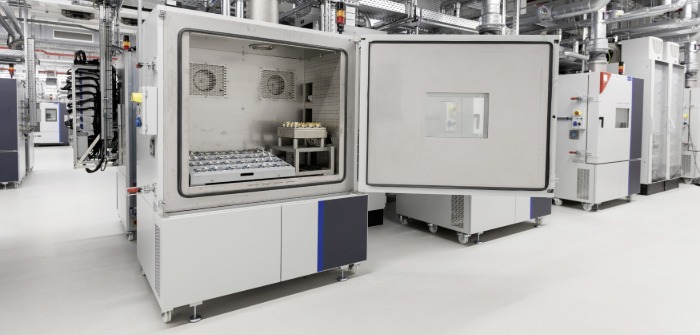
The cell development lab conducts evaluations on new materials and accesses their suitability. Chemical formulations, electrode materials and other processes are further developed here also. In the analytics lab, the raw materials of the cells and the components are disassembled so that analysis can take place. Cells are subjected to a range of endurance tests in six chambers in the environmental and safety lab, while in the electrical test field laboratory, a wide range of cells are tested for performance and measured electrically to access aging phenomena, and long-term durability.

Around 160 out of 500 employees at the Center of Excellence (CoE) Battery Cell in Salzgitter are currently involved in cell development, and the OEM estimates that by the end of next year, the CoE will employ more than 1,000 people.

“One of the most important future technologies for the Volkswagen Group is being driven forward here. Everything that is done at the Center of Excellence Battery Cell serves to provide customers of all Group brands with e-vehicles with the greatest possible range, charging performance, sustainability and safety,” said Frank Blome, head of the battery cell and battery system business unit.

Share. LinkedIn Twitter Facebook Email

Related Posts

Project Cavendish: Mahle hydrogen-fueled 13-liter engine matches diesel performance

April 23, 2026

GM invests US$150m in Saginaw metal casting facility to support V-8 engine block production

April 8, 2026

New e-axle manufacturing line opens in Pune to power Mahindra’s Born Electric vehicles

April 1, 2026
LATEST NEWS

Renault introduces LPG bi-fuel Clio that delivers up to 1,450km range

May 7, 2026

UK consortium secures funding for ReCAM lithium-ion battery recycling project

May 7, 2026

BorgWarner wins turbocharger contracts with two European OEMs

May 7, 2026

Receive breaking stories and features in your inbox each week, for free


Enter your email address:


Supplier Spotlights
  • GFM GmbH
Featured Listings
  • There are currently no listings to show.
Getting in Touch
  • Contact Us
  • Media Pack
  • Meet the Editors
  • Free Weekly E-Newsletter
Our Social Channels
  • LinkedIn
Related UKi Topics
  • Automotive Interiors
  • Automotive Testing
  • Autonomous Vehicle
  • Professional Motorsport
  • Tire Technology
  • Media Pack
© 2026 UKi Media & Events a division of UKIP Media & Events Ltd
  • Terms and Conditions
  • Privacy Policy
  • Cookie Policy
  • Notice and Takedown Policy

Type above and press Enter to search. Press Esc to cancel.