

Close Menu
  • News
      • Appointments
      • EV Powertrain
      • Emissions
      • Engine Components
      • Electronics
      • Facility Developments
      • Forced Induction
      • Fuel Cell Technologies
      • Fuels & Lubricants
      • Heavy-duty & Diesel Engine Technologies
      • Hybrid Powertrain Technologies
      • Industry Forecasting
      • Legislation
      • Materials & Surface Treatment
      • Metallurgy
      • Mild-hybrid & 48V Technologies
      • New powertrain
      • Partnerships, Investments & Acquisitions
      • Quality Control
      • Prototyping
      • Sustainable fuels
      • Testing
      • Traction Control Systems
      • Transmissions Technologies
      • Webinars
  • Features
  • Online Magazines
    • April 2026
    • January 2026
    • September 2025
    • June 2025
    • March 2025
    • January 2025
    • September 2024
    • Subscribe to Automotive Powertrain Technology
    • Transmission Technology International
    • Subscribe to Transmission Technology
  • Opinion
  • Supplier Spotlight
  • Webinars
Facebook X (Twitter) Instagram
  • Automotive Interiors
  • Automotive Testing
  • Autonomous Vehicle
  • Professional Motorsport
  • Tire Technology
  • Media Pack
LinkedIn
Subscribe
Automotive Powertrain Technology International
  • News
      • Appointments
      • EV Powertrain
      • Emissions
      • Engine Components
      • Electronics
      • Facility Developments
      • Forced Induction
      • Fuel Cell Technologies
      • Fuels & Lubricants
      • Heavy-duty & Diesel Engine Technologies
      • Hybrid Powertrain Technologies
      • Industry Forecasting
      • Legislation
      • Materials & Surface Treatment
      • Metallurgy
      • Mild-hybrid & 48V Technologies
      • New powertrain
      • Partnerships, Investments & Acquisitions
      • Quality Control
      • Prototyping
      • Sustainable fuels
      • Testing
      • Traction Control Systems
      • Transmissions Technologies
      • Webinars
  • Features
  • Online Magazines
    1. April 2026
    2. January 2026
    3. September 2025
    4. June 2025
    5. March 2025
    6. January 2025
    7. September 2024
    8. Subscribe to Automotive Powertrain Technology
    9. Transmission Technology International
    10. Subscribe to Transmission Technology
    Featured

    In this Issue – April 2026

    By Web TeamMay 1, 2026
    Recent

    In this Issue – April 2026

    May 1, 2026

    In this Issue – January 2026

    December 3, 2025

    In this Issue – September 2025

    September 25, 2025
  • Opinion
  • Supplier Spotlight
  • Webinars
LinkedIn Facebook
Subscribe
Automotive Powertrain Technology International
Emissions

OEM’s close in on European CO2 targets

Lawrence ButcherBy Lawrence ButcherOctober 26, 20202 Mins Read
LinkedIn Twitter Facebook Email
Share
LinkedIn Twitter Facebook Email

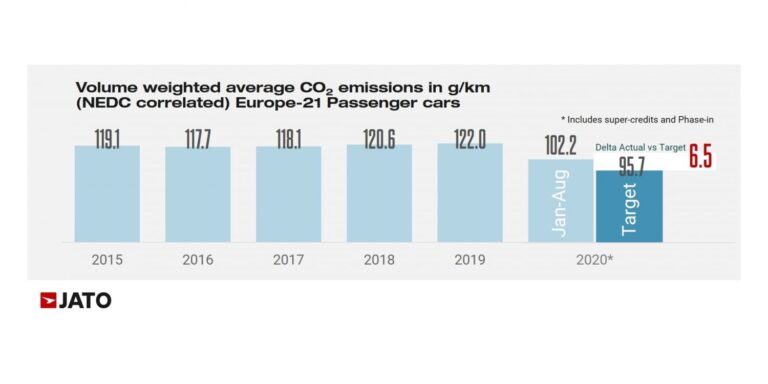
According to data collected by automotive industry analytics specialist Jato Dynamics, many OEMs have started to see a significant reduction in their average emissions levels and are largely on track to hit targets set by the European Commission.

The data, collected and updated on a monthly basis and sourced from 21 countries across Europe, shows that average CO2  emissions totalled 102.2g/km, under the New European Driving Cycle (NEDC), from January 2020 to August 2020. By these calculations, the European automotive market is currently 6.5g/km over their combined target for 2021.

Despite overall vehicle registrations falling by 29% between January and September this year – when contrasted with the same period in 2019 – the data also shows that registrations for electrified cars increased by 67% through September to 1.54 million units. This increase goes some way to explain the double-digit drops seen in demand for gasoline and diesel cars, and the increase in market share for EVs from 7.8% in January – September 2019, to 18.1% in January – September 2020.

Geely Group, owner of Volvo cars, ranked best in the CO2  rankings, outperforming Toyota, which has traditionally led by brand in the CO2  reduction race. Geely met the target by August, four months ahead of the deadline. Its CO2  target for 2020 was an average of 110.3 g/km, but by August 31 its average was 103.1 g/km – making it the only manufacturer to outperform the target. It would appear a focus on EV sales is behind this achievement, with electrified vehicles accounting for almost half of its registrations in August, and 38% in January-August 2020.

BMW is next in line to meet the target. With an average of 103.5g/km in August, it was only 0.54g/km above a target of 102.9g/km. Toyota though is around 2.2g away from its target, a deficit it may struggle to reel in given a lack of pure EV offerings currently on sale in Europe.

Share. LinkedIn Twitter Facebook Email

Related Posts

Marelli showcases latest propulsion and thermal management innovations

April 22, 2026

International’s S13 Integrated Powertrain achieves EPA 2027 compliance

January 8, 2026

Scania releases new combustion and PHEV powertrains for buses and coaches

September 18, 2025
LATEST NEWS

Renault introduces LPG bi-fuel Clio that delivers up to 1,450km range

May 7, 2026

UK consortium secures funding for ReCAM lithium-ion battery recycling project

May 7, 2026

BorgWarner wins turbocharger contracts with two European OEMs

May 7, 2026

Receive breaking stories and features in your inbox each week, for free


Enter your email address:


Supplier Spotlights
  • Gleason Corporation
Featured Listings
  • There are currently no listings to show.
Getting in Touch
  • Contact Us
  • Media Pack
  • Meet the Editors
  • Free Weekly E-Newsletter
Our Social Channels
  • LinkedIn
Related UKi Topics
  • Automotive Interiors
  • Automotive Testing
  • Autonomous Vehicle
  • Professional Motorsport
  • Tire Technology
  • Media Pack
© 2026 UKi Media & Events a division of UKIP Media & Events Ltd
  • Terms and Conditions
  • Privacy Policy
  • Cookie Policy
  • Notice and Takedown Policy

Type above and press Enter to search. Press Esc to cancel.