

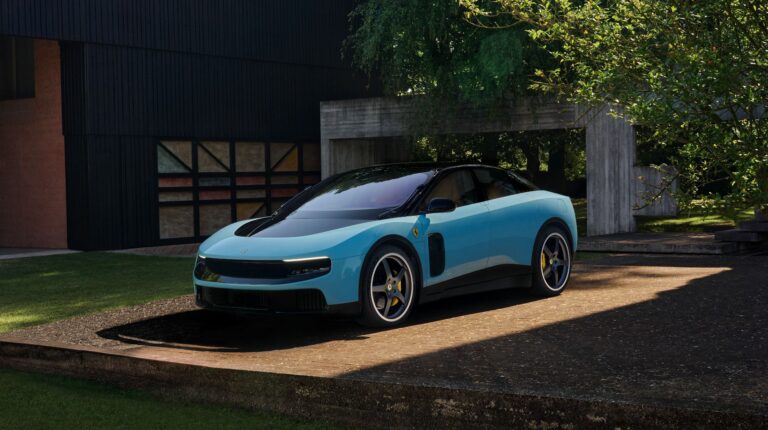
Ferrari has unveiled the all-electric Luce at the Vela di Calatrava – Città dello Sport in Rome in Italy.
Expanding Ferrari’s in-house electric technology expertise has created new opportunities for performance and efficiency across its wider vehicle programs, the auto maker said. This includes technology transfer between Ferrari road cars, the 499P Hypercar that won the most recent World Endurance Championship, and the Ferrari Hypersail project, which serves as a platform for research and innovation. The Ferrari Luce marks the culmination of Maranello’s multi-energy strategy, announced at the 2022 Capital Markets Day.
John Elkann, president of Ferrari, said, “We are not simply unveiling a new car, we are inaugurating a chapter that turns our vision into reality, strengthening Ferrari’s tradition of anticipating and shaping the future.”
In keeping with tradition, Ferrari has chosen to engineer, develop and manufacture the main components in-house. The project includes more than 60 new patents.
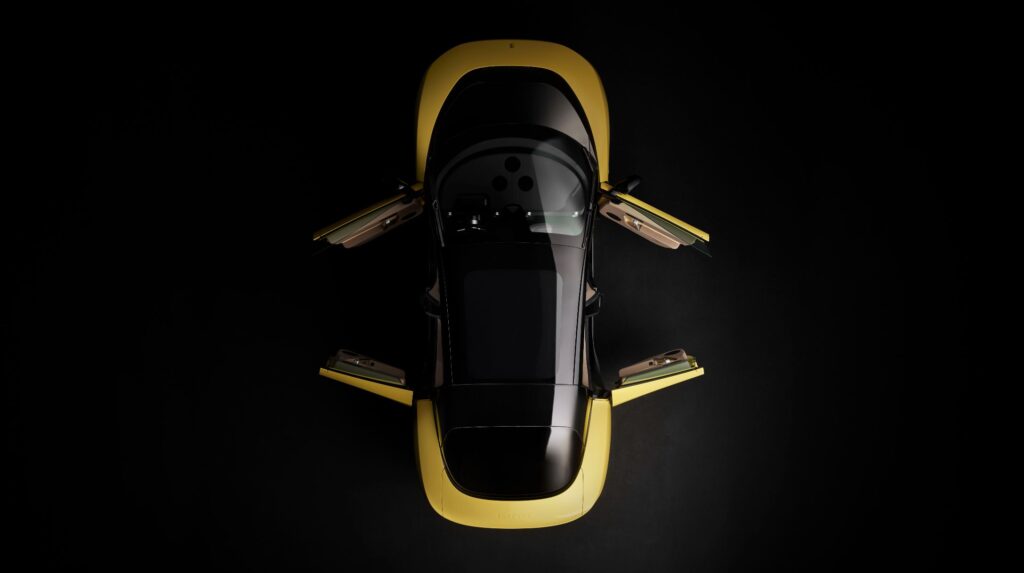
The Ferrari Luce was designed in collaboration with LoveFrom, the design collective led by Sir Jony Ive and Marc Newson, bringing an external perspective to Ferrari’s established design approach under Flavio Manzoni. The electric power source, Ferrari-engineered engines and advanced drivetrain enabled the development of a new architecture that combines Ferrari performance with the luxury of spaciousness.
Technologies derived from Ferrari’s unrivalled experience in the world of motor racing made it possible to contain kerb weight at 2,260kg, helping deliver best‑in‑class performance (0–100 km/h in 2.5 seconds, 0–200 km/h in 6.8 seconds, top speed over 310 km/h and maximum total power output of 1,050hp) and a range in excess of 530km.
The car introduces electric all-wheel drive technology, combining torque vectoring, regenerative braking and adjustable power delivery systems. Steering wheel-mounted paddles enable drivers to modify torque output and energy recovery, while Ferrari says the system has been developed to provide a more progressive acceleration response than typical high-torque electric powertrains.
The car is powered by four electric engines, one per wheel, and is equipped with a high‑capacity 122kWh battery, an active suspension system derived from the F80 and an independently steering rear axle. Within this framework of technological innovation, two concepts best encapsulate Ferrari Luce’s ambitious entry into the world of high‑performance electric sports cars: the control of each wheel’s motion in every direction and in any dynamic condition, and the authentic approach to sound.
Each wheel is equipped with one actuator for traction and regeneration, one for the steering angle and one to control vertical movement. The ability to adapt torque distribution in real time to road conditions and desired performance provides exceptional freedom and precision of control. Each of the Ferrari Luce’s wheels is attuned to the driver’s input, enabling the driver to experience a single, fluid movement. Torque vectoring and the elastic balance of the suspension system also assist in changing direction, enhancing the car’s agility and ease of driving.
The Ferrari Luce’s vehicle dynamics have been developed around the characteristics of its electric platform, including a lower center of gravity and revised weight distribution. The vehicle uses an e-Manettino system to adjust power delivery and traction settings, alongside Ferrari’s five-position Manettino drive mode selector, which adapts vehicle responses to different grip conditions.
The model also introduces Ferrari’s new vehicle control unit, which integrates management of the powertrain and vehicle dynamics systems. According to Ferrari, the system processes updates at up to 200 times per second and works in conjunction with the latest version of the company’s Side Slip X control system.
The powertrain comprises four F80-derived permanent magnet synchronous engines with radial flux, delivering a maximum speed of 30,000rpm at the front and 25,500rpm at the rear. The system operates on 800V architecture and combines performance with efficiency, with solutions directly derived from motorsport. The high-voltage battery pack was designed, validated and built in Maranello and comprises 210 cells in series that deliver 122kWh and support fast charging up to 350kW; it has been designed as a structural element of the car. Power electronics feature compact inverters and a DC/DC resonant converter for the active suspension to achieve record-breaking efficiency of more than 98%.
The Ferrari Luce uses an integrated battery, chassis, and body structure designed to improve rigidity, efficiency, and interior packaging. The aluminum-based architecture places the battery beneath the floor and rear seats, removing the need for a central transmission tunnel and increasing cabin space. Ferrari said the structure delivers increased bending and torsional rigidity compared with its previous four-door models.
The vehicle also features double wishbone suspension, rear-wheel steering, carbon ceramic brakes, and a rear subframe mounted to improve ride comfort and handling balance.
The extensive use of recycled secondary-alloy aluminum enables a reduction in CO₂e emissions during production of around 70% of the overall vehicle weight.
Benedetto Vigna, CEO of Ferrari, said, “We are convinced that a company demonstrates its leadership when it has the courage to dare and to take on the challenge of new technologies. Ferrari Luce was born precisely from this challenge, offering our unprecedented vision of electrification.”
Related news, BYD enters UK eLCV market with Dolphin Cargo e-Van