

Close Menu
  • News
      • Appointments
      • EV Powertrain
      • Emissions
      • Engine Components
      • Electronics
      • Facility Developments
      • Forced Induction
      • Fuel Cell Technologies
      • Fuels & Lubricants
      • Heavy-duty & Diesel Engine Technologies
      • Hybrid Powertrain Technologies
      • Industry Forecasting
      • Legislation
      • Materials & Surface Treatment
      • Metallurgy
      • Mild-hybrid & 48V Technologies
      • New powertrain
      • Partnerships, Investments & Acquisitions
      • Quality Control
      • Prototyping
      • Sustainable fuels
      • Testing
      • Traction Control Systems
      • Transmissions Technologies
      • Webinars
  • Features
  • Online Magazines
    • April 2026
    • January 2026
    • September 2025
    • June 2025
    • March 2025
    • January 2025
    • September 2024
    • Subscribe to Automotive Powertrain Technology
    • Transmission Technology International
    • Subscribe to Transmission Technology
  • Opinion
  • Supplier Spotlight
  • Webinars
Facebook X (Twitter) Instagram
  • Automotive Interiors
  • Automotive Testing
  • Autonomous Vehicle
  • Professional Motorsport
  • Tire Technology
  • Media Pack
LinkedIn
Subscribe
Automotive Powertrain Technology International
  • News
      • Appointments
      • EV Powertrain
      • Emissions
      • Engine Components
      • Electronics
      • Facility Developments
      • Forced Induction
      • Fuel Cell Technologies
      • Fuels & Lubricants
      • Heavy-duty & Diesel Engine Technologies
      • Hybrid Powertrain Technologies
      • Industry Forecasting
      • Legislation
      • Materials & Surface Treatment
      • Metallurgy
      • Mild-hybrid & 48V Technologies
      • New powertrain
      • Partnerships, Investments & Acquisitions
      • Quality Control
      • Prototyping
      • Sustainable fuels
      • Testing
      • Traction Control Systems
      • Transmissions Technologies
      • Webinars
  • Features
  • Online Magazines
    1. April 2026
    2. January 2026
    3. September 2025
    4. June 2025
    5. March 2025
    6. January 2025
    7. September 2024
    8. Subscribe to Automotive Powertrain Technology
    9. Transmission Technology International
    10. Subscribe to Transmission Technology
    Featured

    In this Issue – April 2026

    By Web TeamMay 1, 2026
    Recent

    In this Issue – April 2026

    May 1, 2026

    In this Issue – January 2026

    December 3, 2025

    In this Issue – September 2025

    September 25, 2025
  • Opinion
  • Supplier Spotlight
  • Webinars
LinkedIn Facebook
Subscribe
Automotive Powertrain Technology International
Electric Powertrain Technologies

BMW’s 7 Series goes electric

Lawrence ButcherBy Lawrence ButcherApril 22, 20223 Mins Read
LinkedIn Twitter Facebook Email
Share
LinkedIn Twitter Facebook Email

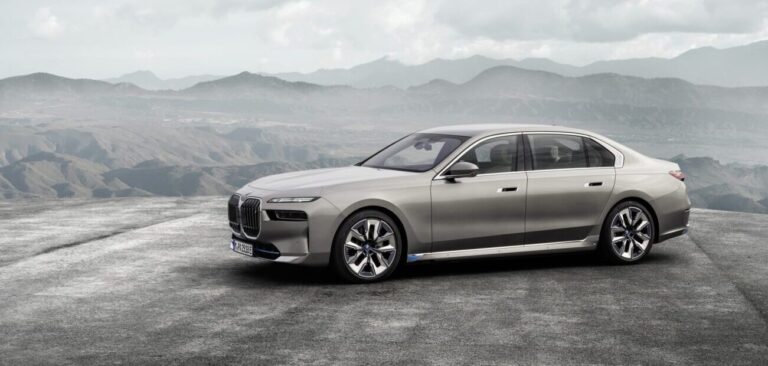
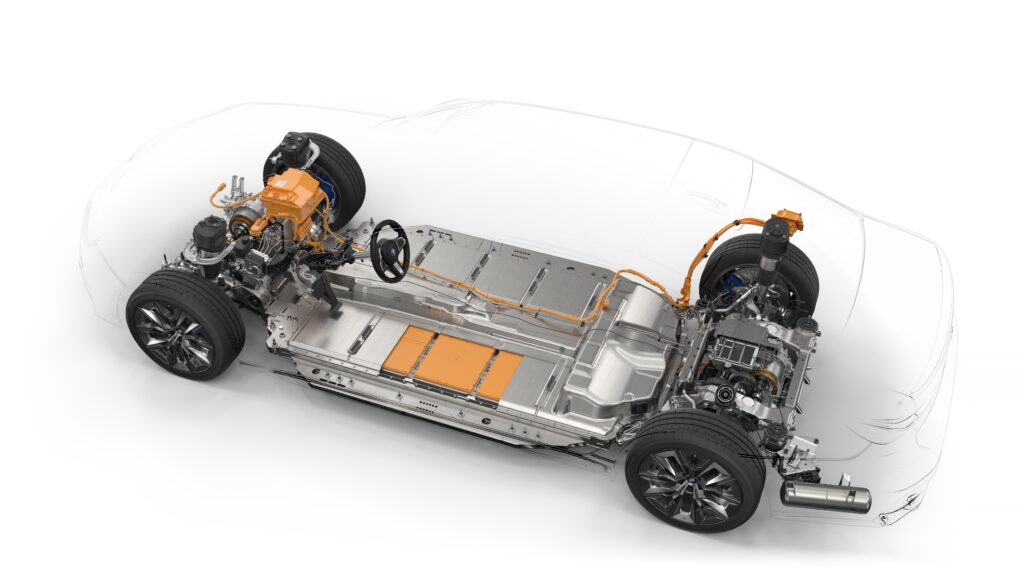
BMW’s latest generation of 7 Series has been unveiled, with the range gaining an all-electric variant for the first time, the i7. This harnesses BMW’s fifth-generation eDrive technology consisting of integrated drive units at the front and rear axles in addition to the accompanying charging and high-voltage battery systems.

Compared to current applications of the latest e-drive, BMW states that control of the system’s adaptive recuperation function has been further refined in the BMW i7 to increase range. Compared with the BMW iX and BMW i4 models, the charging software has also undergone further improvement, meaning the temperature of the high-voltage battery is controlled more precisely and there is also an innovative facility for saving charging profiles.

The drive units do not use any rare earth magnets, instead relying on a pair of electrically excited synchronous motors. The motor driving the rear wheels generates peak output of 233kW, while the unit at the front axle produces 192kW, giving a combined maximum output of 425kW and torque of 745Nm.

BMW says it has gone to great lengths to reduce the height of the floor-mounted battery pack, which is just 110mm tall, and provides 101.7 kWh of usable energy. Heat pump technology used in the integrated heating and cooling system for the cabin and drive system also helps boost efficiency, as does the adaptive or individually adjustable recuperation feature. The high-voltage battery is heated using a dedicated 5.5kW electric flow heater.

Refinement of the adaptive recuperation feature means it is now also able to take downhill sections and information from the traffic-light recognition function into account. Adaptive recuperation generally allows the intensity of brake energy regeneration during overrun and braking to be automatically optimized for the road situation, as detected using data from the navigation system and the driver assistance systems’ sensors.

When approaching a junction, for example, the level of recuperation can be increased – even if route guidance isn’t activated – thereby feeding energy back into the high-voltage battery while harnessing the deceleration effect at the same time. On the open road, meanwhile, the coasting function can take over, enabling the car to “freewheel” with no drive power whenever the driver eases off the accelerator. Energy is no longer supplied to the two electric motors in this state, meaning no battery power is consumed.

The charging control algorithms have also come in for attention compared to BMW’s other EV models. Now, once the high-voltage battery reaches a higher charge level, the new charging process aims to ensure the charging rate drops smoothly instead of following the previous “stepped” curve. This produces a more rounded charging curve overall, resulting in shorter charging times. Following an initial, temperature-dependent phase of constant power supply, the new process now also controls charging based on a continuous nominal voltage curve that allows for the variables of temperature, recharged capacity and charge level at start of charging.

Furthermore, alternating phases of full and partial cooling power are used during fast charging to avoid excessive cooling of the battery. This prevents cell temperatures from dropping too low in the process, particularly at higher charge levels, thereby opening up potential for short charging times and reduced aging of the high-voltage battery’s cells.
Share. LinkedIn Twitter Facebook Email

Related Posts

New chassis and powertrain event to launch at Vehicle Tech Week North America 2026

May 6, 2026

AI-defined vehicles and expanded electrification shape Nissan’s future mobility strategy

April 20, 2026

Nissan launches electric Juke

April 16, 2026
LATEST NEWS

Renault introduces LPG bi-fuel Clio that delivers up to 1,450km range

May 7, 2026

UK consortium secures funding for ReCAM lithium-ion battery recycling project

May 7, 2026

BorgWarner wins turbocharger contracts with two European OEMs

May 7, 2026

Receive breaking stories and features in your inbox each week, for free


Enter your email address:


Supplier Spotlights
  • Japan Metal Gasket
Featured Listings
  • There are currently no listings to show.
Getting in Touch
  • Contact Us
  • Media Pack
  • Meet the Editors
  • Free Weekly E-Newsletter
Our Social Channels
  • LinkedIn
Related UKi Topics
  • Automotive Interiors
  • Automotive Testing
  • Autonomous Vehicle
  • Professional Motorsport
  • Tire Technology
  • Media Pack
© 2026 UKi Media & Events a division of UKIP Media & Events Ltd
  • Terms and Conditions
  • Privacy Policy
  • Cookie Policy
  • Notice and Takedown Policy

Type above and press Enter to search. Press Esc to cancel.