
Close Menu
  • News
      • Appointments
      • EV Powertrain
      • Emissions
      • Engine Components
      • Electronics
      • Facility Developments
      • Forced Induction
      • Fuel Cell Technologies
      • Fuels & Lubricants
      • Heavy-duty & Diesel Engine Technologies
      • Hybrid Powertrain Technologies
      • Industry Forecasting
      • Legislation
      • Materials & Surface Treatment
      • Metallurgy
      • Mild-hybrid & 48V Technologies
      • New powertrain
      • Partnerships, Investments & Acquisitions
      • Quality Control
      • Prototyping
      • Sustainable fuels
      • Testing
      • Traction Control Systems
      • Transmissions Technologies
      • Webinars
  • Features
  • Online Magazines
    • April 2026
    • January 2026
    • September 2025
    • June 2025
    • March 2025
    • January 2025
    • September 2024
    • Subscribe to Automotive Powertrain Technology
    • Transmission Technology International
    • Subscribe to Transmission Technology
  • Opinion
  • Events
  • Supplier Spotlight
  • Webinars
Facebook X (Twitter) Instagram
  • Automotive Interiors
  • Automotive Testing
  • Autonomous Vehicle
  • Professional Motorsport
  • Tire Technology
  • Media Pack
LinkedIn
Subscribe
Automotive Powertrain Technology International
  • News
      • Appointments
      • EV Powertrain
      • Emissions
      • Engine Components
      • Electronics
      • Facility Developments
      • Forced Induction
      • Fuel Cell Technologies
      • Fuels & Lubricants
      • Heavy-duty & Diesel Engine Technologies
      • Hybrid Powertrain Technologies
      • Industry Forecasting
      • Legislation
      • Materials & Surface Treatment
      • Metallurgy
      • Mild-hybrid & 48V Technologies
      • New powertrain
      • Partnerships, Investments & Acquisitions
      • Quality Control
      • Prototyping
      • Sustainable fuels
      • Testing
      • Traction Control Systems
      • Transmissions Technologies
      • Webinars
  • Features
  • Online Magazines
    1. April 2026
    2. January 2026
    3. September 2025
    4. June 2025
    5. March 2025
    6. January 2025
    7. September 2024
    8. Subscribe to Automotive Powertrain Technology
    9. Transmission Technology International
    10. Subscribe to Transmission Technology
    Featured

    In this Issue – April 2026

    By Web TeamMay 1, 2026
    Recent

    In this Issue – April 2026

    May 1, 2026

    In this Issue – January 2026

    December 3, 2025

    In this Issue – September 2025

    September 25, 2025
  • Opinion
  • Events
  • Supplier Spotlight
  • Webinars
LinkedIn Facebook
Subscribe
Automotive Powertrain Technology International
Battery management

SABIC demonstrates potential of thermoplastics to prevent thermal runaway in EV batteries

Izzy WoodBy Izzy WoodMay 8, 20243 Mins Read
LinkedIn Twitter Facebook Email
SABIC demonstrates potential of thermoplastics to prevent thermal runaway in EV batteries
Share
LinkedIn Twitter Facebook Email

Chemical specialist SABIC has presented test results that demonstrate the potential of thermoplastic-based thermal runaway barrier solutions to help prevent fire spread within electric vehicle (EV) batteries.

Visitors to SABIC’s booth at the NPE2024: The Plastics Show in Orlando, Florida, this week are able to see the tested thermoplastic battery module box, which is on display in an area of the show dedicated to the BlueHero initiative supporting the automotive industry’s transition to electric power and a low-carbon future. Various EV battery components made with SABIC’s materials, including module enclosures, busbars and end plates, are also on display at the booth.

The test series conducted by SABIC at the sub-system level revealed that using a battery module box made from Stamax 30YH570 long glass fiber polypropylene (PP) resin, with an intercellular thickness as low as 1mm, could serve as an effective thermal barrier. This material, according to SABIC, demonstrates the ability to provide necessary thermal insulation and flame resistance, reducing the likelihood of cell-to-cell propagation during a thermal runaway scenario, thus helping to mitigate safety risks.
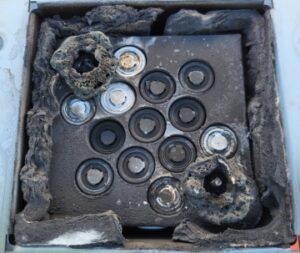
Cylindrical battery cells arranged within a thermal runaway barrier made of SABIC’s flame-retardant Stamax resin with a minimum intercellular gap of 1.0 mm, after thermal runaway test, with evidence of no propagation from trigger cells (top left cell and bottom right cell) to neighboring cells.

These recent findings build upon previous independent evaluations of SABIC’s Stamax 30YH570 resin, which in 2023 received the UL Verified Mark from Underwriters Laboratories for effective flame delay performance. The assessment, based on UL 2596, highlighted the material’s ability to delay flames effectively, particularly in battery enclosure applications.

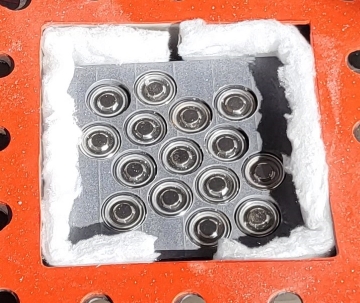
The thermal runaway propagation tests conducted at NPE involved a cluster of lithium-ion battery cells enclosed in a steel chamber, with and without injection-molded Stamax 30YH570 resin blocks serving as a thermal barrier. In tests without the thermal barrier, thermal runaway led to hazards such as high-temperature gas, open flames, and pressure increases, propagating to neighboring cells. However, the presence of the thermal barrier effectively suppressed heat transfer and thermal propagation, ensuring the safety of the remaining cells.

Furthermore, SABIC is also presenting various EV battery applications at NPE that successfully use its thermoplastics. For instance, the battery module from the 2023 Hyundai Ioniq 6 incorporates SABIC polypropylene compound H1030 for module enclosures, designed to meet stringent fire safety regulations for EVs.

“We are pleased to share this additional validation of our thermoplastic solutions’ strong potential for use in EV battery components and systems,” said Fahad Al-Harthi, global director of automotive at SABIC Polymers.

“Our portfolio of flame-retardant materials, combined with our expertise in application design and fire-polymer interaction, can help enable new thermal runaway barrier approaches. We look forward to continued collaboration across the automotive value chain to help improve the safety, efficiency and performance of EV battery systems.”

Share. LinkedIn Twitter Facebook Email

Related Posts

BatteryIQ calls for connected battery-health monitoring to reduce recalls

March 6, 2026

Independent tests verify Donut Lab’s five-minute solid-state charging solution

February 24, 2026

Integrals Power LMFP cells pass 1,500-cycle test milestone with strong durability and low-temperature performance

February 17, 2026
LATEST NEWS

Renault introduces LPG bi-fuel Clio that delivers up to 1,450km range

May 7, 2026

UK consortium secures funding for ReCAM lithium-ion battery recycling project

May 7, 2026

BorgWarner wins turbocharger contracts with two European OEMs

May 7, 2026

Receive breaking stories and features in your inbox each week, for free


Enter your email address:


Supplier Spotlights
  • Valvoline Europe (Ellis Enterprises B.V.)
Featured Listings
  • There are currently no listings to show.
Getting in Touch
  • Contact Us
  • Media Pack
  • Meet the Editors
  • Free Weekly E-Newsletter
Our Social Channels
  • LinkedIn
Related UKi Topics
  • Automotive Interiors
  • Automotive Testing
  • Autonomous Vehicle
  • Professional Motorsport
  • Tire Technology
  • Media Pack
© 2026 UKi Media & Events a division of UKIP Media & Events Ltd
  • Terms and Conditions
  • Privacy Policy
  • Cookie Policy
  • Notice and Takedown Policy

Type above and press Enter to search. Press Esc to cancel.