

Close Menu
  • News
      • Appointments
      • EV Powertrain
      • Emissions
      • Engine Components
      • Electronics
      • Facility Developments
      • Forced Induction
      • Fuel Cell Technologies
      • Fuels & Lubricants
      • Heavy-duty & Diesel Engine Technologies
      • Hybrid Powertrain Technologies
      • Industry Forecasting
      • Legislation
      • Materials & Surface Treatment
      • Metallurgy
      • Mild-hybrid & 48V Technologies
      • New powertrain
      • Partnerships, Investments & Acquisitions
      • Quality Control
      • Prototyping
      • Sustainable fuels
      • Testing
      • Traction Control Systems
      • Transmissions Technologies
      • Webinars
  • Features
  • Online Magazines
    • April 2026
    • January 2026
    • September 2025
    • June 2025
    • March 2025
    • January 2025
    • September 2024
    • Subscribe to Automotive Powertrain Technology
    • Transmission Technology International
    • Subscribe to Transmission Technology
  • Opinion
  • Supplier Spotlight
  • Webinars
Facebook X (Twitter) Instagram
  • Automotive Interiors
  • Automotive Testing
  • Autonomous Vehicle
  • Professional Motorsport
  • Tire Technology
  • Media Pack
LinkedIn
Subscribe
Automotive Powertrain Technology International
  • News
      • Appointments
      • EV Powertrain
      • Emissions
      • Engine Components
      • Electronics
      • Facility Developments
      • Forced Induction
      • Fuel Cell Technologies
      • Fuels & Lubricants
      • Heavy-duty & Diesel Engine Technologies
      • Hybrid Powertrain Technologies
      • Industry Forecasting
      • Legislation
      • Materials & Surface Treatment
      • Metallurgy
      • Mild-hybrid & 48V Technologies
      • New powertrain
      • Partnerships, Investments & Acquisitions
      • Quality Control
      • Prototyping
      • Sustainable fuels
      • Testing
      • Traction Control Systems
      • Transmissions Technologies
      • Webinars
  • Features
  • Online Magazines
    1. April 2026
    2. January 2026
    3. September 2025
    4. June 2025
    5. March 2025
    6. January 2025
    7. September 2024
    8. Subscribe to Automotive Powertrain Technology
    9. Transmission Technology International
    10. Subscribe to Transmission Technology
    Featured

    In this Issue – April 2026

    By Web TeamMay 1, 2026
    Recent

    In this Issue – April 2026

    May 1, 2026

    In this Issue – January 2026

    December 3, 2025

    In this Issue – September 2025

    September 25, 2025
  • Opinion
  • Supplier Spotlight
  • Webinars
LinkedIn Facebook
Subscribe
Automotive Powertrain Technology International
Battery technology

Tech Insight: Battery construction, Pt.2. Cooling

Lawrence ButcherBy Lawrence ButcherDecember 25, 20233 Mins Read
LinkedIn Twitter Facebook Email
Share
LinkedIn Twitter Facebook Email

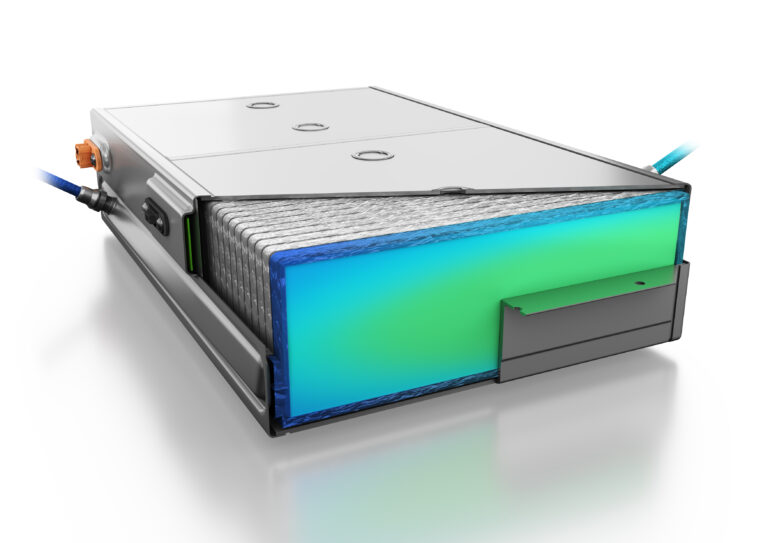
Cooling strategies can have a significant impact not only on the operation of a battery pack, but also on the manufacturability. Balancing an effective cooling system, which ensures even temperature distribution across cells, against the cost of complexity can be approached in a variety of ways.

As with pack construction, every manufacturer has their own unique take. Looking at the very high-performance end of the market, Lucid uses a cold plate design that sits atop the cylindrical cells in each of its modules, with the current collector fingers located on the bottom of each module (the tops of the cells are oriented downward so that if they vent, this is directed away from the passenger cabin). The cold plates feature dimples to increase surface area and are supplied with a water-glycol cooling mix from a central cooling supply that runs up the center of the pack. The cells in Lucid’s modules are not potted; block of cells are split by dividers to deliver a degree of compartmentalization. Contrast this with Tesla’s approach on the Model S and others, which use a side cooling approach. For the ultimate in performance, top and side cooling can be deployed, as is the case with Rimac’s pack design in the Nevera, which has top and bottom cooling plates.

One cooling solution that is particularly worthy of note from a manufacturability perspective is that developed by Hyundai for its E-GMP (Electric Global Modular Platform), which uses a single large cold plate to form the bottom of its battery pack, rather than individual module level plates. This has a number of benefits: it reduces the number of processes needed for manufacture of the pack while also placing all of the cooling connections external to the pack, which not only aids serviceability but also practically eliminates the possibility of internal coolant leaks. VW’s MEB (modular electric drive matrix) platform takes a similar approach.
Immersion time
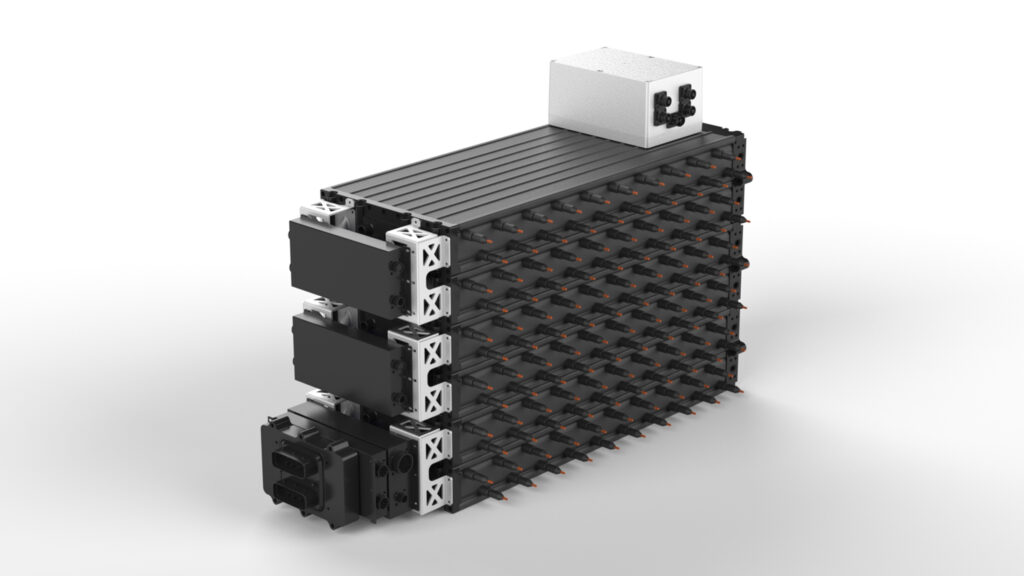
Direct or immersion liquid cooling1 is one area of particular interest for high-performance battery applications. Although it does introduce considerable complexity into the construction of a pack, it is exceptionally effective for heat removal.

There are plenty of immersion-cooled battery systems in development. For example, UK-based Sprint Power is looking to commercialize a modular battery concept that places a 5kWh pack, complete with BMS, immersion cooling and integrated pump within a single housing. Capable of a peak discharge rate of 230kW over five seconds, or 105kW continuously, the pack is aimed at use in hybrid vehicles. The high C-rate is achieved through the use of both immersion cooling and very high power cells from another UK company, AMTE Power. According to the company, the pouch cells are capable of 35C continuous discharge. Notably, Sprint Power has been working closely with Castrol, the brand of BP responsible for lubricant and coolant development, on immersion cooling fluids for EV applications.

1) Roe C, Feng X, White G, Li R, Wang H, Rui X, Li C, Zhang F, Null V, Parkes M, Patel Y, Wang Y, Wang H, Ouyang M, Offer G & Wu B (2022), Immersion cooling for lithium-ion batteries – a review. Journal of Power Sources

Share. LinkedIn Twitter Facebook Email

Related Posts

Ferrari unveils all-electric Luce

May 29, 2026

Scania under-cab battery module and Megawatt Charging System available for order

May 29, 2026

Mercedes‑AMG presents all-electric GT 4‑Door Coupe

May 21, 2026
LATEST NEWS

Ferrari unveils all-electric Luce

May 29, 2026

Scania under-cab battery module and Megawatt Charging System available for order

May 29, 2026

Maserati Nettuno engine transformed into 480kW hydrogen race unit

May 29, 2026

Receive breaking stories and features in your inbox each week, for free


Enter your email address:


Supplier Spotlights
  • Dytran
Featured Listings
  • There are currently no listings to show.
Getting in Touch
  • Contact Us
  • Media Pack
  • Meet the Editors
  • Free Weekly E-Newsletter
Our Social Channels
  • LinkedIn
Related UKi Topics
  • Automotive Interiors
  • Automotive Testing
  • Autonomous Vehicle
  • Professional Motorsport
  • Tire Technology
  • Media Pack
© 2026 UKi Media & Events a division of UKIP Media & Events Ltd
  • Terms and Conditions
  • Privacy Policy
  • Cookie Policy
  • Notice and Takedown Policy

Type above and press Enter to search. Press Esc to cancel.