
Close Menu
  • News
      • Appointments
      • EV Powertrain
      • Emissions
      • Engine Components
      • Electronics
      • Facility Developments
      • Forced Induction
      • Fuel Cell Technologies
      • Fuels & Lubricants
      • Heavy-duty & Diesel Engine Technologies
      • Hybrid Powertrain Technologies
      • Industry Forecasting
      • Legislation
      • Materials & Surface Treatment
      • Metallurgy
      • Mild-hybrid & 48V Technologies
      • New powertrain
      • Partnerships, Investments & Acquisitions
      • Quality Control
      • Prototyping
      • Sustainable fuels
      • Testing
      • Traction Control Systems
      • Transmissions Technologies
      • Webinars
  • Features
  • Online Magazines
    • April 2026
    • January 2026
    • September 2025
    • June 2025
    • March 2025
    • January 2025
    • September 2024
    • Subscribe to Automotive Powertrain Technology
    • Transmission Technology International
    • Subscribe to Transmission Technology
  • Opinion
  • Events
  • Supplier Spotlight
  • Webinars
Facebook X (Twitter) Instagram
  • Automotive Interiors
  • Automotive Testing
  • Autonomous Vehicle
  • Professional Motorsport
  • Tire Technology
  • Media Pack
LinkedIn
Subscribe
Automotive Powertrain Technology International
  • News
      • Appointments
      • EV Powertrain
      • Emissions
      • Engine Components
      • Electronics
      • Facility Developments
      • Forced Induction
      • Fuel Cell Technologies
      • Fuels & Lubricants
      • Heavy-duty & Diesel Engine Technologies
      • Hybrid Powertrain Technologies
      • Industry Forecasting
      • Legislation
      • Materials & Surface Treatment
      • Metallurgy
      • Mild-hybrid & 48V Technologies
      • New powertrain
      • Partnerships, Investments & Acquisitions
      • Quality Control
      • Prototyping
      • Sustainable fuels
      • Testing
      • Traction Control Systems
      • Transmissions Technologies
      • Webinars
  • Features
  • Online Magazines
    1. April 2026
    2. January 2026
    3. September 2025
    4. June 2025
    5. March 2025
    6. January 2025
    7. September 2024
    8. Subscribe to Automotive Powertrain Technology
    9. Transmission Technology International
    10. Subscribe to Transmission Technology
    Featured

    In this Issue – April 2026

    By Web TeamMay 1, 2026
    Recent

    In this Issue – April 2026

    May 1, 2026

    In this Issue – January 2026

    December 3, 2025

    In this Issue – September 2025

    September 25, 2025
  • Opinion
  • Events
  • Supplier Spotlight
  • Webinars
LinkedIn Facebook
Subscribe
Automotive Powertrain Technology International
Features

BMW details twin-cylinder boxer concept

Sam PettersBy Sam PettersDecember 4, 20192 Mins Read
LinkedIn Twitter Facebook Email
Share
LinkedIn Twitter Facebook Email

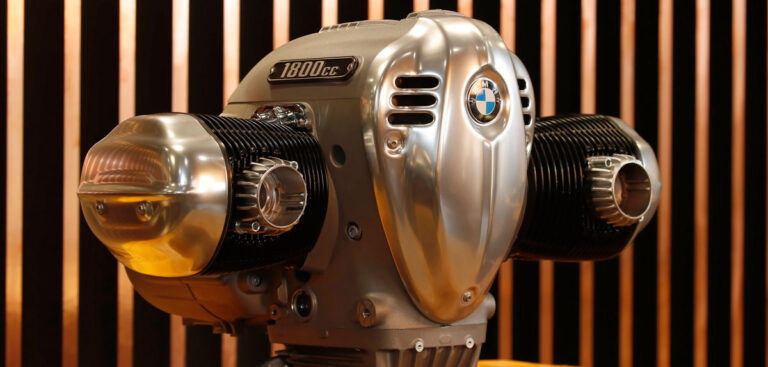
At the debut of BMW Motorrad’s Concept R 18, the company also unveiled a state-of-the-art boxer engine. Claimed by BMW to be the highest-capacity two-cylinder boxer engine ever, the 1,802cc Big Boxer will output 91ps at 4,750rpm.

With an OHV valve drive along with a separate engine and transmission housing, the new boxer engine has the same structural features that distinguished the very first BMW Motorrad boxer engine, which at that time had laterally controlled valves.

The twin-cylinder engine has a 107.1mm bore and a 100mm stroke, while maximum torque of 158Nm is available at 3,000rpm. More than 150Nm is available from 2,000rpm to 4,000 rpm. The maximum engine speed is 5,750rpm, while the idling speed is 950rpm.

BMW’s Big Boxer is air/oil cooled, has large ribbed cylinders and cylinder heads and weighs 110.8kg including gearbox and intake system. It has a vertically split aluminum engine housing.

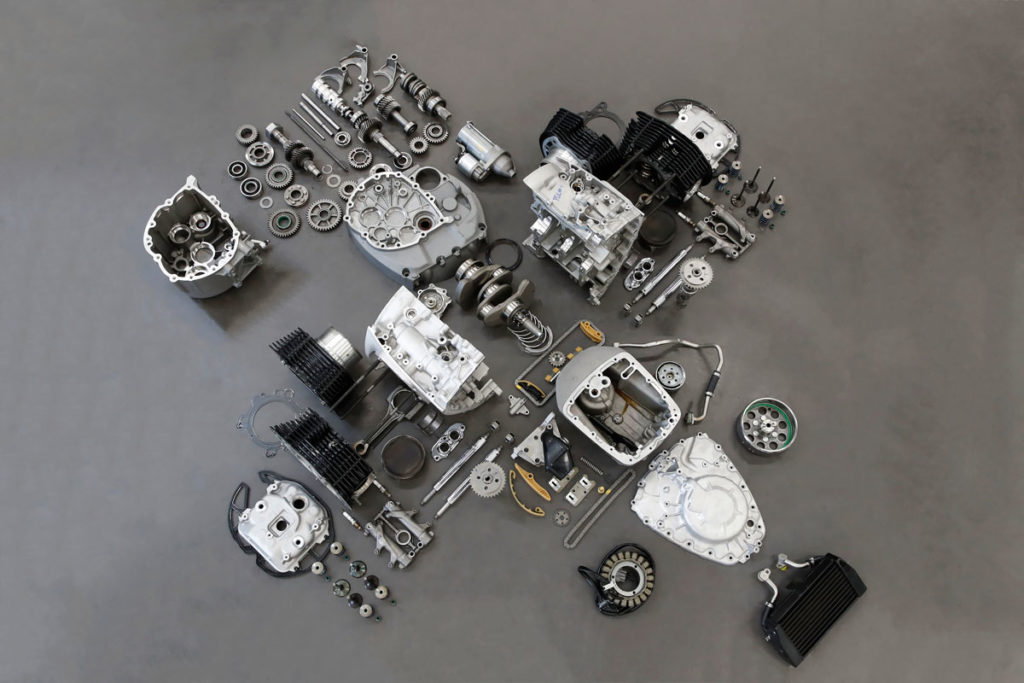
Unlike the classic air-cooled two-valve boxer engines made by BMW Motorrad, however, the crankshaft – forged from quenched and tempered steel – has an additional main bearing at the center, which was necessary due to the cylinder volume in order to prevent bending vibrations of the crankshaft.

Lubricating and cooling oil is supplied by a wet sump lubrication system with a two-stage oil pump via sleeve-type chain driven by the crankshaft.

Although the Big Boxer has four valves, dual ignition, a modern combustion chamber architecture, intake manifold injection and the BMS-O engine management system, it uses the classic OHV configuration for its valve drive.

The two camshafts are positioned to the left and right above the crankshaft. The advantage of this is the shorter pushrods. This makes for reduced moving masses, minimized deflections and lower linear expansions, as well as a generally stiffer valve drive with improved control precision and higher speed stability.
Share. LinkedIn Twitter Facebook Email

Related Posts

Study reveals what EV buyers really ask about batteries

November 12, 2025

New self-assembling material could be the key to recyclable EV batteries

September 4, 2025

Hyundai/GM alliance powers forward with five all-new vehicles

August 12, 2025
LATEST NEWS

Renault introduces LPG bi-fuel Clio that delivers up to 1,450km range

May 7, 2026

UK consortium secures funding for ReCAM lithium-ion battery recycling project

May 7, 2026

BorgWarner wins turbocharger contracts with two European OEMs

May 7, 2026

Receive breaking stories and features in your inbox each week, for free


Enter your email address:


Supplier Spotlights
  • Amsted Automotive
Featured Listings
  • There are currently no listings to show.
Getting in Touch
  • Contact Us
  • Media Pack
  • Meet the Editors
  • Free Weekly E-Newsletter
Our Social Channels
  • LinkedIn
Related UKi Topics
  • Automotive Interiors
  • Automotive Testing
  • Autonomous Vehicle
  • Professional Motorsport
  • Tire Technology
  • Media Pack
© 2026 UKi Media & Events a division of UKIP Media & Events Ltd
  • Terms and Conditions
  • Privacy Policy
  • Cookie Policy
  • Notice and Takedown Policy

Type above and press Enter to search. Press Esc to cancel.