

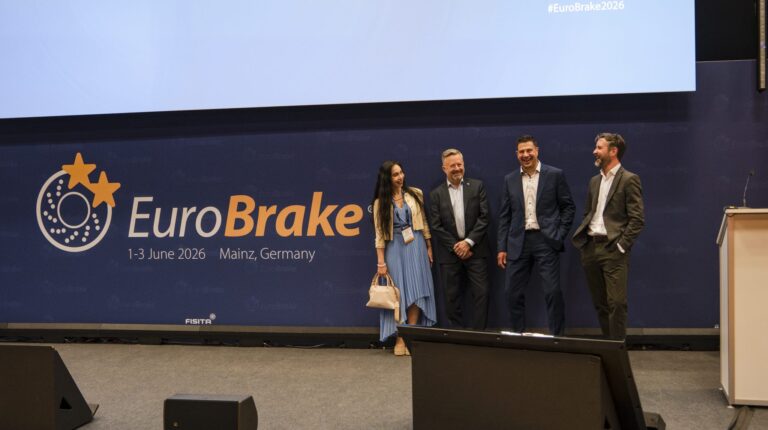
This year’s EuroBrake highlighted the role of brake technology as a fundamental safety-critical component, alongside its expanding function in next-generation mobility engineering – from the development of safer vehicles and intelligent systems architectures to cleaner, more sustainable mobility.
Organized by FISITA and the EuroBrake Steering Committee, and held in Mainz, Germany, on June 1-3, the 14th edition of EuroBrake gathered speakers, 110 exhibitors and 1,100 delegates to explore brake emissions, Euro 7 readiness, software-defined braking and integrated system design in a rapidly evolving field.
A clear message emerged: braking is no longer a standalone component, but central to safety, sustainability, vehicle performance and intelligent system architecture.
Safety first
The plenary session discussed brakes as the baseline for vehicle safety. “As tech advances, safety advances,” said Jan Münchhoff, EuroBrake chair and head of development functions assisted driving and parking, active safety, at Audi. “Brake systems are integrating with software and creating safer, cleaner environments.” For example, speaker Tomohiro Yokoyama, brake-by-wire project manager at Toyota, proposed a brake-by-wire (BBW) solution to address brake misapplication among elderly drivers.
The next emissions frontier
EU data revealed brakes and tires account for nearly half of total particle emissions. To address this, Timo Schmidt, manager for e-drive system design and testing, and Niels Schreuders, project lead for in-drive brake, at Mercedes-Benz, proposed an in-drive brake concept, moving the brake system into the e-drive system, significantly reducing rear axle emissions. Enhanced vehicle dynamics are required to scale the concept. “A torque vectoring module could improve agility and predictability while acting as a differential on the rear axle,” said Schreuders.
Sustainability also creates challenges. Arianna Pavesi, a materials specialist at Brembo, shared how recycled aluminum alloys can negatively affect the mechanical performance of brake callipers.
Beyond stopping
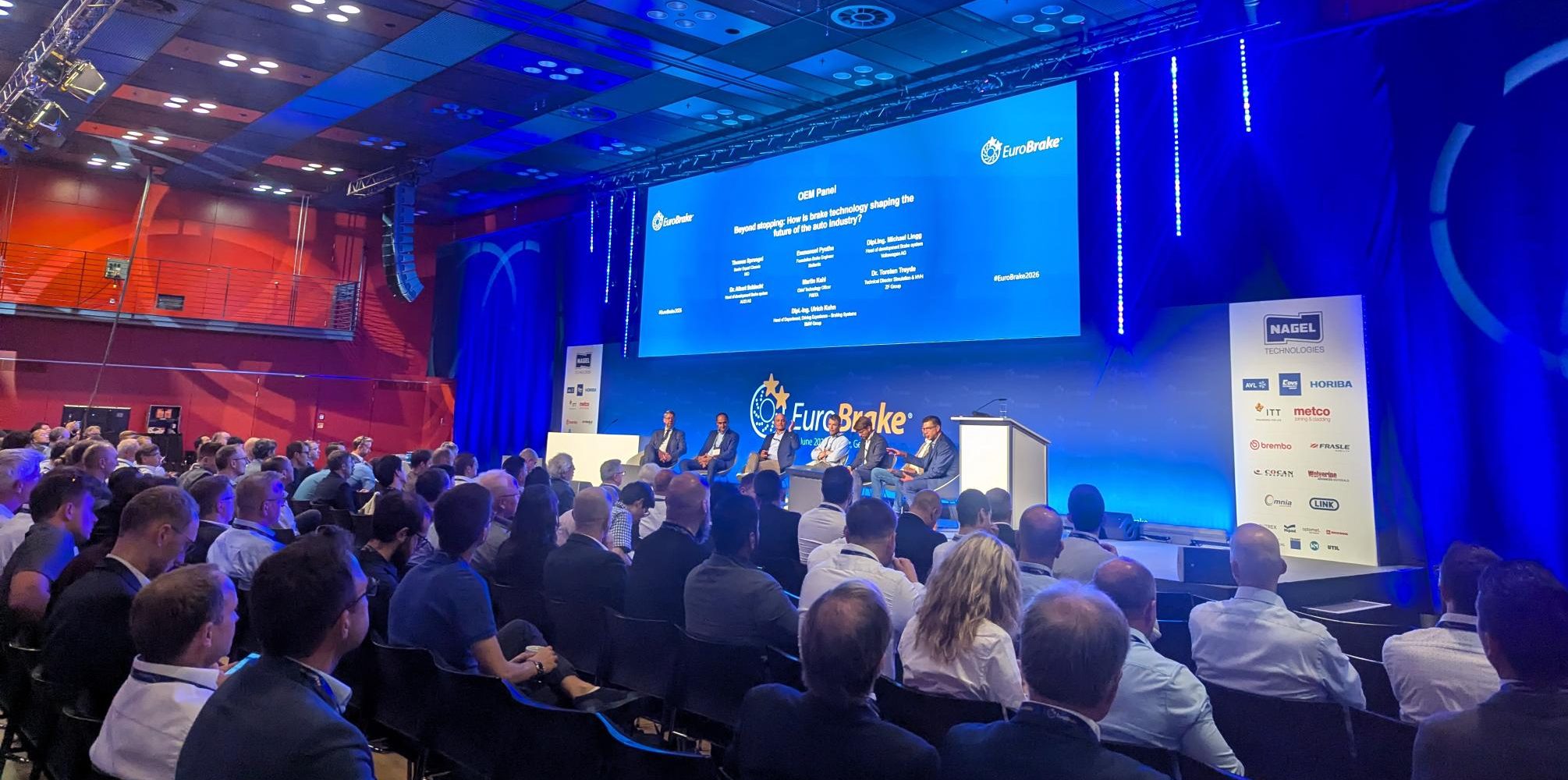
An OEM panel addressed customer expectations, regulation, cost, electrification, software-defined vehicles and automated driving. Albert Schlecht, head of brake system development at Audi, emphasized high-integration to connect functions, whereas Thomas Sprengel, senior chassis expert at Nio, highlighted pressure to adopt technologies such as brake-by-wire (BBW) to meet customer expectations.
Disruptive technologies include brake-by-wire, open-system architectures, motor disc brakes, in-drive braking concepts and AI-driven development, as well as the need for BBW standardization. Panelists agreed AI’s role lies in accelerating development and optimization rather than safety-critical decision-making. And FISITA CTO Martin Kahl noted, “Braking is evolving from a friction product to an intelligent, electronic system at the heart of vehicle development.”
Reinventing braking
A strategy panel explored how disruptive development pathways rethink system innovation beyond the friction pair. Nico Waegerle, CEO and co-founder at Certivity, said AI can accelerate product compliance but that human-in-the-loop is essential and Frank Beier, developer of actuation and brake components at Volkswagen, noted that reinvented pedal boxes are a major component in future BBW systems.
Christof Danner, a technical expert in brake systems at the Austrian Center of Brake Competence, said Euro7 is propelling new technologies such as coated discs, electromechanical brakes and alternative brake designs, but that issues remain with BBW brake pedal feeling and integration with all drive systems.
Tires, regulation and emissions
Braking distances depend heavily on tire wear, which was highlighted by Dr Ludovic Grèverie, vice president of technical operations – passenger car and light truck tires at Michelin, who underlined the need for tires optimized for braking performance.
Research from Stockholm University’s Wandera Kisimbiri showed VOC to PM10 emission ratios increase with braking intensity and pad composition, reinforcing the importance of brake particle regulation.
 AVL also exhibited its fully integrated AVL Brake Test System, featuring the Particle Sampling Enclosure (see above), which minimizes particle loss and ensures homogeneous aerosol distribution, capturing all particle sizes. AVL’s business marketing specliaist Marina Gross said, “As a key contributor to GTR24 and UNR179 on brake emissions, AVL also presented its latest research, underlining its commitment to shaping future brake emissions regulations for light and heavy duty.”
Chassis integration
FISITA’s Advanced Chassis Technology Expert Group highlighted how integral braking is to the chassis ecosystem, with software-defining system behavior. “EuroBrake is the premier global forum for brake development and technical discussion,” said Fabio Squadrani, senior manager for braking systems at Applus Idiada and chair of this FISITA expert group. “This year spotlighted a fundamental shift across OEMs and Tier 1 suppliers: the recognition that brake systems are no longer standalone components, but integral elements within a holistic motion control ecosystem.”
Testing and development tools
Anton Tworek, a development engineer at MdynamiX, presented a unified approach to HIL- and DIL-connected testing of brake systems for robustness and driver acceptance, and noted that standard simulators aren’t fully suitable for brake development.
“The market needs to speed development,” said Tristan Schwandke, head of sales and marketing at Mdynamix. “Our HiL solutions increase efficiency by bridging SIL/MIL to real testing. Chassis systems, such as steering and braking, are integrated in a real-time simulation environment with DIL. You can calibrate/tune ECUs and test drive in one loop.”
Process tools
Advanced image processing and deep learning techniques for corrosion detection and evaluation of brake discs were presented by Brembo SGL Carbon Ceramic Brakes data scientist Lorenzo Rota and R&D testing laboratory head Giovanni Arena. “Cosmetic corrosion on brake pads should be measured for customer perception, benchmarking, and continuous improvement,” said Lorenzo. “A missing component in the testing workflow to meet the ISO standard is a quantitative, objective evaluation. Using main field image processing and AI, the most relevant KPI is the ratio between the corroded and total surface area.”
Beyond automotive
The event touched on passenger cars, commercial vehicles, bicycles, motorcycles, and trains. Klaus Jaeckel, manager of wheel brake systems at Daimler Truck, chaired the HDV session, and said, “Upcoming legislation on the regulation of brake particulate emissions has led to many HDV presentations. I have received excellent feedback from HDV OEMs, brake and lining manufacturers and universities.”
“Innovative solutions are taking braking away from the corners into the center of the vehicle, integrating it into the electric motor and transmission unit,” said FISITA CTO Kahl. “But more needs to be done for friction brake systems on current platforms and vehicles launched in the next few years.”
The EuroBrake Student Opportunities Programme (ESOP)
FISITA CEO Chris Mason shared how EuroBrake is supporting young engineers to learn about mobility and braking technology, through the Harald Abendroth Award as well as special recognition of the top three EuroBrake poster presentations and the top three ESOP poster presentations.
Up next: FISITA’s Intelligent Safety Group will be speaking at this week’s Autonomous Vehicle Tech Expo Europe, which will take place at the Messe Stuttgart, Germany, on June 23-25.
Read more about Autonomous Vehicle Tech Expo Europe here.
Autonomous Vehicle Tech Expo, Automotive Interiors Expo and Automotive Testing Expo together comprise Vehicle Tech Week Europe, the continent’s landmark event for vehicle technology.