

Close Menu
  • News
      • Appointments
      • EV Powertrain
      • Emissions
      • Engine Components
      • Electronics
      • Facility Developments
      • Forced Induction
      • Fuel Cell Technologies
      • Fuels & Lubricants
      • Heavy-duty & Diesel Engine Technologies
      • Hybrid Powertrain Technologies
      • Industry Forecasting
      • Legislation
      • Materials & Surface Treatment
      • Metallurgy
      • Mild-hybrid & 48V Technologies
      • New powertrain
      • Partnerships, Investments & Acquisitions
      • Quality Control
      • Prototyping
      • Sustainable fuels
      • Testing
      • Traction Control Systems
      • Transmissions Technologies
      • Webinars
  • Features
  • Online Magazines
    • April 2026
    • January 2026
    • September 2025
    • June 2025
    • March 2025
    • January 2025
    • September 2024
    • Subscribe to Automotive Powertrain Technology
    • Transmission Technology International
    • Subscribe to Transmission Technology
  • Opinion
  • Events
  • Supplier Spotlight
  • Webinars
Facebook X (Twitter) Instagram
  • Automotive Interiors
  • Automotive Testing
  • Autonomous Vehicle
  • Professional Motorsport
  • Tire Technology
  • Media Pack
LinkedIn
Subscribe
Automotive Powertrain Technology International
  • News
      • Appointments
      • EV Powertrain
      • Emissions
      • Engine Components
      • Electronics
      • Facility Developments
      • Forced Induction
      • Fuel Cell Technologies
      • Fuels & Lubricants
      • Heavy-duty & Diesel Engine Technologies
      • Hybrid Powertrain Technologies
      • Industry Forecasting
      • Legislation
      • Materials & Surface Treatment
      • Metallurgy
      • Mild-hybrid & 48V Technologies
      • New powertrain
      • Partnerships, Investments & Acquisitions
      • Quality Control
      • Prototyping
      • Sustainable fuels
      • Testing
      • Traction Control Systems
      • Transmissions Technologies
      • Webinars
  • Features
  • Online Magazines
    1. April 2026
    2. January 2026
    3. September 2025
    4. June 2025
    5. March 2025
    6. January 2025
    7. September 2024
    8. Subscribe to Automotive Powertrain Technology
    9. Transmission Technology International
    10. Subscribe to Transmission Technology
    Featured

    In this Issue – April 2026

    By Web TeamMay 1, 2026
    Recent

    In this Issue – April 2026

    May 1, 2026

    In this Issue – January 2026

    December 3, 2025

    In this Issue – September 2025

    September 25, 2025
  • Opinion
  • Events
  • Supplier Spotlight
  • Webinars
LinkedIn Facebook
Subscribe
Automotive Powertrain Technology International
New Engine

BYD hits efficiency target with hybrid-specific engine

Lawrence ButcherBy Lawrence ButcherNovember 18, 20202 Mins Read
LinkedIn Twitter Facebook Email
Share
LinkedIn Twitter Facebook Email

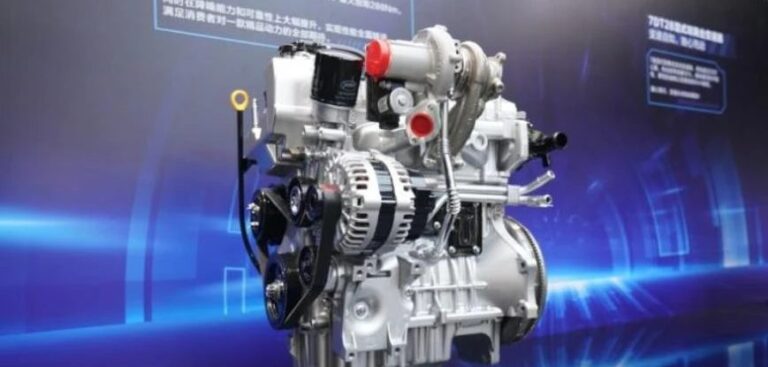
Chinese manufacturer BYD has launched a high-efficiency version of the 1.5-liter Xiaoyun engine, dedicated for use with PHEVs.

The new engine is specifically built to accommodate the company’s DM-i hybrid technology, with a brake thermal efficiency (BTE) of 43%; its makers claim this makes it the world’s most thermally efficient gasoline engine in production.

Eric Li, deputy general manager of BYD Auto Sales, commented, “BYD has always insisted on self-reliance to build its core technology. With our advantages in new energy technologies, we have achieved major breakthroughs in several key areas. The DM-i hybrid will rigorously accelerate the replacement of traditional fuel cars with new energy vehicles.”

In order to achieve such an impressive level of thermal efficiency, BYD says it has used a compression ratio (CR) of 15.5, an increased B/S (Bore to Stroke) ratio, an Atkinson cycle for improved combustion efficiency, an exhaust gas recirculation (EGR) system, and a series of friction-reducing measures.

In addition, the Xiaoyun engine takes full advantage of the electrification of plug-in hybrid models, electrifying accessories and removing the traditional front-engine accessory drive system, further improving efficiency.

The company states it has also implemented a split cooling system for the first time. Through on-demand cylinder head and cylinder block temperature measurements, the cooling provision can be actively managed to ensure optimal running temperatures. BYD notes that mitigating heating losses shortens the warmup cycle after a cold start by 15-20%, reducing fuel consumption and carbon emissions during the process.

Share. LinkedIn Twitter Facebook Email

Related Posts

New chassis and powertrain event to launch at Vehicle Tech Week North America 2026

May 6, 2026

AI-defined vehicles and expanded electrification shape Nissan’s future mobility strategy

April 20, 2026

911 GT3 S/C debuts as lightweight open-top driver’s car with 510ps flat-six engine

April 16, 2026
LATEST NEWS

Renault introduces LPG bi-fuel Clio that delivers up to 1,450km range

May 7, 2026

UK consortium secures funding for ReCAM lithium-ion battery recycling project

May 7, 2026

BorgWarner wins turbocharger contracts with two European OEMs

May 7, 2026

Receive breaking stories and features in your inbox each week, for free


Enter your email address:


Supplier Spotlights
  • ECONAMIQ
Featured Listings
  • There are currently no listings to show.
Getting in Touch
  • Contact Us
  • Media Pack
  • Meet the Editors
  • Free Weekly E-Newsletter
Our Social Channels
  • LinkedIn
Related UKi Topics
  • Automotive Interiors
  • Automotive Testing
  • Autonomous Vehicle
  • Professional Motorsport
  • Tire Technology
  • Media Pack
© 2026 UKi Media & Events a division of UKIP Media & Events Ltd
  • Terms and Conditions
  • Privacy Policy
  • Cookie Policy
  • Notice and Takedown Policy

Type above and press Enter to search. Press Esc to cancel.