

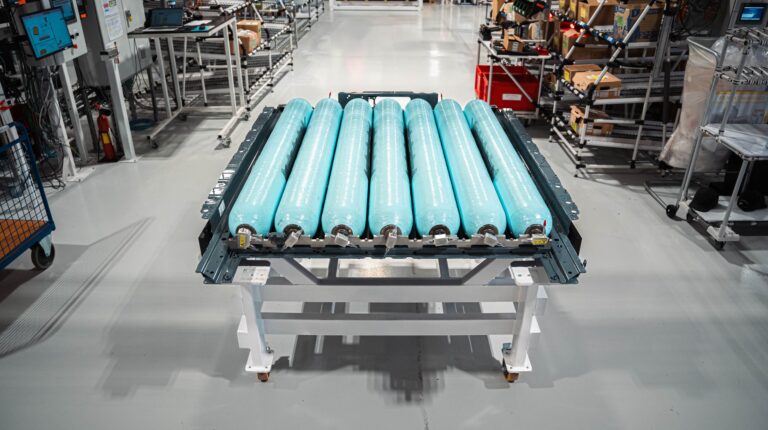
The BMW Group has used its latest hydrogen tank technology in the iX5 Hydrogen. The arrangement and size of the tanks enable a range of up to 750km.
BMW’s Hydrogen Flat Storage system is designed to use vehicle space efficiently and is compatible with the Gen6 high-voltage battery, ensuring no loss of cabin space. This allows fuel cell models to be produced on the same assembly lines as vehicles with other powertrains. The 700-bar high-pressure hydrogen tanks are also integrated within the vehicle structure, providing additional mechanical protection and enhancing safety, according to BMW.
“Our new storage concept allows us to fit the hydrogen drive system into the new X5 precisely and in a way that saves space,” said Dr Joachim Post, the member of the board of management at BMW AG responsible for development. “Think of it as installation Tetris: every customer gets the drive system best suited to their needs and a true BMW X5 with no compromises. This is technology openness and the art of engineering just the way we developers love them!”
Smart storage, more range
The flat tank system consists of seven high-pressure tanks made of carbon-fiber-reinforced composite, which are connected to one another in parallel and integrated into a robust metal frame. Instead of individual pressure vessels, there are several chambers connected to form an enclosed unit. This unit is controlled by a central main valve. In this way, the optimized storage concept enables the BMW iX5 Hydrogen to achieve a greater range. This development alone accounts for several patent applications filed by the BMW Group. The system can store at least 7kg of hydrogen and can be filled from empty in under five minutes.
The BMW Hydrogen Flat Storage technology forms part of the powertrain. It combines with the fuel cell system and an innovative high-voltage battery. The iX5 Hydrogen also benefits from the new Heart of Joy drivetrain and chassis control software, as well as BMW Dynamic Performance Control. It is equipped with latest-generation Gen3 fuel cell technology.
Flexible production
Thanks to the smart and highly flexible architecture of the BMW X5, five drive system variants can be built to suit customer requirements: from battery-electric systems and plug-in hybrids through highly efficient conventional drive systems to hydrogen fuel cell technology.
BMW intends to introduce the BMW iX5 Hydrogen into the group’s production network in 2028.
In related news, GM invests US$150m in Saginaw metal casting facility to support V-8 engine block production