

Close Menu
  • News
      • Appointments
      • EV Powertrain
      • Emissions
      • Engine Components
      • Electronics
      • Facility Developments
      • Forced Induction
      • Fuel Cell Technologies
      • Fuels & Lubricants
      • Heavy-duty & Diesel Engine Technologies
      • Hybrid Powertrain Technologies
      • Industry Forecasting
      • Legislation
      • Materials & Surface Treatment
      • Metallurgy
      • Mild-hybrid & 48V Technologies
      • New powertrain
      • Partnerships, Investments & Acquisitions
      • Quality Control
      • Prototyping
      • Sustainable fuels
      • Testing
      • Traction Control Systems
      • Transmissions Technologies
      • Webinars
  • Features
  • Online Magazines
    • April 2026
    • January 2026
    • September 2025
    • June 2025
    • March 2025
    • January 2025
    • September 2024
    • Subscribe to Automotive Powertrain Technology
    • Transmission Technology International
    • Subscribe to Transmission Technology
  • Opinion
  • Supplier Spotlight
  • Webinars
Facebook X (Twitter) Instagram
  • Automotive Interiors
  • Automotive Testing
  • Autonomous Vehicle
  • Professional Motorsport
  • Tire Technology
  • Media Pack
LinkedIn
Subscribe
Automotive Powertrain Technology International
  • News
      • Appointments
      • EV Powertrain
      • Emissions
      • Engine Components
      • Electronics
      • Facility Developments
      • Forced Induction
      • Fuel Cell Technologies
      • Fuels & Lubricants
      • Heavy-duty & Diesel Engine Technologies
      • Hybrid Powertrain Technologies
      • Industry Forecasting
      • Legislation
      • Materials & Surface Treatment
      • Metallurgy
      • Mild-hybrid & 48V Technologies
      • New powertrain
      • Partnerships, Investments & Acquisitions
      • Quality Control
      • Prototyping
      • Sustainable fuels
      • Testing
      • Traction Control Systems
      • Transmissions Technologies
      • Webinars
  • Features
  • Online Magazines
    1. April 2026
    2. January 2026
    3. September 2025
    4. June 2025
    5. March 2025
    6. January 2025
    7. September 2024
    8. Subscribe to Automotive Powertrain Technology
    9. Transmission Technology International
    10. Subscribe to Transmission Technology
    Featured

    In this Issue – April 2026

    By Web TeamMay 1, 2026
    Recent

    In this Issue – April 2026

    May 1, 2026

    In this Issue – January 2026

    December 3, 2025

    In this Issue – September 2025

    September 25, 2025
  • Opinion
  • Supplier Spotlight
  • Webinars
LinkedIn Facebook
Subscribe
Automotive Powertrain Technology International
Fuel Cell Technologies

Bosch Engineering and Ligier Automotive present hydrogen vehicle at Le Mans 24 Hours

Lawrence ButcherBy Lawrence ButcherJune 9, 20233 Mins Read
LinkedIn Twitter Facebook Email
Share
LinkedIn Twitter Facebook Email

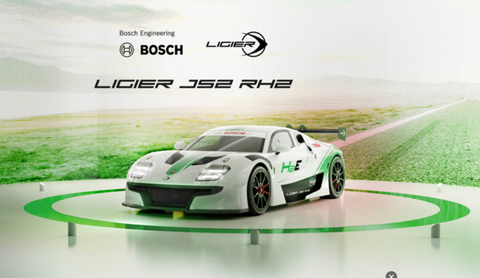
A high-performance hydrogen ICE vehicle, based on the Ligier JS2 R race car, has been unveiled by Bosch Engineering and Ligier Automotive at the 2023 Le Mans 24 hour.

“Hydrogen engines offer a huge potential for high-performance applications, especially in motorsports. By constructing the demonstration vehicle, we illustrate our many years of expertise as an engineering service provider and, in particular, our competence in the complex environment of hydrogen,” said Dr. Johannes-Jörg Rüger, president of Bosch Engineering.

Jacques Nicolet, president of Ligier Automotive, said, “The Ligier JS2 RH2 shows that Bosch Engineering and Ligier Automotive are ready to tackle tomorrow’s challenges by offering innovative solutions to integrate new energies.”

The Ligier JS2 RH2 has already been driven on test tracks in Germany and will be further developed and tested during the summer.

The vehicle is the product of a joint innovation project. Bosch Engineering oversaw the overall vehicle design and played the key role in developing the concept for engine and tank system, in addition to a comprehensive multistage hydrogen safety system. Ligier Automotive was responsible for chassis engineering, the design of the monocoque, and adaptation of its existing Ligier JS2 R. It also optimized the mechanical components for use with hydrogen and led their overall integration into the new vehicle.

The vehicle features a V6 hydrogen engine and a carbon monocoque that integrates three 700-bar type IV hydrogen cylinders from Hexagon Purus. The 3.0-liter biturbo charged V6 engine already has an output of 420kW and is based on a volume-production gasoline power unit that the Bosch has converted for use with hydrogen.

This involved adapting the ignition and the entire injection system. Bosch notes that not only does the engine concept ensure very lean combustion, with especially low nitrogen oxide emissions up to partial load. It also delivers a very high specific output. Another challenge while developing the engine was to achieve stable combustion without preignition at high loads and engine speeds of over 7,000 rpm.

The vehicle’s multistage hydrogen safety concept incorporates the storage system with its high-pressure tanks as well as the pressure controllers and supply lines to the engine and injection system. Bosch highlights that separation of tank, gas control components and engine compartments, plus a passive ventilation concept through pipes and chimneys, ensure that gases are removed to the outside in the event of any failure rather than entering the passenger compartment or getting close to hot parts in the engine bay. In addition, leaks in the system are detected by an extensive sensor system. Rüger explained, “Depending on the type and severity of the defect, the system triggers a multistage active safety concept, ranging from a warning to the driver on the display to a shutdown of individual line circuits up to an entire system shutdown.”

Adapting the Ligier JS2 R to integrate the hydrogen system was key to the project’s success. “We decided to replace the existing structure with a carbon monocoque and worked closely with our sister company HP Composites and the R&D specialist Carbon Mind on this aspect of the project,” explained Julien Jehanne, plant manager at Ligier Automotive.

“We have relied on all our experience as a racing car constructor and created a custom-made carbon monocoque. With our current Ligier range of cars and the expertise we have developed in the past years, we have all the tools to design and build reliable high-performance cars integrating new energies.”

Share. LinkedIn Twitter Facebook Email

Related Posts

Maserati Nettuno engine transformed into 480kW hydrogen race unit

May 29, 2026

BYD enters UK eLCV market with Dolphin Cargo e-Van

May 29, 2026

TotalEnergies and Stellantis expand engine oil partnership

May 29, 2026
LATEST NEWS

Ferrari unveils all-electric Luce

May 29, 2026

Scania under-cab battery module and Megawatt Charging System available for order

May 29, 2026

Maserati Nettuno engine transformed into 480kW hydrogen race unit

May 29, 2026

Receive breaking stories and features in your inbox each week, for free


Enter your email address:


Supplier Spotlights
  • EcoNovaTech
Featured Listings
  • There are currently no listings to show.
Getting in Touch
  • Contact Us
  • Media Pack
  • Meet the Editors
  • Free Weekly E-Newsletter
Our Social Channels
  • LinkedIn
Related UKi Topics
  • Automotive Interiors
  • Automotive Testing
  • Autonomous Vehicle
  • Professional Motorsport
  • Tire Technology
  • Media Pack
© 2026 UKi Media & Events a division of UKIP Media & Events Ltd
  • Terms and Conditions
  • Privacy Policy
  • Cookie Policy
  • Notice and Takedown Policy

Type above and press Enter to search. Press Esc to cancel.