
Close Menu
  • News
      • Appointments
      • EV Powertrain
      • Emissions
      • Engine Components
      • Electronics
      • Facility Developments
      • Forced Induction
      • Fuel Cell Technologies
      • Fuels & Lubricants
      • Heavy-duty & Diesel Engine Technologies
      • Hybrid Powertrain Technologies
      • Industry Forecasting
      • Legislation
      • Materials & Surface Treatment
      • Metallurgy
      • Mild-hybrid & 48V Technologies
      • New powertrain
      • Partnerships, Investments & Acquisitions
      • Quality Control
      • Prototyping
      • Sustainable fuels
      • Testing
      • Traction Control Systems
      • Transmissions Technologies
      • Webinars
  • Features
  • Online Magazines
    • April 2026
    • January 2026
    • September 2025
    • June 2025
    • March 2025
    • January 2025
    • September 2024
    • Subscribe to Automotive Powertrain Technology
    • Transmission Technology International
    • Subscribe to Transmission Technology
  • Opinion
  • Events
  • Supplier Spotlight
  • Webinars
Facebook X (Twitter) Instagram
  • Automotive Interiors
  • Automotive Testing
  • Autonomous Vehicle
  • Professional Motorsport
  • Tire Technology
  • Media Pack
LinkedIn
Subscribe
Automotive Powertrain Technology International
  • News
      • Appointments
      • EV Powertrain
      • Emissions
      • Engine Components
      • Electronics
      • Facility Developments
      • Forced Induction
      • Fuel Cell Technologies
      • Fuels & Lubricants
      • Heavy-duty & Diesel Engine Technologies
      • Hybrid Powertrain Technologies
      • Industry Forecasting
      • Legislation
      • Materials & Surface Treatment
      • Metallurgy
      • Mild-hybrid & 48V Technologies
      • New powertrain
      • Partnerships, Investments & Acquisitions
      • Quality Control
      • Prototyping
      • Sustainable fuels
      • Testing
      • Traction Control Systems
      • Transmissions Technologies
      • Webinars
  • Features
  • Online Magazines
    1. April 2026
    2. January 2026
    3. September 2025
    4. June 2025
    5. March 2025
    6. January 2025
    7. September 2024
    8. Subscribe to Automotive Powertrain Technology
    9. Transmission Technology International
    10. Subscribe to Transmission Technology
    Featured

    In this Issue – April 2026

    By Web TeamMay 1, 2026
    Recent

    In this Issue – April 2026

    May 1, 2026

    In this Issue – January 2026

    December 3, 2025

    In this Issue – September 2025

    September 25, 2025
  • Opinion
  • Events
  • Supplier Spotlight
  • Webinars
LinkedIn Facebook
Subscribe
Automotive Powertrain Technology International
Engine Components

Honeywell unveils next-gen turbo technology

Dean SlavnichBy Dean SlavnichSeptember 20, 20172 Mins Read
LinkedIn Twitter Facebook Email
Share
LinkedIn Twitter Facebook Email

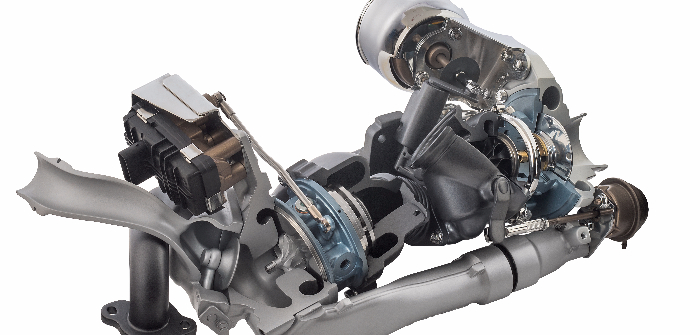
Tier One supplier Honeywell is set to debut an all-new turbocharger on the new BMW 2.0-liter engine program. The move will see the company attempt to ramp up power and torque, while still aiding the reduction of emissions.

The third-generation turbocharger, which the supplier claims will produce power increases from 90kW/l to 100kW/l and in torque from 175Nm/l to 200Nm/l, has been redeveloped for twin-scroll four-cylinder engines that are 1.5-liter or bigger.

The turbo features an all-new wastegate system, with a redesigned mono-block arm and valve. The upgraded system, which replaces the traditional three-piece valve, results in noise reduction of up to 10dB and a 0.5% improvement in fuel economy.

In addition to this, the Tier One supplier claims the valve design provides better controllability and 50% less wear due to repetitive motion against the turbo housing. Coupled with electric actuation, the wastegate valve reduces engagement time for the catalytic converter, which means emissions are cut down during cold start conditions.

As Honeywell continues to produce turbo technologies for multiple fuels, the Tier One supplier has also introduced the TwoStage Wastegate-VNT diesel engine turbocharger. The newest development, which debuts in the Opel Astra 1.6-liter unit, adds electric actuation for faster response, and a power increase of 17%.

With the automotive industry continues to look to reduce diesel emissions following diesel-gate, the two-stage charger is claimed to help reduce CO2 and NOx by up to 10% and 20% respectively.

Craig Balis, chief technology officer at Honeywell, sees emissions reduction as a main focus for OEMs: “Global automakers are relying on Honeywell to help them manage the increasing emission targets for CO₂ and particulate emissions, and our third-generation gas turbo technology helps them achieve those goals, without sacrificing performance. We have plenty of innovations available and on the horizon for gas and diesel applications – as well as hybrid and fuel cell powertrains.”

Share. LinkedIn Twitter Facebook Email

Related Posts

BorgWarner wins turbocharger contracts with two European OEMs

May 7, 2026

BorgWarner secures long-term supply agreement with off-highway OEM

April 23, 2026

Marelli showcases latest propulsion and thermal management innovations

April 22, 2026
LATEST NEWS

Renault introduces LPG bi-fuel Clio that delivers up to 1,450km range

May 7, 2026

UK consortium secures funding for ReCAM lithium-ion battery recycling project

May 7, 2026

BorgWarner wins turbocharger contracts with two European OEMs

May 7, 2026

Receive breaking stories and features in your inbox each week, for free


Enter your email address:


Supplier Spotlights
  • Dytran
Featured Listings
  • There are currently no listings to show.
Getting in Touch
  • Contact Us
  • Media Pack
  • Meet the Editors
  • Free Weekly E-Newsletter
Our Social Channels
  • LinkedIn
Related UKi Topics
  • Automotive Interiors
  • Automotive Testing
  • Autonomous Vehicle
  • Professional Motorsport
  • Tire Technology
  • Media Pack
© 2026 UKi Media & Events a division of UKIP Media & Events Ltd
  • Terms and Conditions
  • Privacy Policy
  • Cookie Policy
  • Notice and Takedown Policy

Type above and press Enter to search. Press Esc to cancel.