
Close Menu
  • News
      • Appointments
      • EV Powertrain
      • Emissions
      • Engine Components
      • Electronics
      • Facility Developments
      • Forced Induction
      • Fuel Cell Technologies
      • Fuels & Lubricants
      • Heavy-duty & Diesel Engine Technologies
      • Hybrid Powertrain Technologies
      • Industry Forecasting
      • Legislation
      • Materials & Surface Treatment
      • Metallurgy
      • Mild-hybrid & 48V Technologies
      • New powertrain
      • Partnerships, Investments & Acquisitions
      • Quality Control
      • Prototyping
      • Sustainable fuels
      • Testing
      • Traction Control Systems
      • Transmissions Technologies
      • Webinars
  • Features
  • Online Magazines
    • April 2026
    • January 2026
    • September 2025
    • June 2025
    • March 2025
    • January 2025
    • September 2024
    • Subscribe to Automotive Powertrain Technology
    • Transmission Technology International
    • Subscribe to Transmission Technology
  • Opinion
  • Supplier Spotlight
  • Webinars
Facebook X (Twitter) Instagram
  • Automotive Interiors
  • Automotive Testing
  • Autonomous Vehicle
  • Professional Motorsport
  • Tire Technology
  • Media Pack
LinkedIn
Subscribe
Automotive Powertrain Technology International
  • News
      • Appointments
      • EV Powertrain
      • Emissions
      • Engine Components
      • Electronics
      • Facility Developments
      • Forced Induction
      • Fuel Cell Technologies
      • Fuels & Lubricants
      • Heavy-duty & Diesel Engine Technologies
      • Hybrid Powertrain Technologies
      • Industry Forecasting
      • Legislation
      • Materials & Surface Treatment
      • Metallurgy
      • Mild-hybrid & 48V Technologies
      • New powertrain
      • Partnerships, Investments & Acquisitions
      • Quality Control
      • Prototyping
      • Sustainable fuels
      • Testing
      • Traction Control Systems
      • Transmissions Technologies
      • Webinars
  • Features
  • Online Magazines
    1. April 2026
    2. January 2026
    3. September 2025
    4. June 2025
    5. March 2025
    6. January 2025
    7. September 2024
    8. Subscribe to Automotive Powertrain Technology
    9. Transmission Technology International
    10. Subscribe to Transmission Technology
    Featured

    In this Issue – April 2026

    By Web TeamMay 1, 2026
    Recent

    In this Issue – April 2026

    May 1, 2026

    In this Issue – January 2026

    December 3, 2025

    In this Issue – September 2025

    September 25, 2025
  • Opinion
  • Supplier Spotlight
  • Webinars
LinkedIn Facebook
Subscribe
Automotive Powertrain Technology International
Emissions

Johnson Matthey reducing emissions from older buses

Dean SlavnichBy Dean SlavnichJune 27, 20173 Mins Read
LinkedIn Twitter Facebook Email
Share
LinkedIn Twitter Facebook Email

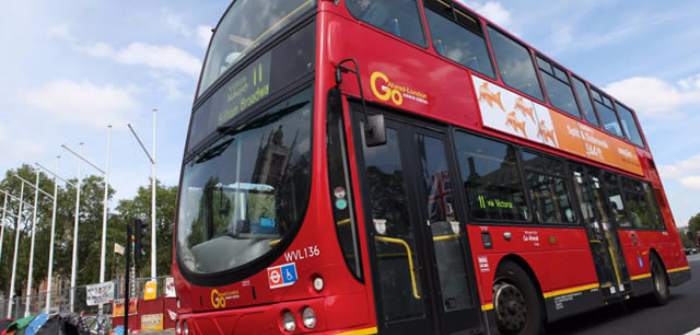
An ambitious multi-year programme to breathe fresh life into, and cleaner air from, Transport for London’s fleet of thousands of buses has been announced by Johnson Matthey. Johnson Matthey’s catalysts are installed in one third of new vehicles worldwide, preventing 40 tonnes of potentially harmful emissions from entering the atmosphere every minute of the day.

Its emission control systems have already been installed in more than 1,000 London buses to enable them to meet increasingly stringent emissions targets. The process started with the retrofitting of 54 older buses for the London Olympics that were used to ferry passengers between sites.

These catalyst and filter systems are installed in the exhaust system of a vehicle, as close to its engine as possible in order to take advantage of the heat generated. They clean the exhaust the vehicle sends out into the atmosphere. A precious metal catalyst (usually containing platinum and palladium), converts harmful carbon monoxide and hydrocarbons into carbon dioxide and water. In conjunction with this, another catalyst typically using base metals such as vanadium, copper or iron, converts oxides of nitrogen, or NOx, to nitrogen. Each installation requires fine tuning and requires careful testing on each type of vehicle. Between these catalysts, a diesel particulate filter traps and then combusts very small soot particles, preventing them from leaving the exhaust.

To ensure optimum real-world performance in cities such as London, the catalyst systems are tested in old buses at Millbrook, a state-of-the-art testing facility, replicating Route 159 in London, which runs from Streatham to Marble Arch via Oxford Street. The test route was selected because traffic conditions on the route generate one of the capital’s highest levels of emissions. Buses are loaded to reflect a 50% seated passenger load. The journey includes high and low speed sections and features many stops, putting buses through their paces in a wide range of conditions.

The technology enables Johnson Matthey and its partners to take a twelve-year-old bus and achieve emissions comparable to those from a modern bus. Approximately fifteen older buses can be retrofitted for the cost of a brand new model, conserving natural resources, reducing fleet costs and minimising environmental impact. The process of developing effective catalysts for London’s fleet of retrofitted buses involves the application of precise science, including a system for injecting low levels of ammonia to react with emissions as they pass through the catalyst.

Johnson Matthey scientists are working on new advanced catalysts that could enable 5,000 London buses to meet the latest clean air threshold defined by EU regulations, known as Euro VI. London has a stated objective of achieving an ultra-low emission zone at its heart by 2019 and Johnson Matthey and its partners have already demonstrated that the latest technology is capable of meeting this stringent standard.

“When our business was founded 200 years ago, the air in parts of London was visibly dirtier than it is today, but what is visible isn’t a reliable guide to air quality,” said John Walker, sector chief executive, Clean Air at Johnson Matthey. “We are working at atomic level on a global scale to capture and convert microscopic particles and gas phase pollutants to prevent them from escaping from vehicles and into the environment. We’re proud of our 200-year heritage and in the work that we are doing to make the world a cleaner and healthier place.”

Share. LinkedIn Twitter Facebook Email

Related Posts

Marelli showcases latest propulsion and thermal management innovations

April 22, 2026

International’s S13 Integrated Powertrain achieves EPA 2027 compliance

January 8, 2026

Scania releases new combustion and PHEV powertrains for buses and coaches

September 18, 2025
LATEST NEWS

Renault introduces LPG bi-fuel Clio that delivers up to 1,450km range

May 7, 2026

UK consortium secures funding for ReCAM lithium-ion battery recycling project

May 7, 2026

BorgWarner wins turbocharger contracts with two European OEMs

May 7, 2026

Receive breaking stories and features in your inbox each week, for free


Enter your email address:


Supplier Spotlights
  • Robertshaw® Controls Company
Featured Listings
  • There are currently no listings to show.
Getting in Touch
  • Contact Us
  • Media Pack
  • Meet the Editors
  • Free Weekly E-Newsletter
Our Social Channels
  • LinkedIn
Related UKi Topics
  • Automotive Interiors
  • Automotive Testing
  • Autonomous Vehicle
  • Professional Motorsport
  • Tire Technology
  • Media Pack
© 2026 UKi Media & Events a division of UKIP Media & Events Ltd
  • Terms and Conditions
  • Privacy Policy
  • Cookie Policy
  • Notice and Takedown Policy

Type above and press Enter to search. Press Esc to cancel.