

Close Menu
  • News
      • Appointments
      • EV Powertrain
      • Emissions
      • Engine Components
      • Electronics
      • Facility Developments
      • Forced Induction
      • Fuel Cell Technologies
      • Fuels & Lubricants
      • Heavy-duty & Diesel Engine Technologies
      • Hybrid Powertrain Technologies
      • Industry Forecasting
      • Legislation
      • Materials & Surface Treatment
      • Metallurgy
      • Mild-hybrid & 48V Technologies
      • New powertrain
      • Partnerships, Investments & Acquisitions
      • Quality Control
      • Prototyping
      • Sustainable fuels
      • Testing
      • Traction Control Systems
      • Transmissions Technologies
      • Webinars
  • Features
  • Online Magazines
    • April 2026
    • January 2026
    • September 2025
    • June 2025
    • March 2025
    • January 2025
    • September 2024
    • Subscribe to Automotive Powertrain Technology
    • Transmission Technology International
    • Subscribe to Transmission Technology
  • Opinion
  • Supplier Spotlight
  • Webinars
Facebook X (Twitter) Instagram
  • Automotive Interiors
  • Automotive Testing
  • Autonomous Vehicle
  • Professional Motorsport
  • Tire Technology
  • Media Pack
LinkedIn
Subscribe
Automotive Powertrain Technology International
  • News
      • Appointments
      • EV Powertrain
      • Emissions
      • Engine Components
      • Electronics
      • Facility Developments
      • Forced Induction
      • Fuel Cell Technologies
      • Fuels & Lubricants
      • Heavy-duty & Diesel Engine Technologies
      • Hybrid Powertrain Technologies
      • Industry Forecasting
      • Legislation
      • Materials & Surface Treatment
      • Metallurgy
      • Mild-hybrid & 48V Technologies
      • New powertrain
      • Partnerships, Investments & Acquisitions
      • Quality Control
      • Prototyping
      • Sustainable fuels
      • Testing
      • Traction Control Systems
      • Transmissions Technologies
      • Webinars
  • Features
  • Online Magazines
    1. April 2026
    2. January 2026
    3. September 2025
    4. June 2025
    5. March 2025
    6. January 2025
    7. September 2024
    8. Subscribe to Automotive Powertrain Technology
    9. Transmission Technology International
    10. Subscribe to Transmission Technology
    Featured

    In this Issue – April 2026

    By Web TeamMay 1, 2026
    Recent

    In this Issue – April 2026

    May 1, 2026

    In this Issue – January 2026

    December 3, 2025

    In this Issue – September 2025

    September 25, 2025
  • Opinion
  • Supplier Spotlight
  • Webinars
LinkedIn Facebook
Subscribe
Automotive Powertrain Technology International
Electric Powertrain Technologies

Honda brings its novel hybrid system to the Civic line-up

Lawrence ButcherBy Lawrence ButcherMarch 25, 20222 Mins Read
LinkedIn Twitter Facebook Email
Share
LinkedIn Twitter Facebook Email

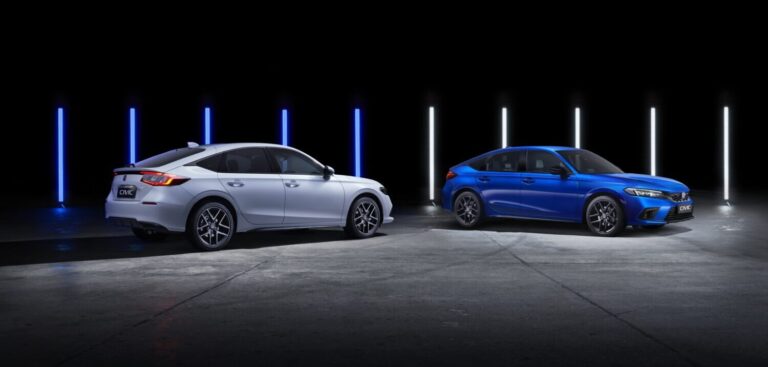
Auto maker Honda has released the latest version of its Civic hatchback with the range now including the option of its e:HEV hybrid powertrain.

The Civic e:HEV sees the deployment of a new 72-cell lithium-ion battery and two compact electric motors, paired with what Honda says is a redeveloped 2.0-liter direct-injection, Atkinson-cycle engine. Combined, the powertrain delivers a maximum motor output of 135kW and 315Nm of torque.

Honda states that the latest iteration of the internal combustion engine has several new elements within its architecture, which combine to help achieve a stated thermal efficiency (TE) of 41%, one of the highest figures within the automotive industry for a production road car.

The layout of Honda’s e:HEV hybrid system is interesting and bucks the conventional approach to hybridization – it has many of the traits of a range extender/series hybrid layout but with the ability to directly power the wheels via the ICE.

The ICE is connected to a single-speed transmission, which houses the two electric motors, with a clutch between them. One motor is primarily used as a generator, the other for propulsion, and in most operation modes, the ICE spins the generator, which then feeds electrical energy directly to the propulsion motor, while also charging the rear-mounted battery pack with any excess power.

During low-speed driving, the ICE operates at an almost steady state, within its most efficient RPM range, hence the impressive 41% TE. In pure EV mode, power can be fed from the battery with the ICE inactive, though the small capacity of the battery means range is very limited as a pure EV (there is no plug-in charging option).

The main role of the battery is to provide a boost to the drive motor under heavy load. At high speeds, the ICE becomes the primary means of propulsion, with the clutch in between the motors engaging to transmit drive directly to the wheels. Overall, the system nets WLTP emissions of 110g CO2 /km with a fuel consumption of under 5L/100km.

Share. LinkedIn Twitter Facebook Email

Related Posts

Ferrari unveils all-electric Luce

May 29, 2026

BYD enters UK eLCV market with Dolphin Cargo e-Van

May 29, 2026

Mercedes‑AMG presents all-electric GT 4‑Door Coupe

May 21, 2026
LATEST NEWS

Ferrari unveils all-electric Luce

May 29, 2026

Scania under-cab battery module and Megawatt Charging System available for order

May 29, 2026

Maserati Nettuno engine transformed into 480kW hydrogen race unit

May 29, 2026

Receive breaking stories and features in your inbox each week, for free


Enter your email address:


Supplier Spotlights
  • Associated Spring
Featured Listings
  • There are currently no listings to show.
Getting in Touch
  • Contact Us
  • Media Pack
  • Meet the Editors
  • Free Weekly E-Newsletter
Our Social Channels
  • LinkedIn
Related UKi Topics
  • Automotive Interiors
  • Automotive Testing
  • Autonomous Vehicle
  • Professional Motorsport
  • Tire Technology
  • Media Pack
© 2026 UKi Media & Events a division of UKIP Media & Events Ltd
  • Terms and Conditions
  • Privacy Policy
  • Cookie Policy
  • Notice and Takedown Policy

Type above and press Enter to search. Press Esc to cancel.